Tunisia

Tunisia

Memoir 44 Tunisia

The Battle for Tunisia (1942–1943) was a key campaign in the North African theater of World War II. Following the Allied invasion of North Africa (Operation Torch) in November 1942, German and Italian forces, under Field Marshal Erwin Rommel, sought to hold Tunisia as a defensive stronghold. The Axis aimed to counter the Allied advance from Algeria and Morocco while securing supply lines to Italy.  The Allies, under the command of General Dwight D. Eisenhower, faced challenges due to difficult terrain, logistical issues, and initial inexperience.

General Howitzer’s observation:
The Battle for Tunisia was one tough brawl—Rommel dug in with his Axis boys trying to make Tunisia a fortress, but we weren’t about to let that desert rat keep his grip. Ike had green troops, bad roads, and a chaotic supply headache, but we pushed through it all, hammering east from Torch and learning fast. Tunisia was the doorway to Italy, and by God, we were kicking it open.

6 VP’s

Card Balance:

Allies – 4

Axis – 6

Complexity:

3

Conditions:

Countryside

countryside

Location:
Tunisa, North Africa

Year:

1942

Theater:

Mediterranean

Codename
Operation Torch

Summary:

Objectives

6 medals, no territorial objectives

Terrain:

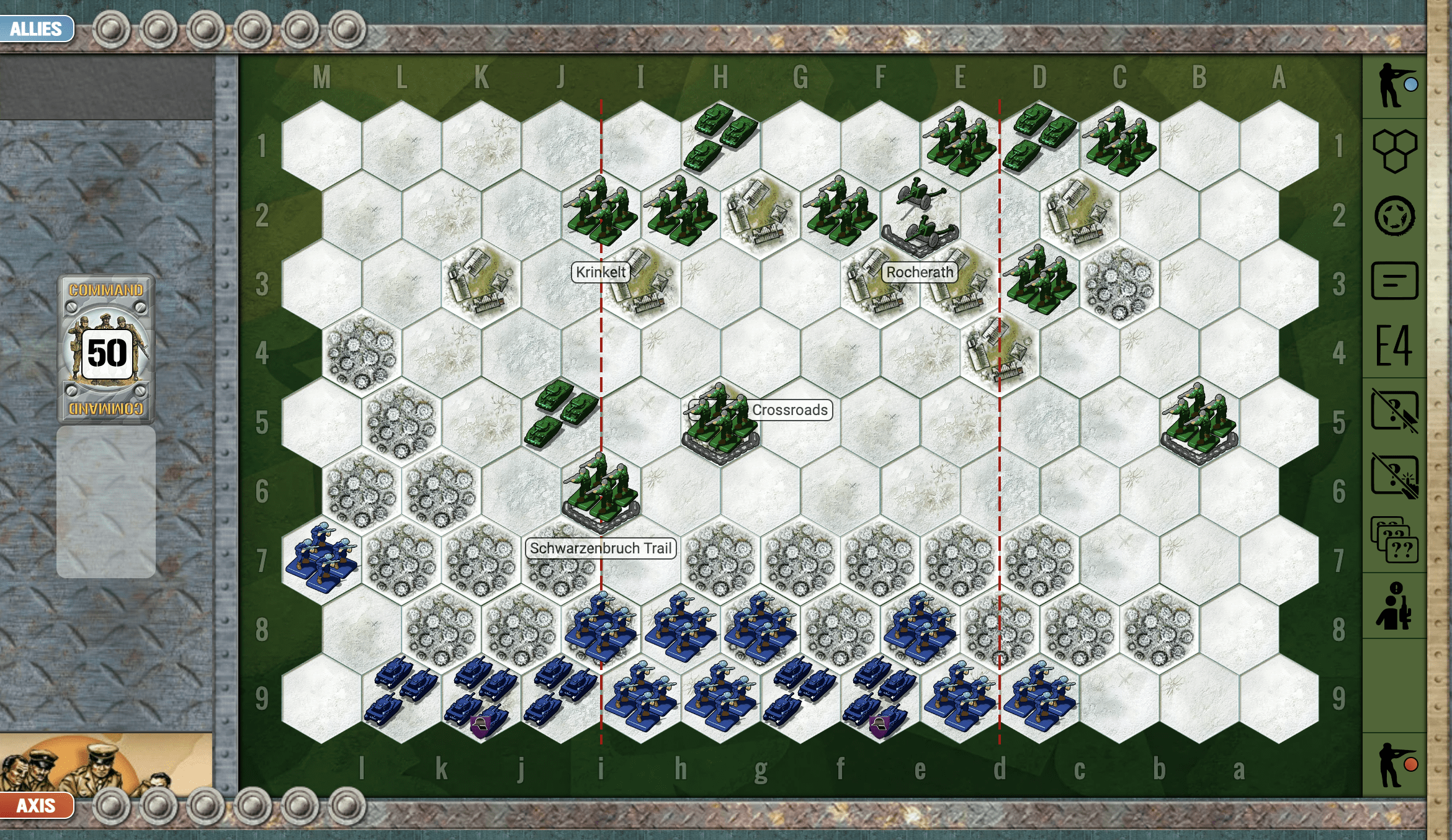
The many woods and hills in the center section present an excellent opportunity for whomever can gain control of them.

Troops:

Allies – 8 Infantry, 4 Armor, 2 Artillery

Axis – 7 Infantry, 5 Armor, 2 Artillery

medal allies

Allied Strategy:

1.  Big picture strategy for Allies is that when the battle starts you have partial control of the central hills.  If you can consolidate that control by moving in additional infantry and armor, plus move your center-section artillery forward, you can hold on and fight the battle from there.  However, if the enemy gets an immediate push forward with cards like Armor Assault or Infantry Assault, they will very quickly be on top of that hill. If you have not yet consolidated power, you may have to either fight to the death right there, or pull back to the nearby town and mini-hills and fight from there. 

medal axis

Axis Strategy:

1.  Big picture strategy for Axis is that they win this two-thirds of the time against the Allies, because you have a lot of firepower very close to the central hills where the primary battle is fought.  If you can mobilize all the forces stuck in the right-flank corner, you can bring a massive attack against the enemy.  With a few well placed cards, you can very quickly have your forces battling for control of the central hills.

Battle Reports

(percentage of Allied victories):

31%

18
BR - Tunisia

Author:

Link:

Toulon

Toulon

Scenario_Toulon_start_Allies

The Battle of Toulon (August 20–26, 1944) was a key engagement during the Allied invasion of southern France in World War II, as part of Operation Dragoon. The objective was to liberate the strategic port city of Toulon, essential for supplying the advancing Allied forces.

Now here’s a fight that showed the grit of France reborn. General de Lattre and his men from the French Army of Africa hit Toulon like a hammer on an anvil. The Germans had dug in—guns, bunkers, street traps—you name it. Every block was a battlefield. But the French didn’t flinch. They fought yard by yard, with their artillery pounding and the Navy blasting from offshore.

Six bloody days later, the tricolor flew over the port, and the German garrison laid down its arms. Toulon was free, Marseille followed, and the Allies had their supply lifeline to drive deeper into France. It wasn’t just a victory of arms—it was France standing up, shoulder to shoulder with her liberators, and proving she still had fire in her soul.

~~ General Howitzer

6 VP’s

Card Balance:

Allies – 6

Axis – 4

Complexity:

4

Conditions:

Countryside

Context:

Historical

Location:

France

Year:

1944

Theater:

Mediterranean

Campaign:

Codename:

Operation Dragoon

Summary:

Objectives:

6 VP’s, plus the City of Toulon

Battlefield:

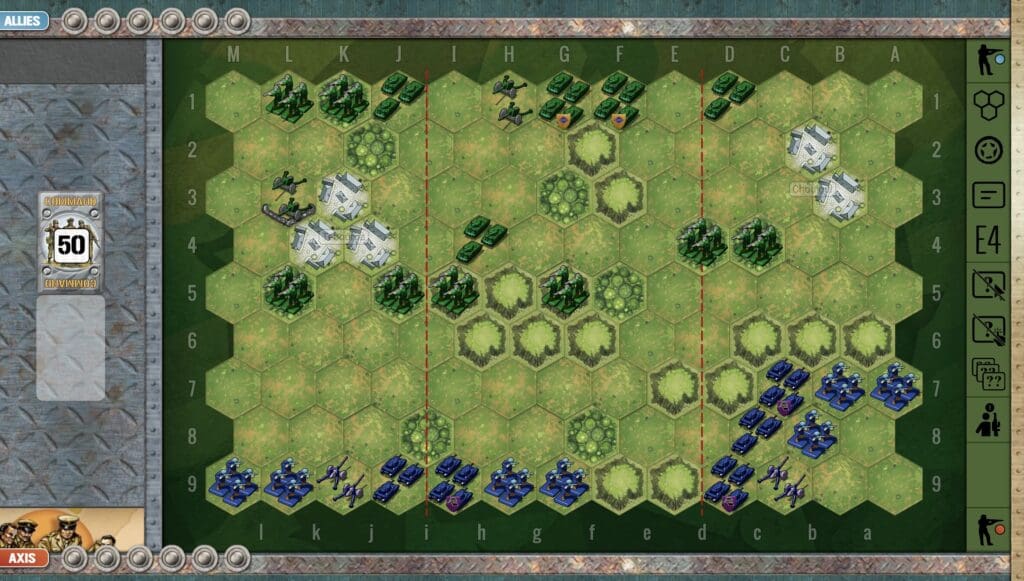
Because of the two sets of thick hilly forests cutting across the left and right flanks at an angle, it limits movement of both forces from section to section. Thus proper placement of troops in the early moves of the game can have a dramatic effect on its final outcome.

Troops:

Allies – 10 Infantry, 4 Armor

Axis – 10 Infantry, 1 Artillery


medal allies

Allied Strategy:

1.  The key objective for the Allies is to capture the town of Toulon. If the Allies occupy three of the town hexes at the end of any turn, they win immediately. So, besides the need to simply destroy Axis units, the Allied player should keep up a relentless push toward the center section which contains Toulon. This will force the Axis player to not only defend individual hexes, but also to move troops toward defending the center, thus dislodging some from behind sandbags.

2. The most imminent need for the Allies is to get their infantry away from the back wall and into the fight against the two sandbagged hexes right in front of them. Any retreat flags thrown by the Axis powers will increase odds of a hit from 50% to 67% against the Allies.

medal axis

Axis Strategy:

1.  Because the Allies have four Armor units, the Axis are outnumbered. So the scenario is primarily defensive. Given the right cards, some offensive operations may be possible. But historically, the Germans had to eventually pull back, so be aware, and be careful.

2.  Your forward infantry in the center section may get overwhelmed by the Allies, so you will want to get in your hits while you can. If appropriate, you may consider a strategic retreat to let your infantry fight another day.

3. Because you are outnumbered in terms of forces, your best chance of scoring hits will be to remain in your defensive positions and hit the enemy as they approach.

4. Be sure to protect the four hexes of Toulon, for should the enemy gain control of three hexes, you will lose instantly.

Memoir 44
Classic Battle Reports

(percentage of Allied victories):

66%

27
BR - Toulon

Author:

Days of Wonder

Link:

Suomussalmi – Russo-Finnish War

Suomussalmi

scenario_Suomussalmi_start

Let me tell you about Suomussalmi, a frozen corner of Finland where, in the winter of ’39, a handful of tough, stubborn Finns showed the world how a smaller force—if it’s smart, fast, and mean enough—can tear a lumbering giant to pieces.

The Russians came in heavy, marching two full divisions down those narrow forest roads, thinking they could just roll over Finland and split the country in half. But those Finns didn’t fight the war the way the textbooks said. They didn’t stand still and get crushed. They moved. They lived on skis, slipping through the woods like ghosts, striking the Soviet columns where they were weakest—supply lines, roadblocks, isolated pockets of troops.

While the Russians froze in the open and bogged down in snowdrifts, the Finns carved them up piece by piece. They cut those long Soviet columns into little “motti” bundles—isolated groups with no food, no ammunition, no rescue. And then they finished them.

By early January, the Finns had smashed one Soviet division entirely and sent the other running back the way it came. What happened at Suomussalmi wasn’t luck; it was proof that speed, ingenuity, and the will to win can turn a frozen forest into a fortress and a small army into a battering ram.

The Finns didn’t just win a battle—they delivered a lesson every commander ought to remember:
Victory belongs to the side that fights smarter, moves faster, and never stops hitting.

~~ General Howitzer

6 VP’s

Card Balance:

Russian – 4

Finnish – 6

Complexity:

3

Conditions:

Winter

Location:

Finland

Year:

1939

Theater:

Eastern Front

Campaign:

Russo – Finnish War

Summary:
The Finns switched sides during WW2, all in the name of defending themselves.  

Objectives
Six VP’s, plus if the Finns occupy three of the four hexes of Suomussalmi, they win immediately, which I have done, and is a very satisfying win.

Battlefield
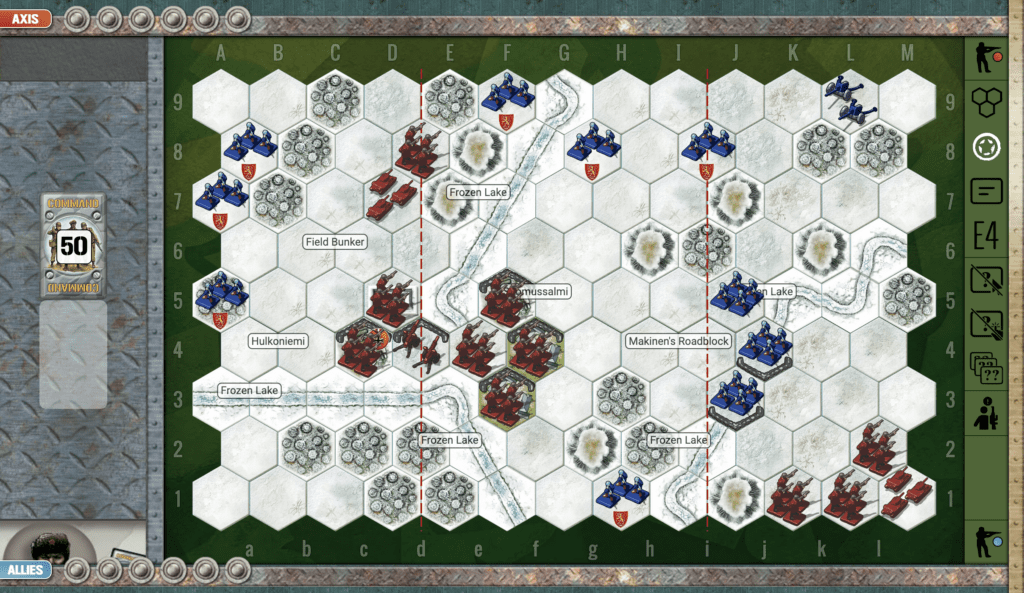
The battlefield for this scenario is marked by three frozen rivers cutting across the field of play and creating hazardous conditions for troop movements.

Troops:
Finns: 10 Infantry, 1 Artillery
Russians:  10 Infantry, 2 Armor, 1 Artillery

Allied Strategy:

Allies must defend the town of Suomussalmi, as it will be instant defeat if the Axis occupies 3 of the 4 town hexes. But the town is heavily defended with sandbagged troops, so do not try the attack unless you are able to assemble a strong force with powerful Combat cards.

Axis Strategy:

Axis (Finnish) ski troops have a major movement advantage. They can move 0-3, and fire at 3 or 2. Plus they can move onto any terrain and still fire. So your infantry movement cards will allow you to quickly mass your troops for an attack.

Battle Reports

(percentage of Allied victories):

54%

10
BR - Suomussalmi

Author:

Days of Wonder

Link:

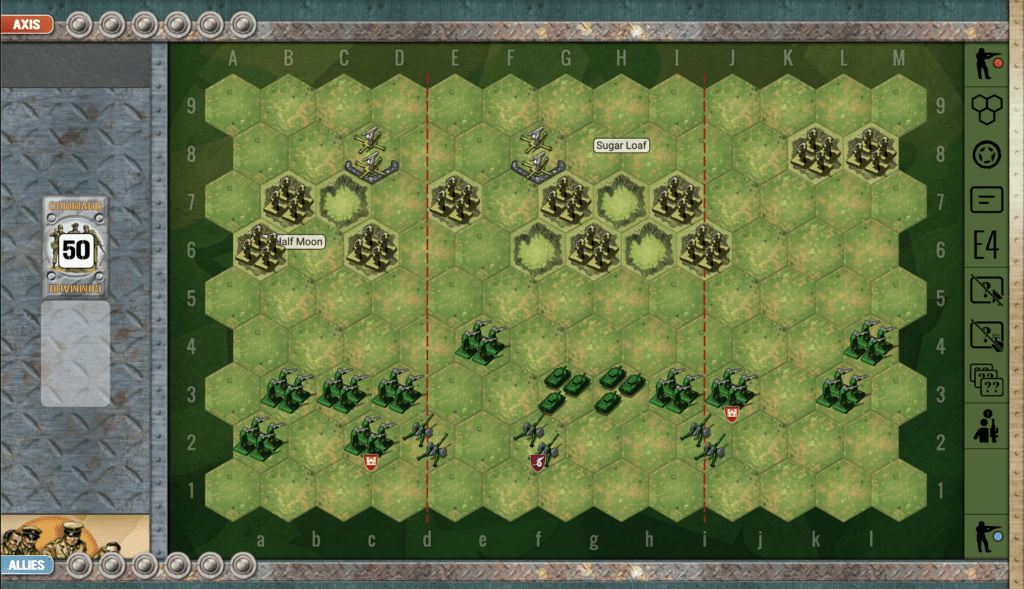
Sugar Loaf and Half Moon

Sugar Loaf and Half Moon

The Battle of Sugar Loaf and Half Moon took place during the Battle of Okinawa in May 1945, one of the final and bloodiest battles of World War II. Sugar Loaf Hill and Half Moon Hill were heavily fortified Japanese positions that U.S. Marines needed to capture to advance on the island.

Listen up. Sugar Loaf and Half Moon weren’t just two lumps of dirt on Okinawa—they were the kind of fortified hellholes the enemy turns into a butcher shop. The Japanese were dug in deep, with bunkers you couldn’t see and tunnels you couldn’t count, and they poured out artillery, machine-gun fire, and counterattacks like they had an endless supply of men and steel.

Our Marines fought inch by inch, bleeding for every blasted ridge. They stormed those heights again and again, under fire hot enough to melt the paint off a helmet. Casualties were heavy, but the boys never broke. After days of slugging it out—crawling, climbing, charging—they took both hills and tore the heart out of the enemy’s northern line.

Seizing Sugar Loaf and Half Moon opened the door to Okinawa’s southern defenses, and it proved a cold, hard truth: fighting in the Pacific demanded guts, grit, and sacrifice on a scale few can imagine. And it was a grim preview of what it might have taken if we’d ever had to storm Japan itself.

~~ General Howitzer

6 VP’s

Card Balance:

USA – 6

Japanese – 4

Complexity:

2

Conditions:

Jungle


Location:

Pacific

Year:

1945

Theater:

Pacific

Campaign:

Battle of Okinawa

Codename:

Summary:

Objectives:

6 VP’s
(Special Rule: Note that if the Marines clear out an entire section of Japanese forces, it counts as a temporary VP.)

Battlefield:

This scenario begins with both forces arrayed across the battlefield and ready to engage in immediate warfare. It is a countryside with hills and caves spread across all three sections. The caves allow for rapid movement of Japanese troops.

Troops:

Allies – 10 Infantry, 2 Armor, 2 Artillery

(Infantry practices the Gung-Ho! rule.)

Axis – 10 Infantry, 2 Artillery

(Japanese Infantry practices the Seishin Kyoiku Doctrine (SKD), and the Yamato Damashi Concept, and the Banzai War Cry.)

Allied Strategy:

1. The enemy is weak on your right flank. They have no artillery protection on half the flank. With your artillery, you have a slight numeric advantage. If you can work up the cards, you could launch an attack on tht side, and gain half the VP’s you need. Once you overwhelm that section, your remaining forces can combine with your center section troops to finish off the job and gain your final three VP’s.

2.  Use your Artillery to hit every full force Infantry unit at least once in order to cancel out the SKD advantage they have.

3.  Note that one of your artillery is mobile, so you can move in and fire. But do not move in too close prematurely, or the Japanese forces will overwhelm you with their SKD power.

4.  Strategic consideration based on this special rule:
“When all the Japanese units in a section of the battlefield (right, center or left) are eliminated, the Marines gain one Victory Medal.”  This means that if you can concentrate all of your attacks in one section, you will gain not only the medals for eliminating units, but also one extra Victory Medal for clearing out the section. 

Axis Strategy:

1.  Use the Banzai War Cry combined with the Seishin Kyoiku Doctrine to quickly advance your full-power Infantry units to attack any enemy who are within striking range. With the additional dice roll that SKD provides, you can quickly weaken the enemy.

2. Remember to use the tunnel system to quickly move infantry from hill to hill to get your forces into the action.

3. Use your artillery at every opportunity on any enemy forces that approach.

4.  Your Infantry are sitting mostly on Cave on a Hill hexes, which give a massive defensive advantage of minus 2 (only one dice attack), for normal attacks.  This allows you to fend off many attacks. And when they get weak, you can do a quick swap out with fresh units using the cave system.  So do not be quick to leave such a defensive position unless you can launch a decisive attack.

Battle Reports

(classic percentage of Allied victories):

68%

18
BR - SugarLoaf

Author:

Days of Wonder

Link:

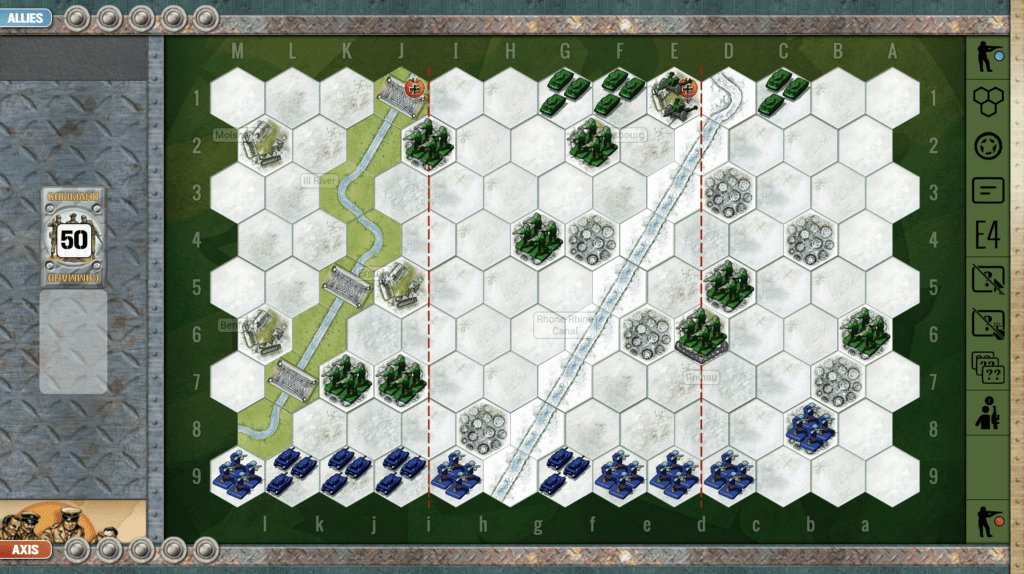
Strasbourg

Strasbourg

On January 7, 1945, the German Nineteenth Army launched an attack south of Strasbourg against the First French Army in an operation code-named Sonnenwende (“Winter Solstice”). This offensive was part of a broader German effort to counter the Allies’ advance in Alsace and maintain control over key territory in eastern France.

The attack aimed to push back the French forces and threaten Strasbourg, a strategically vital city for the Allies. Despite initial German gains, the French First Army, with support from American forces, mounted a resilient defense. Allied artillery and air support helped to stall the German assault, ultimately preventing the Nineteenth Army from achieving its objectives.

The failure of Sonnenwende weakened German forces in the region and contributed to the broader collapse of German defenses in Alsace, allowing the Allies to solidify their hold on Strasbourg and continue their push toward Germany. 

General Howitzer’s summary:  

Sonnenwende was a damn flop for the Germans—it drained their strength, cracked their lines in Alsace, and handed us the keys to Strasbourg. From there, it was full steam ahead, straight into the heart of Germany.


5 VP’s

Card Balance:

Allies – 6

Axis – 4

Complexity:

4

Conditions:

Winter

Location:

France

Year:

1945

Theater:

Western Front

Campaign

Codename:

Sonnenwende (“Winter Solstice”)

Summary:

Objectives:

5 VP’s, and two Medal Objectives for Axis

Battlefield:

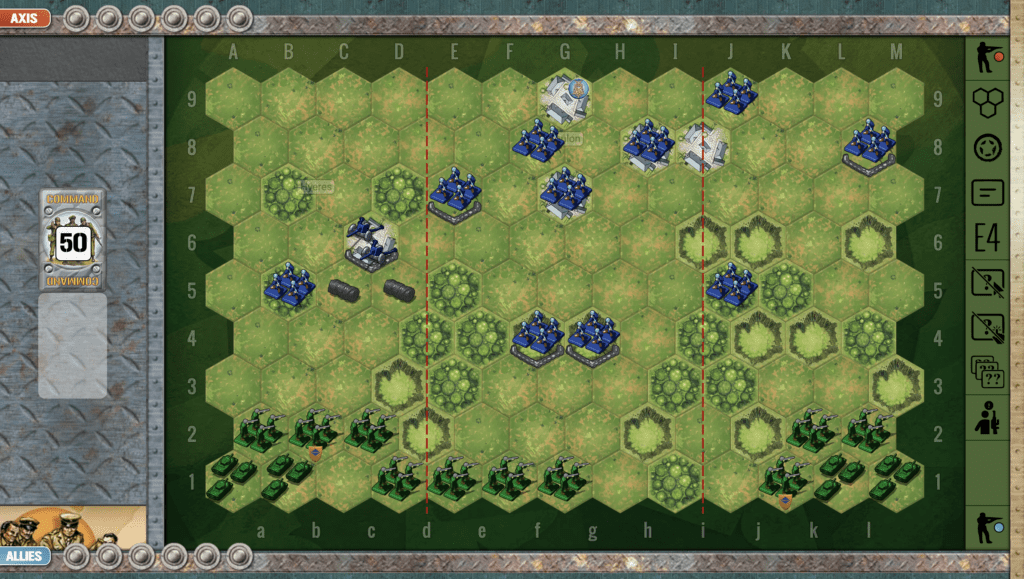
Strasbourg is a winter scenario with a frozen river cutting diagonally across the battlefield. It is passable. There is also an impassable river with three bridges crossing it. Each set of troops are squeezed against opposite corners causing an exciting asymmetrical warfare experience.

Troops:

Allies – 8 Infantry, 3 Armor, 1 Artillery

Axis – 6 Infantry, 4 Armor

Allied Strategy:

1. You need to defend the medals in the town and bridge hexes because the Axis are going to come at you with everything they’ve got.  They have you outnumbered by armor and there is a lot of open territory, so you will need to get your forces into defensive positions.  

2.  Your infantry in the forward right flank are in a position to attack the enemy forces backed up against the border so hit them while you can. 

Axis Strategy:

1.  Big picture strategy for you is to push your forces down the cener section and to pursue the two medal objectives in the town and bridge hex. 

2.  Because your forces are pushed up against the back wall, you need to get them mobile as soon as possible. 

19
BR - Strasbourg

Author:

Days of Wonder

URL

St. Vith, Ardennes

St. Vith

Scenario_StVith_start_Axis

The Battle of St. Vith, fought in December 1944 during the Battle of the Bulge, was a critical engagement on the Western Front in World War II. Located in Belgium, St. Vith was a key road junction that the German Army sought to capture to facilitate their advance into the Ardennes.

Men — what you saw at St. Vith was grit forged in steel. Outnumbered, outgunned, and half-frozen, those boys of the 106th Infantry and 7th Armored stood toe-to-toe with the damned 5th Panzer Army and said, “You’ll move through us only over our dead bodies.”

They fought for every yard of ground, every shell hole and hedgerow, and by God, they made the Germans pay for every inch. Their stand wrecked the enemy’s timetable, blunted his spearhead, and bought the time our armies needed to gather their strength for the counterblow.

When they finally withdrew on December 23rd, it wasn’t defeat — it was a tactical victory paid in blood and courage. St. Vith was no retreat; it was a wall of American willpower that helped break Hitler’s last gamble in the west.

~~ General Howitzer

6 VP’s

Card Balance:

Allies – 4

Axis – 5

Complexity:

4

Conditions:

Countryside

Context:

Historical

Location:

Belgium

Year:

1944

Theater:

Western Front

Campaign:

Ardennes

Context:

Historical

Summary:

Objectives:

6 VP’s

Battlefield:

The St. Vith scenario has a large central battlefield surrounded by forests blocking access to each of the flanks, and a long ridge of impassible mountain hexes (the Prumerberg) across the back of the field. It makes for intense warfare of armor, infantry and artillery battling it out for dominance in the center.

Troops:

Allies – 7 Infantry, 6 Armor

Axis – 10 Infantry, 4 Armor, 1 Artillery

Allied Strategy

1. The Allies are on the defensive here, receiving only 4 cards vs. the Axis’ 5 cards. You have sandbags; use them, and don’t be too quick to move out from them.

2. The center section with the impassable mountains behind and the enemy artillery in front is kind of a kill-zone unless you are prepared for it. Your best assault tactics may be found on the flanks.

Axis Strategy

1.  Your forces are bunched together making for many no-retreat situaions. Move your Infantry into the woods as soon as possible.

2. Note that the enemy has their backs to the wall with the impassable mountains behind them.  Once your infantry are deployed in the woods, use your armor and artillery to hit any forces in the center section. Most of your hits will be enhanced by another 17% because of the no-retreat situation in which the Allied forces find themselves.

3.  Note that although the Allies have a 6-4 armor advantage, their two armor in the back center section will be slow to get into the action. If you can hit or eliminate one or more of the forward armor units before the others come into play, it will even out the battle for you.  

Battle Reports

(percentage of Allied victories):

45%

20
BR - St. Vith

Author:

Days of Wonder

Link: