Ponyri (Kursk)

Ponyri (Kursk)

scenario_Ponyri_start

The Battle of Ponyri took place in Ponyri, a small town in the Kursk Oblast of Russia, during World War II. It occurred in July 1943 as part of the larger Battle of Kursk, one of the biggest tank battles in history.

General Howitzer summarizes:

Ponyri was a slugfest in the mud and blood of Kursk—like a Stalingrad on a smaller scale. The Germans threw their Panzers and infantry at that rail junction with everything they had, trying to break through to Kursk, and the Soviets met them with steel, fire, and sheer grit. House to house, trench to trench, they held the line. The enemy never got past it—and Ponyri became the anvil that broke the German spear.

7 VP’s

Card Balance:

Russian – 4

Axis – 6

Complexity:

3

Conditions:

Countryside

Location:

Russia

Year:

1943

Theater:

Eastern Front

Campaign:

Battle of Kursk

Codename:

part of Operation Citadel

Summary:

Objectives:  7 VP’s.

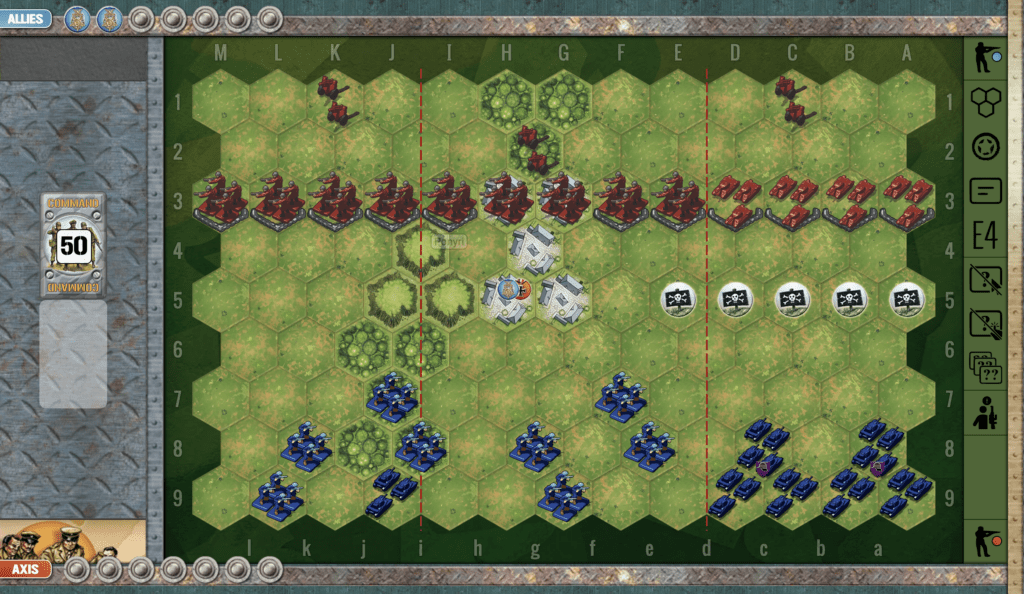
The key to winning Ponyri is controlling the town. It is worth two VP’s. Whichever side controls the town will cause the opponent to waste a lot of troops trying to gain control.

Terrain:

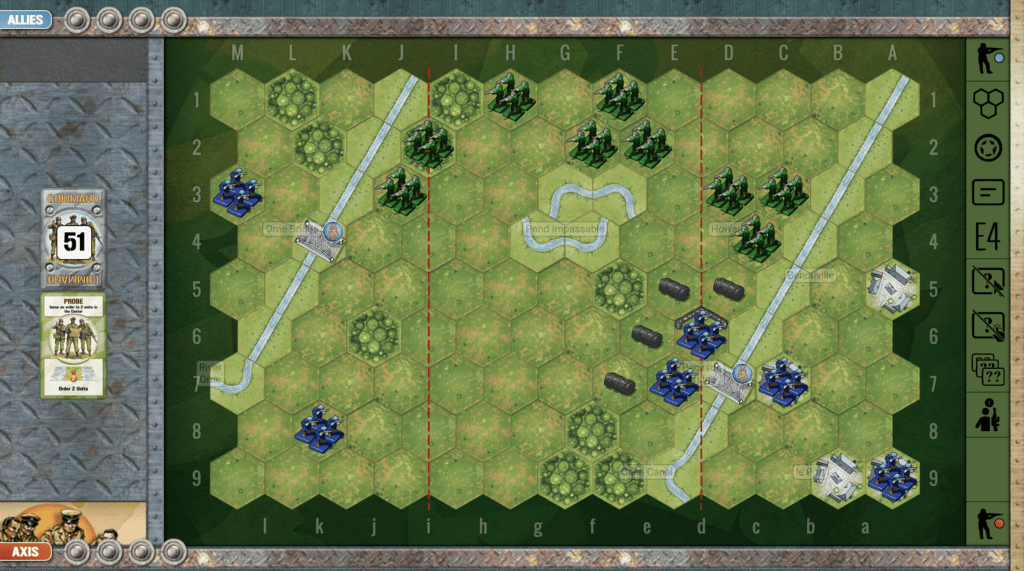
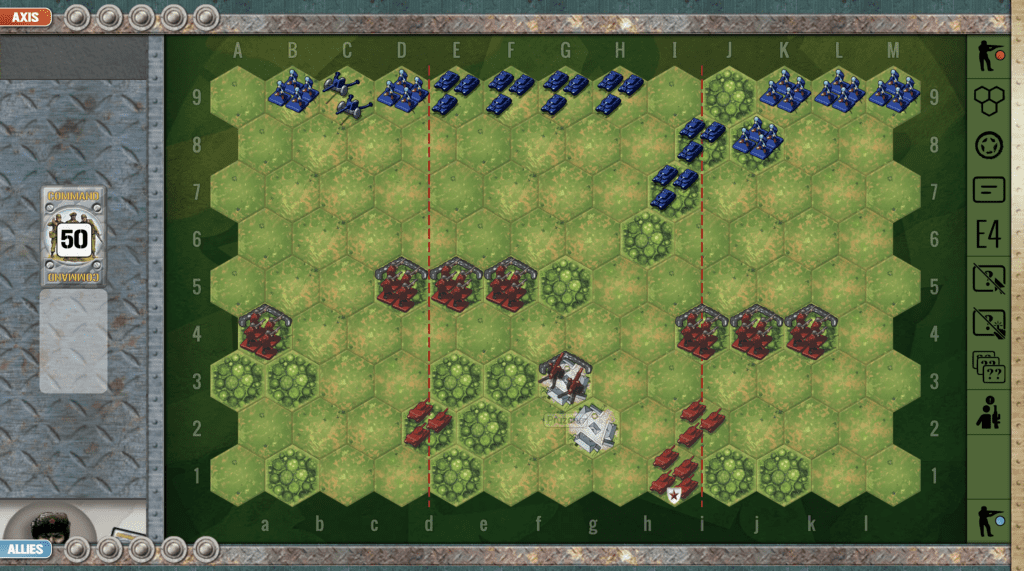
Countryside with forest and hills on one side, mines on the other, and the five-hex town of Ponyri in the center.

Troops:

Allies – 9 Infantry, 4 Armor, 3 Artillery

Axis – 8 Infantry, 7 Armor

medal allies

Allied Strategy:

1. The town of Ponyri is worth two VP’s. You begin with control of it, but since it has 5 hexes, you should take control of the central hex of Ponyri so that you have majority control. This will force the enemy to waste a lot of forces throwing themself against this well-defended town.

2. The Allied role in this scenario is primarily defensive. Use your sandbags and be slow to leave them. But if the enemy begins pummeling your armor on the left flank, you may need to consider a more aggresive approach, if your cards allow it.

3. You have three artillery. Take the time to move them forward one row early in the battle while you still have time, so that they can improve their hit rate against the enemy.

medal axis

Axis Strategy:

1.  Because the town of Ponyri is worth two VP’s! , you should attempt to get your infantry into it pretty quickly, before the enemy occupies all town hexes.  But only take it, if you can keep them there, as they will be surrounded by the enemy on all sides.

2. On your left flank, use the forest and hills to advance your infantry under cover. If you try to make a direct assault in the open countryside, they will get decimated.

3. On your right flank, you have an armor superiority, so you can place yourself behind the mines and continuously degrade the enemy’s strength. But be aware of the artillery on the right. If the Allies move it one row forward, your armor directly behind the row of mines will be subject to 2D rolls against your forces.

4.  When the enemy is sufficiently degraded, you may consider breaching the mines. (Expect some hits, but if you use your elite forces that begin with 4 armor figures, you should have a sufficient survival rate to continue the attack.) If you find the opening, you can push through for direct assaults against the enemy armor. 

Battle Reports:

( percentage of Allied Victories):

54%

24
BR - Ponyri

Author:

Days of Wonder

Link:

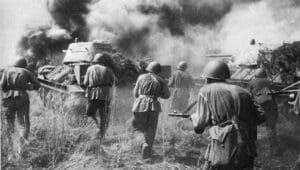
Soviet_troops_and_T-34_tanks_counterattacking_Kursk_Voronezh_Front_July_1943

Battle of Kursk
(Copyright: www.mil.ru)

Pointe-du-Hoc

Pointe-du-Hoc

scenario_PointeHoc_start_Allies

The Battle of Pointe du Hoc was a critical part of the D-Day invasion on June 6, 1944. Pointe du Hoc, a steep cliff overlooking the English Channel between Utah and Omaha beaches, was targeted because it housed a German gun battery capable of threatening the Allied landings.

U.S. Army Rangers were tasked with scaling the 100-foot cliffs to neutralize the German artillery positions believed to be in bunkers at the top.  About 225 Rangers from the 2nd and 5th Ranger Battalions led by Lieutenant Colonel James Rudder.  Using ropes, ladders, and grappling hooks under intense German fire, the Rangers climbed the cliffs while under heavy fire.  The Rangers discovered the artillery guns had been moved inland. They located and destroyed the guns using thermite grenades. The Rangers suffered heavy losses—fewer than half were still capable of fighting after the battle.

General Howitzer sums up its importance:

Listen up, men—Pointe du Hoc wasn’t just another hill; it was the lynchpin in the whole damned invasion. Our boys scaled those cliffs under fire, ripped out the German artillery, and made damn sure nothing could rain hell on Utah and Omaha. It was guts, grit, and glory—one of the boldest strikes of D-Day, and it damn well helped crack open Fortress Europe.

~ General Howitzer

4 VP’s

Card Balance:

Allies – 6

Axis – 4

Complexity:

2

Conditions:

Beach

Location:

Normandy

Year:

1944

Theater:

Western Front

Campaign:

Invasion of Normandy

Codename:

Part of Operation Overlord

Briefing:

This scenario is a tough one for the Germans, as the Allies have a 69% success rate.

Objectives:

Because this is a 4 VP scenario, every single hit matters, so both Axis and Allies need to carefully target and concentrate their fire.

Battlefield:

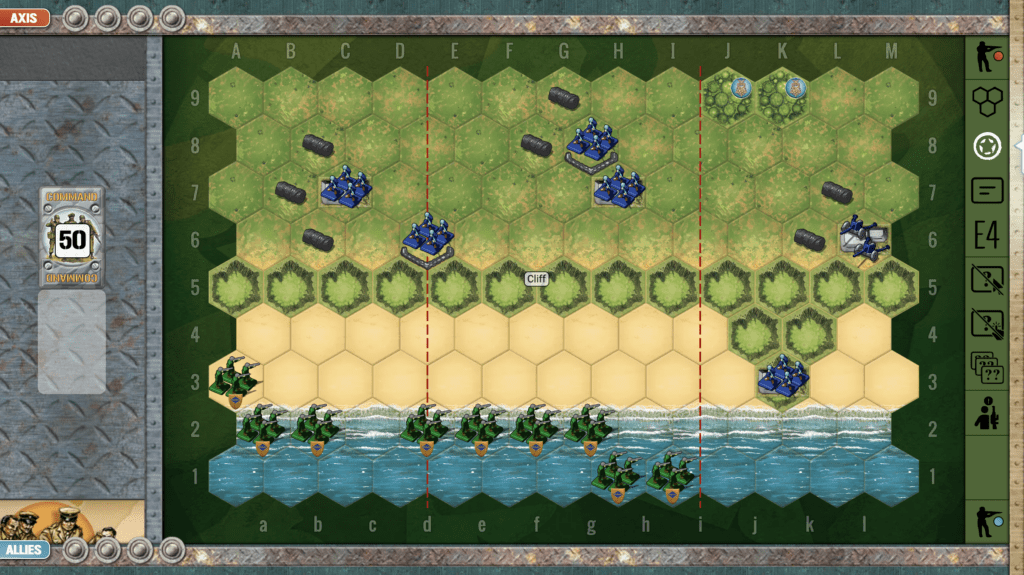
This scenario has a ridge running across the entire battlefield. It is a two-hex move to climb the hill, so it is a challenge for the Allies to mount it. But once they do, it is a short trip to the forest in the corner containing additional victory points. 

Troops:

Allies – 9 Infantry

Axis – 5 Infantry, 1 Artillery

Allied Strategy:

1. Like all beach scenarios, the goal is to get off the beach as quickly as possible. But the ridge running across the beach, does allow Allies to assemble their forces just behind the ridge, massing together, until they are ready to climb the ridge together and attack.

2. Watch out for the infantry hex on the Pointe, and for the artillery on your right flank. You will need to shift your forces to the left as quickly as possible, or the enemy could gain one VP before you even get out of the water. You can move your infantry in a straight lateral move while still in the water, to get away from the Pointe.

3. The best pathway to the VP’s in the forest on your right flank, is to overwhelm the enemy on the left flank, and work your way all the way across the middle section into the forest. Once you make your way off the beach on the left flank, you can take a bit of time to assemble all of your forces, and gather the cards you need for your center section attack.  This will keep you out of the Artillery range.

Memoir 44 scenario Pointe de Hoc

Axis Strategy:

1. Take advantage of the ridge facing the shore. If you have the infantry movement cards, get to the ridge and batter the troops as they approach. If you just sit in your bunkers or sandbags, and wait for them to mass and attack, you will be overwhelmed.

2. First moves are to attack with your infantry from on the point, and your artillery while Allies are still in the water. This will force them up the coast away from your artillery, and most importantly, away from the victory points in the woods.

3. Use your artillery well to slow down, harass, and destroy the troops while they are still on the beach.

4. Once the Allies make it up onto the ridge, if you can restore your remaining forces back into your bunkers, it may give you enough time to degrade the enemy forces enough to prevent their achievement of the VP’s in the forest on your left flank.

Battle Reports

(percentage of Allied victories):

69%

30
BR - Pointe

Author:

Days of Wonder

Link:


Pegasus Bridge

Pegasus Bridge

The Battle of Pegasus Bridge took place on June 6, 1944, during the D-Day invasion of Normandy. Just after midnight, British airborne troops from the 6th Airborne Division, led by Major John Howard, carried out a daring glider assault to capture two critical bridges over the Caen Canal and the Orne River, later known as Pegasus Bridge and Horsa Bridge.

General Howitzer:

Now listen up! The mission was crystal clear: secure those bridges, and do it without hesitation. Why? So no German panzers dare roll onto our beaches and stomp the Allied advance inland. You shall not let them through!

Despite stiff resistance, the British airborne forces struck swiftly and clean—bridges seized, German counterattacks cut off, and few casualties to count. That’s the hallmark of precision, restraint, and utter battlefield dominance.

Capturing Pegasus Bridge wasn’t a side theater—it was the backbone of D‑Day success. Once secured, reinforcements poured inland and German armored units were effectively nailed down before they ever saw the fight. This operation wasn’t coincidence—it was craftsmanship.

Let me be blunt: this was one of the most precise airborne operations in history—pure planning, unshakeable bravery, executed in lockstep with strategic vision. That’s how wars are won—not by waiting for luck, but by making it happen.

4 VP’s

Card Balance:

Allies – 6

Axis – 2, 3, 4

Complexity:

1

Conditions:

Countryside

Location:

Normandy

Year:

1944

Theater:

Western Front

Campaign

Codename

Briefing:

This intro scenario to M44 has only infantry, so managing their movements and ability to attack will determine victory and success. It is heavily favored for the Allies, to represent history, so the Axis need to have a great combination of card management, lucky dice and good strategy to win.

Objectives
Four VP’s, and two bridge Objective Medals.

Battlefield:
Countryside, slashed by two rivers – the Orne and the Caen Canal, whose bridges are the focus of the Objective Medals.

Troops:
Allies – 9 Infantry
Axis – 6 Infantry

🔥 Winning as Allies:

1. The Allies are faced with the need to literally ‘divide and conquer’ on two fronts. One strategy to address this is to focus your energies first on your right flank and take out the units defending the bridge. Once they are gone, and the bridge is gained you will already have three of your needed four points. You will of course have to manage your forces on your left flank so that the enemy is not picking them off one by one from acrosss the sandbags and from across the river.

2. The other attack option is to encircle the enemy by going around the lake with your excess Infantry forces. The Allies have more Infantry than can effectively attack in the narrow range between the river and the lake.  So you can send some around the lake on a long-range mission to attack the enemy from the other side as well.

Memoir 44 Pegasus Bridge Scenario

🔥 Winning as Axis:

1, Because Allies are heavily favored with a 9-6 infantry count, and a 69% success rate, the Axis must get all of their infantry into the fight as soon as possible. Early moves to activate the infantry in the corner of the right flank should be implemented. They can bring a good flanking maneuver to slow down the Allied attack on their sandbagged comrades by firing across the Benouville river.

2. An alternative attack strategy, if you have the movement cards for it is to get at least one of your infantry units across the bridge and into the fight in the center section.

3. Although the Objective Medal of Orne Bridge is within easy reach of the Allies, there is no need to sit on it and wait to be attacked out in the open (As a bridge provides no defensive value). A better strategy would be to have the two infantry units on the left flank to secure protection in the grove of trees above and below near the bridge. Each unit would be within two hexes of the bridge and able to send a withering attack against any Allied units who prematurely try to grab the bridge without first clearing the Axis defenders.

DoW Battle Reports

( percentage of Allied victories):

69%

26
BR - Pegasus

Author:

Days of Wonder

Link

Operation Goodwood

Operation Goodwood

scenario_Goodwoord_1

The Battle of Goodwood (July 18–20, 1944) was a major Allied offensive during the Normandy Campaign in World War II. The operation was spearheaded by the British Second Army, under Lieutenant General Sir Miles Dempsey, and aimed to break through German defenses east of Caen and open the way for a broader advance.

General Howitzer explains:

“Listen up! The Battle of Goodwood was one hell of a slugfest in the summer of ‘44. It kicked off with the skies roaring—a massive aerial bombardment to soften up those German positions, and then the British and Canadian tanks rolled out, thousands of ‘em, across that open French ground.

But you know how it goes— the Germans were dug in deep. Minefields, anti-tank guns, artillery—the whole works—slowed down that armored push, and the Germans counterattacked with everything they had.

Even though they didn’t break through like they hoped, it wasn’t for nothing—the Germans were bleeding, and those tanks kept ‘em busy. It gave us breathing room to launch Operation Cobra and tear open the western flank.

So remember this, boys—even when the breakthrough doesn’t come, if you’re tying up the enemy and keeping him on his heels, you’re still doing the job! That’s the mark of a real fighting force!

6 VP’s

card

Card Balance:

5 – 5

Complexity:

3

Conditions:

Countryside

countryside

Location:

France

Year:

1944

Theater:

Western Front

Campaign:

Normandy Invasion

Summary:

 In the Goodwood scenario, whichever side can gain control of the ridge on the flank, will be in a position of dominance for that flank. Control of the town in the other flank, will lend an advantage to whomever controls it.

Objectives:

Six medals, no terrain objectives

Terrain:

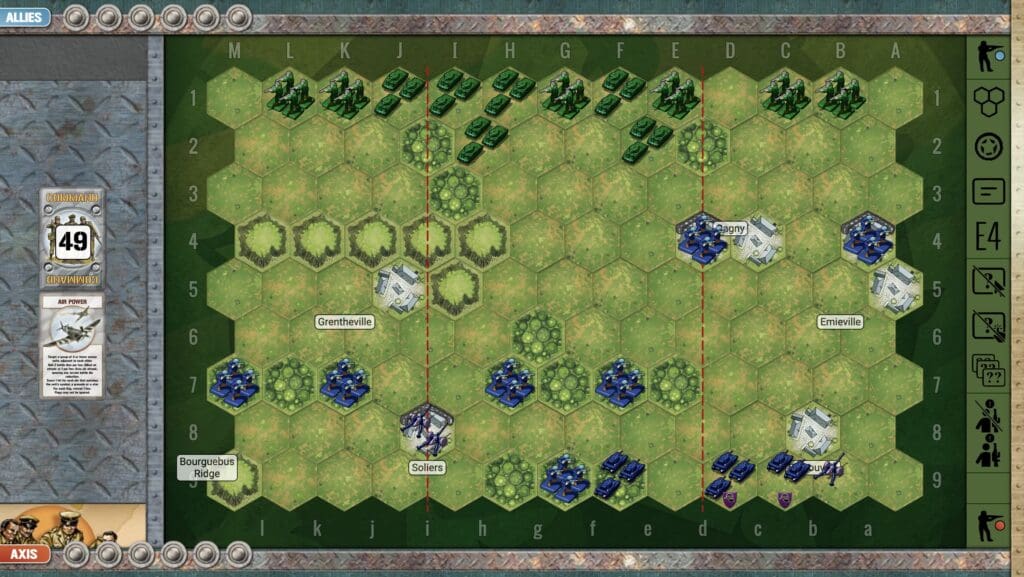
The Goodwood scenario is marked by a large hilly ridge on one flank, while the other two sections are basically a wide open battlefield, with just one two-hex town in the center of it. The center section is wide-open to allow the tank battle which occurred historically.

Troops:

Allies – 6 Infantry, 6 Armor

Axis – 7 Infantry, 3 Armor, 2 Artillery

medal allies

Allied Strategy:

1. The most important first thing which the Allies need to do in this scenario is in the center section. Their armor is only two hexes away from the Axis infantry in the town of Cagny. The armor has no retreat option. Therefore, the typical odds of a one in three hit ratio, increase by 17% to a one in two possibility of a hit, per die. So the armor will need to be moved into the adjacent forest, or moved away entirely to a spot where it has a retreat option.

2.  You have six armor to the enemy’s three armor.  Use it by rapidly gaining control of the center and attacking from there.  You will also need to be ready to move into your left flank to defend your weak infantry.

medal axis

Axis Strategy:

1. Although outnumbered, the Axis’ armor has been able to defeat the Allied armor with the right combination of tactics and patience.  You need to stay in your defensive positions, and attack as opportunities present themselves. Then with the right combination of cards, you can push up through the center and take control.

2.  Potential Attack Vector:  You are strong on the right flank, while the enemy is weak.  If you can move your armor forward rapidly, you could score a lot of points.

9
BR - Goodwood

Author:

Days of Wonder

URL
Operation Cobra

Operation Cobra

scenario_Cobra_start_Allies

Operation Cobra was a key World War II military offensive launched by the Allies in late July 1944 during the Battle of Normandy. Its goal was to break through German defenses and enable a rapid advance across France. Following the D-Day landings, Allied forces faced strong German resistance, slowing their progress.

General Howitzer summarizes:
Operation Cobra was a hammer blow—Bradley opened with a sky full of bombs, and when the smoke cleared, our boys rolled right through Saint-Lô and tore the German line apart. We punched deep into France, drove the enemy into the Falaise Pocket, and opened the road straight to Paris. That’s how you break a front—fast, hard, and without mercy.

5 VP’s

Card Balance:

Allies – 5

Axis -4

Complexity:

3

Conditions:

Countryside

Location:

France

Year:

1944

Theater:

Western Front

Campaign:

Battle of Normandy

Codename:

Cobra

Context:

Historical

Summary:

The Allies begin with a numerical advantage at the start of the scenario. But they have to make it past well-protected Axis forces who are lodge in hedgerows scattered across the battlefield.

Objectives:

5 VP medals including two territorial medal objectives.

Terrain:

Hedgerows and countryside

Troops:

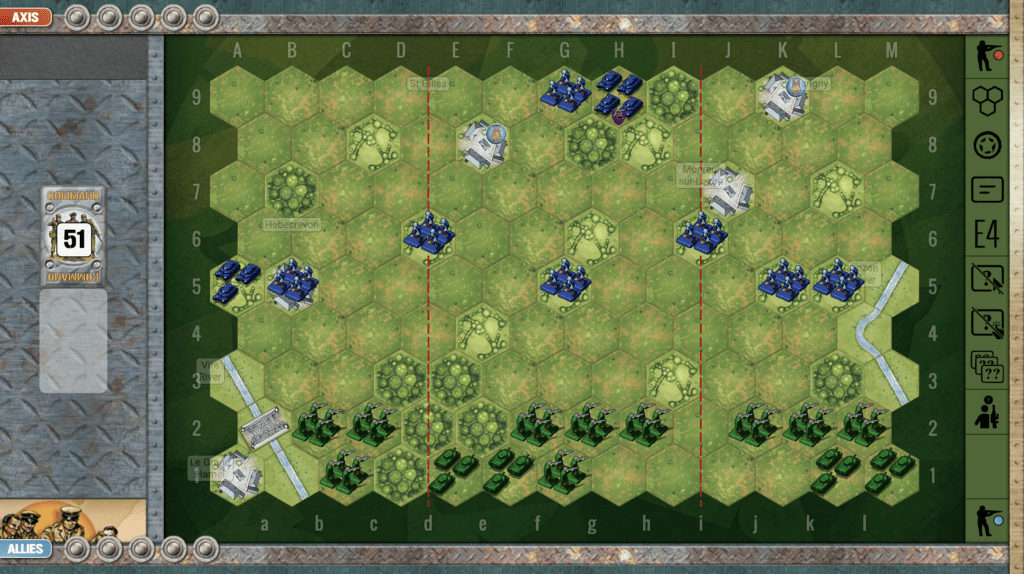
Allies – 10 Infantry, 4 Armor

Axis – 7 Infantry, 2 Armor

Allied Strategy:

1.  Big picture strategy is to push up the center and to the right towards the territorial medal objectives in the two towns. You should be able to dislodge the infantry in the center hedgerow at G5. But the two infantry in the hedgerows at L5 and K5 are going to be more difficult. You may be able to by-pass them by just going up the center. If you gain the initiative, the enemy will have to respond. And then you can hit him with your superior firepower from your armor, and overwhelm him with your infantry.

2.  You have a numerical superiority everywhere except your left flank. That will be quickly under attack by the enemy forces which can attack your no-retreat infantry. So first turn available, get them into the woods to their right.

3. All of your armor is stuck behind the infantry, so get some movement on your troops. The goal is to maximize mobility, in order to capitalize on opportunity.  Based on the cards, you can decide whether to attack center or right; preferably with armor at a distance to degrade enemy preparedness.

Axis Strategy:

1.  Big picture strategy is that the Allies outnumber you, and your role may be primarily defensive. But your front units in the hedgerows can put up a good fight. If you can get a Dig-In! card early on that will help. 

2. Get your armor which is trapped in the back out into a mobile position as soon as you can.

3.  Some early attacks from your troops on the right flank against the trapped Allied troops could gain you a medal, or at least a weakened Allied force in that section.

4.  If it looks like the Allies are going to push past you towards the territorial medal of St. Gilles, you will want to move some infantry there as an additional defensive measure.  Protect your two territorial medals from enemy capture!

Battle Reports
(percentage of Allied victories):
52%

21
BR - Cobra

Author:

Days of Wonder

Link:

Normandy – Vaumicel Manor

Normandy - Vaumicel Manor

scenario_VaumicelManor_start

The Battle of Vaumicel Manor occurred on June 6, 1944, as part of the D-Day landings during Operation Overlord in Normandy. It was a localized but intense engagement involving the U.S. 502nd Parachute Infantry Regiment of the 101st Airborne Division.

The battle focused on the capture of Vaumicel Manor, a key German stronghold near the beachheads. The heavily fortified manor served as a command post and artillery position, threatening Allied movements inland. The paratroopers, despite being scattered during their drop, regrouped and launched a coordinated assault on the manor.

After fierce fighting, including close-quarters combat, the U.S. forces captured the manor, neutralizing its defenders and securing a critical position. This success contributed to the broader efforts to consolidate the Allied beachheads and disrupt German defenses in the region.

The battle exemplified the resourcefulness and determination of airborne troops in achieving their objectives under challenging conditions.

General Howitzer comments on this battle:

“Now listen here! After some downright brutal fighting, including hand-to-hand combat, our boys took that manor and wiped out the defenders. It wasn’t just a fancy house—it was a key position, and taking it helped us lock down the beachhead and throw the enemy’s plans into disarray.

That fight showed exactly what airborne troops are made of—grit, guts, and the will to get the job done no matter the conditions. They didn’t wait for perfect—they took the fight to the enemy and came out on top.

That’s how you win a war, gentlemen—by fighting smart, pushing hard, and never backing down!

6 VP’s

Card Balance:

Allies – 5

Axis – 6

Complexity:

3

Conditions:

Countryside

countryside

Location:

Normandy

Year:

June 5th – 6th 1944

Theater:

Western Front

Campaign:

Normandy Invasion

Codename:
Operation Overlord

Summary:


The Axis forces are scattered across the battlefield, while the Allies are lined up against their border ready for attack. The challenge for both sides is to make their way across the open battlefield. Using hedgerows and forest hexes is the best way to move your forces towards the medal objectives in each of the towns. There are two medals each for Axis and Allies. They seem to be within reach, but getting to it, and holding it are two different things. You will have to make sure you have dealt a crippling blow to any nearby enemy infantry before you seek to posses a town hex medal.

Objectives:
Six VP’s, with two Objective Medals in the towns of Ferme de l’Ormel and St. Laurent for the Axis, and one Objective Medal for the Axis at the town of Vacqueville and at Wn.69.

Battlefield:
Countryside scattered with forests and hedgerows.

Troops:

Allies – 9 Infantry; 2 Armor
Axis – 8 Infantry, 1 Armor, 1 Artillery

Allied Strategy:

1. Big picture strategy is that your right flank is your strong one, and your left flank, although you have a lot of firepower, us up against a well-entrenched artillery which will cut your to ribbons unless you deal with it.  If you get the cards, you can make a good push up the right flank. But you will have to target each unit along the way and take them out one hex at a time. 

2.  Be careful of the Axis artillery on your left flank. They can reach nearly to the back row of hexes. And any attack attempted upon the two infantry hexes at A5 and d4 will be supported by a two-dice response attack from the artillery.

3.  Be sure to protect the two town hexes on the third row which contain Medal Objectives for the Axis.  

Axis Strategy:

1. You are primarily in a defensive position in this scenarios as the Allies advance against you, so remain in defensive positions. But should the cards present an attack opportunity, then take it.

2.  However, you have some Combat Engineers and Special Forces in the back. Move them forward, under protection, but get them into a spot to assault some of the forward positions of the enemy. The special abilities of the Combat Engineers can attack while ignoring terrain battle restrictions.

3.  You have two Temporary Medal Objectives up on row 3, deep in enemy territory.  If you hope to occupy and hold them, you will first need to degrade the enemy forces.  Your best hope of doing this is in the right section, where you have both your Armor (in the center, but can quickly get to the right) and Artillery at. your disposal.

4. General Plan of Attack: Push your forces forward to the right, to gather momentum where you are strongest.

Memoir 44 Vaumicel Manor

26
BR - Vaumicel Manor

Author

URL