General Howitzer’s Field Guide to Memoir 44

A Memoir 44 Strategy & Tactics Community

GENERAL HOWITZER

Scenarios

Explore Memoir ’44 battlefields, maps, and player statistics.

GENERAL HOWITZER

Campaigns

Relive historic campaigns through linked Memoir ’44 battles.

GENERAL HOWITZER

Strategy Tips

Sharpen your tactics and take command of the battlefield.

GENERAL HOWITZER

Field Manuals

Explore field guides and manuals for your next battle.

GENERAL HOWITZER

Tournaments

Find Memoir ’44 tournaments, events, and fellow commanders.

GENERAL HOWITZER

My War Room

Track your battles, campaigns, achievements, and next mission.

The Sausage War [Winter War]

The Sausage War [Winter War]

The Sausage War [Winter War]

The Sausage War scenario map

Victory
6 Medals

Card Balance
Finnish: 5
Soviet: 5

First Player
Soviet

Conditions
Winter

Date: December 10–11, 1939   Location: Finland

Theater: Eastern Front   Campaign: Winter War

Historical Background

On the evening of Sunday 10 December, as the Finns continued to hold the vital Tolvajärvi village, news of a threat to their rear reached Commander Talvela. After a long march, the Soviet 718th Rifle Regiment had finally arrived in the area. Instead of settling down to rest, these troops had immediately pressed on. Swinging west around the side of Tolvajärvi village, they were now about to encircle the Finns, threatening the undefended supply columns.

Despite their initial success in overcoming the surprised defenders, the Soviet attack halted as soon as the Finnish soup kitchens had been secured. After their five-day forced march, the men of the 718th Rifle Regiment were so hungry and tired that they now forgot all about fighting and proceeded to gorge on hot sausage stew.

As luck would have it, Commander Pajari also happened to be in the area. The unwitting Soviets had given the Finns the respite needed to organise their defences by pausing their attack to feast. Now, with his usual alacrity, Pajari formed up a couple of ragtag companies from cooks, clerks and other rear-echelon staff who had been previously scattered by the Soviet assault.

In the dead of night, the Finns began their counter-attack; this soon turned into fierce hand-to-hand combat.

In the cold light of dawn, it came apparent that the supply troops had emphatically blocked this Soviet pincer movement. During the fighting, the Finns had lost 20 dead and 55 wounded, but left over 100 dead Red Army troops on the field. Pieces of sausages were recovered from the freezing bodies of the fallen foes; the surprise had been so complete that some had even died with food still in their mouths. This episode was spoken of afterwards by the Finns as the “Sausage War”.
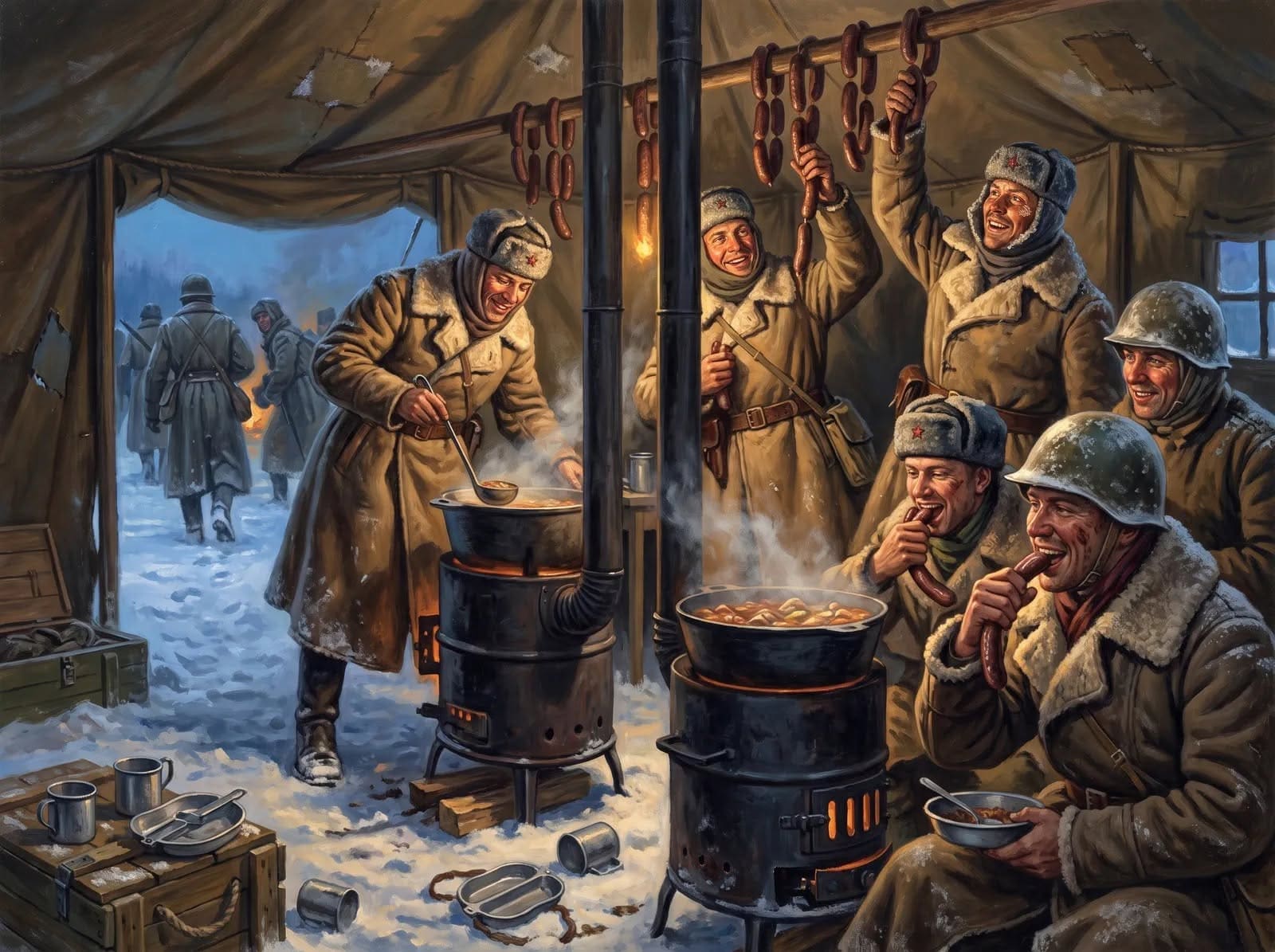
Illustration of Soviet soldiers eating at a captured field kitchen

Briefing

Finnish Player: Take 5 Command Cards.

Soviet Player: Take 5 Command Cards. You move first.

Conditions of Victory

6 Medals

Tolvajärvi village is a Temporary Objective Victory Medal for the Soviet Player.

The kitchen trench is a Temporary Objective Victory Medal for both players.

Special Rules

Russian Command Rules [Nations 2] are in effect.

Finnish Ski Troops [Troops 9] rules are in effect for only the Finnish units marked with the badges. The other three figure units represent the supply and kitchen troops.

Heroic Leader rules [Actions 8] are in effect for the Finnish unit marked with the Battle Star, representing Commander Pajari.

The Marsh hexes represent the frozen lakes. The ice was not thick enough for tanks, so these hexes are impassable for tanks. Infantry may enter the hexes with no effect upon them, except that any unit on a Frozen Lake Hex is considered exposed and is thus also hit by any Stars rolled against it.

When the Soviet Player occupies the kitchen trench hex, flip the Commissar token as you would a coin. On heads, there is no effect; the Commissar keeps the hungry troops in line. If it lands on the star though, that unit may not be ordered on the Soviet players next turn. (It can also not use an Ambush card if targeted by the Finns). At the beginning of the turn, repeat the process to see if they get their act together or keep feasting into the next turn. Repeat the process again next turn if needed.
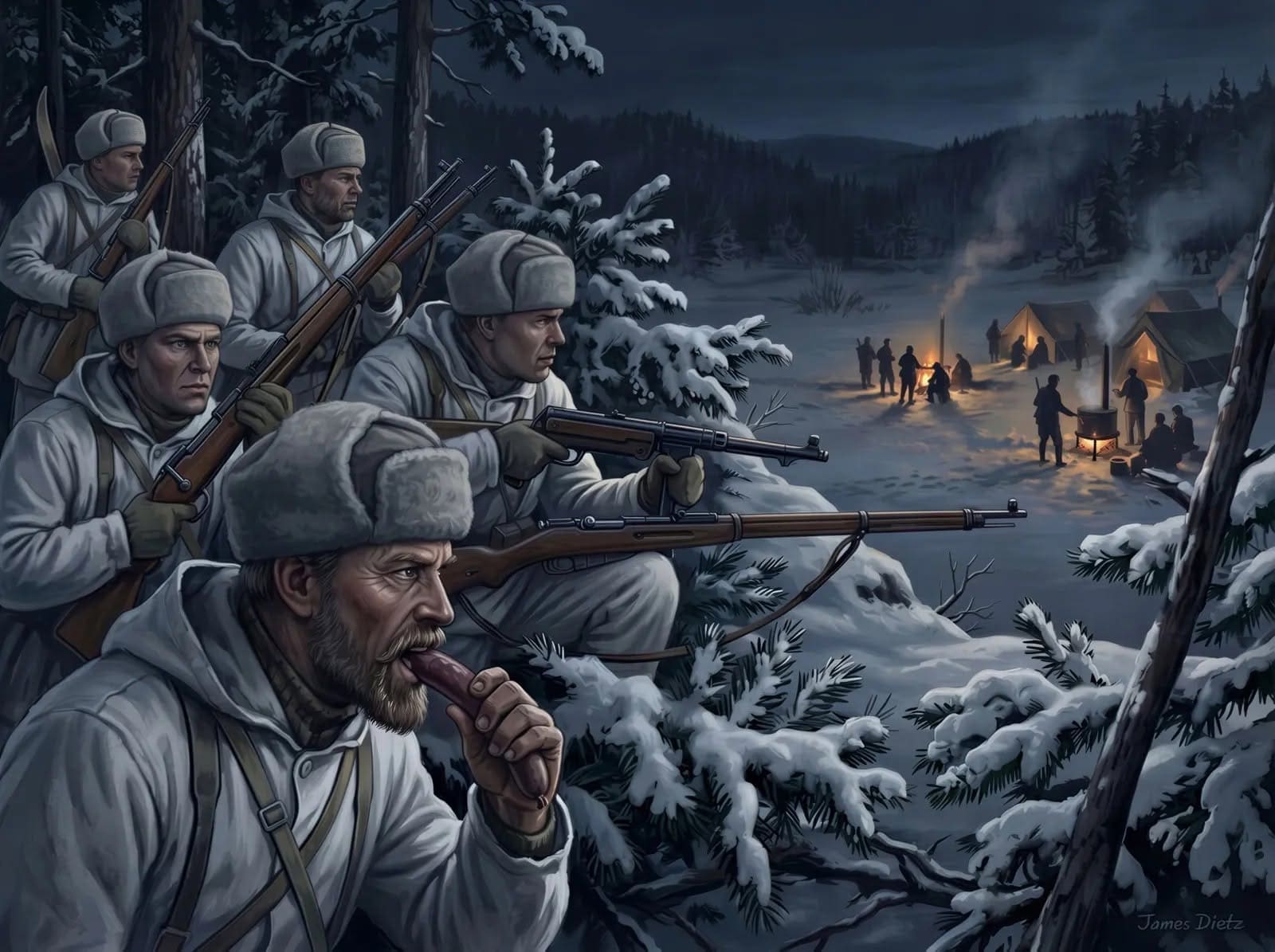
Illustration of Finnish soldiers approaching a winter field kitchen at night

Source/Authorship:  Harley Southwell

Scenario map and text reproduced from the supplied scenario PDF. Symbols & Graphics Copyright (c) 2004–2026 Days of Wonder, Inc. Produced with permission, for non-commercial use only.

Uomaa Village [Winter War]

Uomaa Village [Winter War]

Uomaa Village [Winter War]

Uomaa Village scenario map

Victory
6 Medals

Card Balance
Finnish: 5
Soviet: 5

First Player
Soviet

Conditions
Winter

Date: December 5, 1939   Location: Finland

Theater: Eastern Front   Campaign: Winter War

Historical Background

The Soviet 208th Rifle Regiment encountered strong fortified positions at Uomaa, where the Finns prepared to fight a delaying action. In front of Uomaa they were faced with barbed-wire obstacles, behind these was a minefield, and on the edge of the village there were dugouts for forward observers. Brigade Commander Kondrashev gave orders for a series of direct attacks, but they all failed. Two Soviet tanks hit mines and were destroyed. Machine-gun fire mauled the soldiers. At noon the Soviets dragged up their heavy howitzers; they struck the machine-gun dugouts with direct fire. By the evening they had nearly surrounded the village. The Finns started to burn down the houses and then headed into the woods, retreating toward Kitila where they would make their next stand.

Briefing

Finnish Player: Take 5 Command Cards.

Soviet Player: Take 5 Command Cards. You move first.

Conditions of Victory

6 Medals

Exit medal rules are in effect for the Soviet Player.

Uomaa village is a Temporary Objective Victory Medal for the Soviet Player

Special Rules

Russian Command Rules [Nations 2] are in effect.

Finnish Ski Troops [Troops 9] rules are in effect for only the Finnish units marked with the badges.

The Finnish player lays out the minefields.

The Marsh hexes represent the frozen lakes. The ice was not thick enough for tanks, so these hexes are impassable for tanks. Infantry may enter the hexes with no effect upon them, except that any unit on a Frozen Lake Hex is considered exposed and is thus also hit by any Stars rolled against it.

Source/Authorship: Harley Southwell

Scenario map and text reproduced from the supplied scenario PDF. Symbols & Graphics Copyright (c) 2004–2026 Days of Wonder, Inc. Produced with permission, for non-commercial use only.
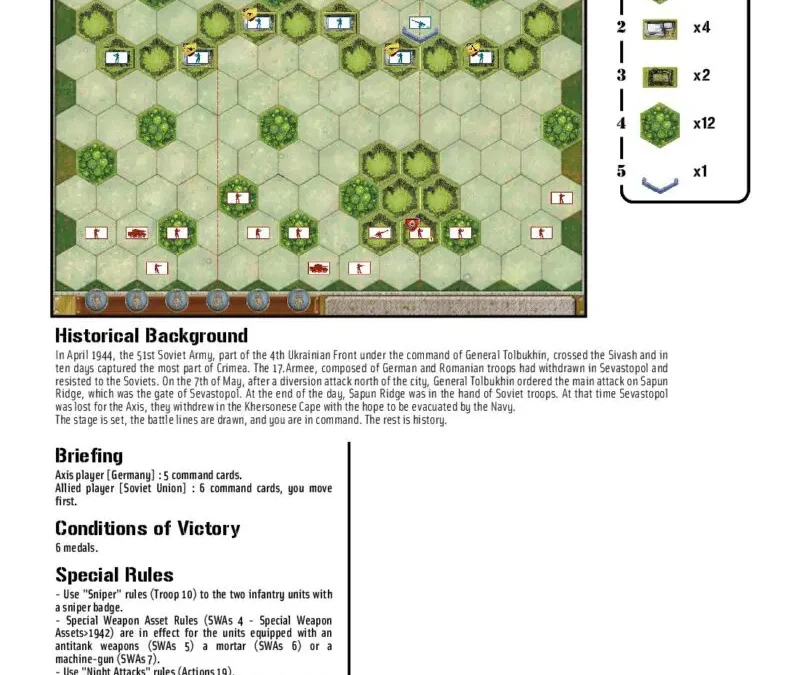
Capture of Sapun Ridge

Capture of Sapun Ridge

Capture of Sapun Ridge

Scenario_Toulon_start_Allies

6 VP’s

Card Balance:

Allies (Soviet Union) – 6

Axis (Germany) – 5

Complexity:

2

Conditions:

Countryside

countryside

Context:

Historical

Location:

Crimea

Year:

1944

Theater:

Eastern

Campaign:

Codename:

Summary:

Objectives:

6 VP’s

Battlefield:

Countryside with trees and hills

Troops:

Allies – 11 Infantry, 2 Armor, 1 Artillery

Axis – 9 Infantry, 1 Artillery

Special Rules: 

1.  Sniper

2. Special Weapons

3. Night Attacks

4.   Steep Hills

medal allies

Allied Strategy:

medal axis

Axis Strategy:

Author:

Link:

Download

Place Battle Reports on a scenario page, or specify its scenario name in the shortcode.

The Tatsinskaya Raid

The Tatsinskaya Raid

The Tatsinskaya Raid

scenario_ColdStream_start

By late December ’42, Paulus’ 6th Army was choking inside the Stalingrad pocket, and the Soviets slammed the door tighter with Operation Little Saturn. They tore through the Italian 8th Army like paper, and Badanov’s 24th Tank Corps drove a steel fist 150 miles deep into German lines. His T-34s rolled right onto Tatsinskaya airfield, smashing up Junkers 52s that were the lifeline to Stalingrad.

The Germans scrambled the 11th Panzer and 306th Infantry to hit back, and they hit hard. Badanov’s tanks took a pounding, but he held that airfield for four bloody days before clawing his way back to his own lines. The cost was high, but the result was clear: the German relief effort was crippled, Stalingrad was left to rot, and the mighty Wehrmacht had been dealt another hammer blow on the Eastern Front.

~~ General Howitzer

VP’s

10 including the Airport Permanent Objective Medal

card

Card Balance:

Allies – 4

Axis – 5

Complexity:

4

Conditions:

Winter

winter

Context:

Historical

Location:

Russia

Year:

1942

Codename:

Operation Little Saturn

Summary:

Victory Points:

10 Medals, including the airport Permanent Medal Objective

Terrain:

Winter terrain

Troops:

Allies – Infantry, Armor, Artillery

Axis – Infantry, Armor, Artillery

medal allies

Allies:

1. Your forces have a massive armor advantage over the Axis in this raid scenario.  You need to coordinate your efforts and arrive at the frontlines of battle together.

2.  Your very first challenge is to deal with the Artillery and Infantry hidden in the forest right in the front center of the battle field. Until you deal with them, they will hamper all of your attack efforts.

3. If you can deal with the Artillery quickly, before the Axis bring down their other units, you can gain a couple of medals very quickly, as that Artillery is the key defensive point on this end of the battlefield. But if you do not have the cards and forces to take it out quickly, you will destroy several units during the attack.  [Athafil, Italy]

4.  The airport is a Permanent Medal Objective. You don’t need to stay on the hex, so you can just grab it and then leave to a more defensive position.

medal axis

Axis:

1.  This is primarily a defensive scenario for the Axis. You need to engage the enemy, but if you attempt to battle the massive armor forces out in the open, your forces will get decimated.

2.  Your forces are stuck behind the forests. You need to get them, especially the armor, forward as quickly as possible to support your advance forces which are defending the airport.

3.  The airport is a Permanent Medal Objective for the enemy.  Hold it as long as you can. Make them pay for it with a lot of units.

4.  Your Artillery in the center frontline is your strongest asset. Use it at every opportunity.  

5.  You have many assets stuck in the forests and marches in the back. Get them out as quickly as possible and forward to provide additional attack strength and support with your forward Artillery.

6.  Note that most of your troops in the woods begin the battle in Camouflage mode, where they can only be attacked in Close Assault. However, if they move or attack, you lose your Camouflage.

Author: Jdrommel

URL

Place Battle Reports on a scenario page, or specify its scenario name in the shortcode.

The Battle of Sokolovo

The Battle of Sokolovo

The Battle of Sokolovo

Historical Summary

8 Medals plus for Axis, the death of the heroic leader

card

Card Balance:

Allies (Czechoslovak)- 4

Axis – 5

Complexity:

3

Conditions:

Winter

winter

Context:

Historical

Location:

Year:

1943

Theater:

Easter

Campaign:

Codename:

Summary:

Objectives:

8 VP’s, plus special rules (see the PDF).

Battlefield:

Winter countryside with a river, roads, hills.

Troops:

Allies – see PDF

Axis – see PDF


medal allies

Allied Strategy:

1.

medal axis

Axis Strategy

1. 

Battle Reports

Author:

Days of Wonder

Link:

Place Battle Reports on a scenario page, or specify its scenario name in the shortcode.

Battle of Dubno – Brody

Battle of Dubno – Brody

Force vs. Finesse: Battle of Dubno - Brody

Scenario_Toulon_start_Allies

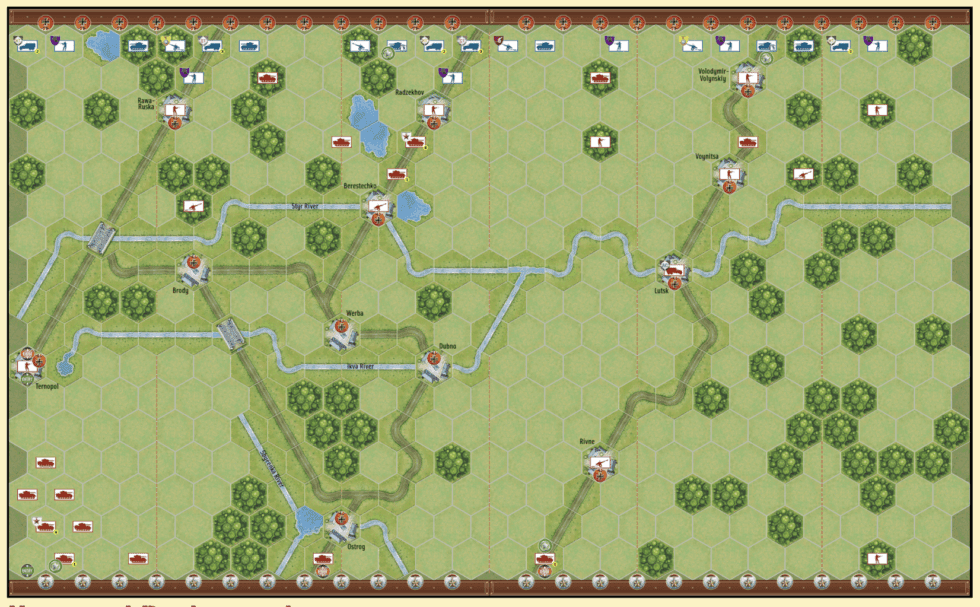
The Battle of Dubno–Brody (June 23–30, 1941) was one of the largest tank battles of World War II, fought during the opening phase of Operation Barbarossa between Germany’s Army Group South and the Soviet Southwestern Front.

Results:

  • German Panzer forces decisively defeated the numerically superior Soviet armored units, destroying or capturing thousands of tanks.

  • Soviet forces suffered catastrophic losses and were forced into retreat.

Strategy:

  • The Germans used fast, coordinated Panzer thrusts and encirclement tactics to neutralize Soviet armor.

  • Soviet forces, hampered by poor coordination, mechanical breakdowns, and weak communications, failed to execute an effective counteroffensive.

General Howitzer summarizes its impact:
That win at Dubno–Brody blew the road wide open for the Germans into Ukraine and straight toward Kiev. It showed the Soviets their armor doctrine was a mess, and they paid for it in steel and blood. But they’re stubborn—those losses lit a fire under them, and the lessons they learned there would come back to bite the Germans hard later in the war.

24 VP’s (!)
[ This is a ‘break-lord’ scenario ]

card

Card Balance:

Allies –

  • 4 cards for each half of the board

Axis –

  • 6 cards for each half of the board

Complexity:

5

Conditions:

Countryside

countryside

Context:

Historical

Location:

Russia

Year:

1941

Theater:

Eastern Front

Campaign:

Codename:

Operation Barbarossa

Summary:

Objectives:

24 VP’s, plus many other conditions. Read the PDF special rules.

Terrain:

Countryside with rivers and roads 

Troops:  (check the PDF for specific the specific troop deployments)

medal allies

Allied Strategy:

1.  

medal axis

Axis Strategy

1. 

Author:

Willem Boersma

Complete Scenario Link:

https://generalhowitzer.com/bsk-pdf-manager/battle-of-dubno-brody/

Place Battle Reports on a scenario page, or specify its scenario name in the shortcode.

Secret Link