
Lipovec

Lipovec

scenario_Lipovec_start_Axis

July 22nd, 1941—Lypovec. Operation Barbarossa was tearing into the Soviet Union, and here came the Slovak Mobile Brigade—five thousand men, 43 tanks, and 123 artillery guns—charging into their first real scrap against the Red Army.

They smashed into General Tkachenko’s 44th Rifle Division—some fresh, some worn ragged—but the fight was no parade. The Slovaks had spirit, but their tanks ran thirsty, and fuel was scarce. They pushed into the town, only to be hammered by furious Soviet counterattacks.

What saved them? The guns. Artillery thundered, covering their retreat and keeping the whole affair from turning into a disaster. In the end, the Slovaks learned the hard truth—courage and machinery mean little without supply and strength in numbers. Against a seasoned, determined foe, they were blooded, beaten back, and reminded that war is unforgiving to the unprepared.

~~ General Howitzer

6 VP’s

Card Balance:

5 – 5

Complexity:

3

Conditions:

Countryside

Context:

Historical

Location:

Ukraine

Year:

1941

Theater:

Eastern Front

Campaign:

Operation Barbarossa

Codename

Summary:

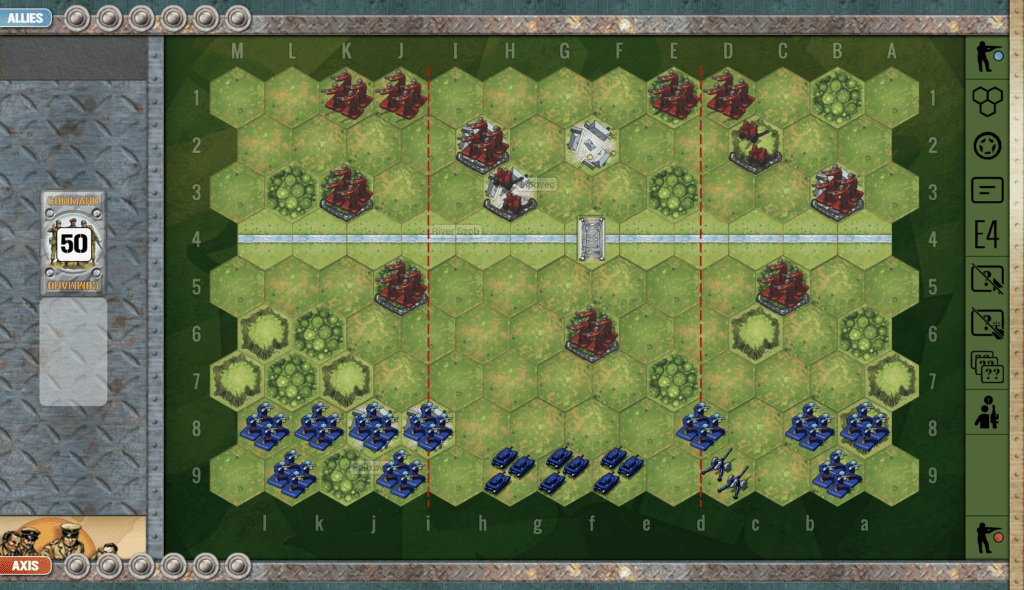
The dominant factors in the Lipovec scenario is the river going across the battlefield, and the two artillery units safely ensconced in each of their own city hexes.  The Axis win most encounters in this scenario, primarily due to the skillful use of their Armor.

Objectives
Six VP’s. No medal objectives

Battlefield
The battlefield is split horizontally by the River Szob, which is a fordable river. There is also one bridge crossing.

Troops:
Allies – 10 Infantry, 2 Artillery
Axis – 10 Infantry, 3 Armor,  1 Artillery

Allied Strategy:

1. The Allies begin the round with three forest hexes deep into Axis territory, controlled by sandbagged infantry. This presents an early point of attack, and becomes the locus of the seesaw battle for control. Take advantage of those forward points and attack as quickly as possible at the Axis enemy pressed up against the battlefield barrier. For every flag thrown against a unit against “the wall” will be counted as a hit. This increases your chance of getting a hit by 17% for each unit.

2.  Allies have two artillery vs. the Axis’ one. So take advantage of the long-range hits available to you. The central artillery has reach of most of the battlefield. Use it.

3. As defenders in this game, unless the cards clearly dictate otherwise, you can wait across the river for the Allied attack, and then hit them when they are paused at the Szob River.

Axis Strategy:

1. The enemy begins with control of three hexes on the Axis side. So Axis will have to target the enemy incursion hex by hex to push him back. Unless Axis is given a great set of cards for a flanking attack, they will want to clear all enemy troops on their side of the river before trying to cross over.

2. You have six infantry units on your left flank. They can approach the enemy under the cover of the forest and hills, to get very close for the attack.

3.  Axis have an overwhelming advantage with armor.  Put them into action by dealing with the infantry hiding in the forest hex center seciton.

4.  The enemy Artillery in the center on third row is a problem.  A direct attack is going to be costly. Wait until you get some powerful attack cards like Barrage, Airpower, BEH, TFH, or Firefight, then attack it. Either destruction or retreat flags will give you some breathing room to attack the enemy on the flanks.

5.  Plan of Attack:  Eliminate the forward central Infantry, while moving up along both flanks to soon attack the other two forward Infantry in each section.  Use your Armor as much as possible, but watch that you do not get in range of the enemy Artillery in the center. Once the enemy Infantry units are gone, the left section across the river provides the best attack vector, as it is further from the two enemy Artillery.  You will have to moderate and adjust this plan as cards allow.

16
BR - Lipovec

Author:

Days of Wonder

URL

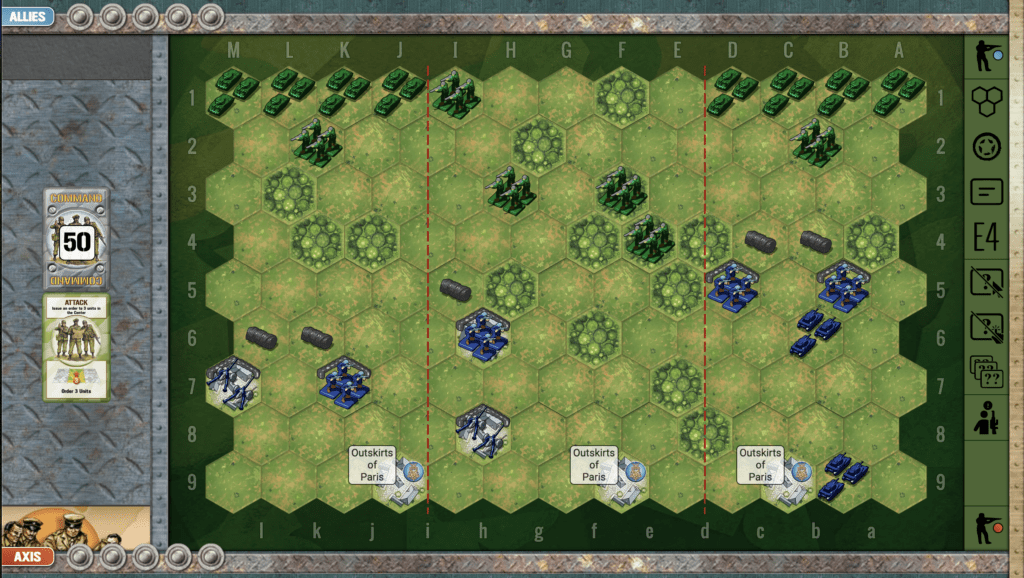
Liberation of Paris

Liberation of Paris

The Liberation of Paris took place from August 19 to August 25, 1944, as Allied forces advanced through France following the D-Day landings. Resistance fighters in Paris, along with civilians, began an uprising against the German occupiers, seeking to reclaim the city before it could be destroyed.

General Howitzer’s summary:

Leclerc’s Free French rolled in with our 4th Infantry on August 24, linking up with the resistance and blasting through what was left of the German holdouts. After some damn fine street fighting, their commander—von Choltitz—had the good sense to ignore orders to torch the city and surrendered the next day.

Taking Paris wasn’t just a win—it was a thunderclap. It lit a fire under Allied morale, crushed the myth of Nazi invincibility, and gave us back the heart of France. From that point on, the road to Berlin got a whole lot shorter.

5 VP’s

Card Balance:

Allies – 5

Axis – 4

Complexity:

3

Conditions:

Countryside

Context:

Historical

Location:

France

Year:

1944

Theater:

Western Front

Summary:

The Allies vastly outnumber the Axis in this scenario. Their objective is to reach the three town hexes on the outskirts, which are permanent medal objectives. But first they have to get past the forest in the center, and the German defenses made up of sandbagged troops, barbwire, and artillery.

Objectives:

5 VP’s, plus the Allies have three towns available to them as Permanent Medal Objectives.

Battlefield:

Countryside with a lot of forests, and the outskirts of Paris at the Axis side of the field.

Troops:

Allies – 6 Infantry, 8 Armor

Axis – 4 Infantry, 2 Armo, 2 Artillery

Allied Strategy:

1.  You have a lot of tanks. Use them. You should be able to very quickly take out the infantry behind the sandbags and move down to the towns to scoop up our Permanent Objective Medals.

2.  The Battle Reports for this scenario heavily favor the Allies, so if you are playing both sides in a full game, make sure to capture all you can while you are playing the Allies.

3. As Allies, it really comes down to the battle on your strong left flank.  You have to break through the blockade of the enemy sandbagged infantry and the defending armor unit.  The more quickly you break through, the more likely the win.  But if the Axis are able to make you pay dearly with two or more units to break through, the game odds may even out.

Axis Strategy:

1.  This is mostly a defensive game for the Axis.  Keep your infantry behind the sandbags, and maximize the use of your armor and artillery to slow down the enemy advance.

2.  At a certain point, you may need to move your infantry into the towns in order to make it more difficult for the Allies to capture those Permanent Objective Medals. Remember, once they get one, they can leave the town and go for the next Objective.

3.  It generally seems to be a mistake to move one of your armor to C5 between your two infantry, in an attempt to get some easy hits on the enemy no-retreat infantry on the second row. You may get as much as three hits. However, in most cases, the Allies are able to bring forward two to four armor units and target all their forces on your lone armor hex, resulting in a quick VP for the enemy.

Battle Reports (percentage of Allied victories):
75%

21
BR - Liberation Paris

Author:

Days of Wonder

Link:

Knightsbridge, Battle of Gazala

Knightsbridge

scenario_Knightsbridge_start

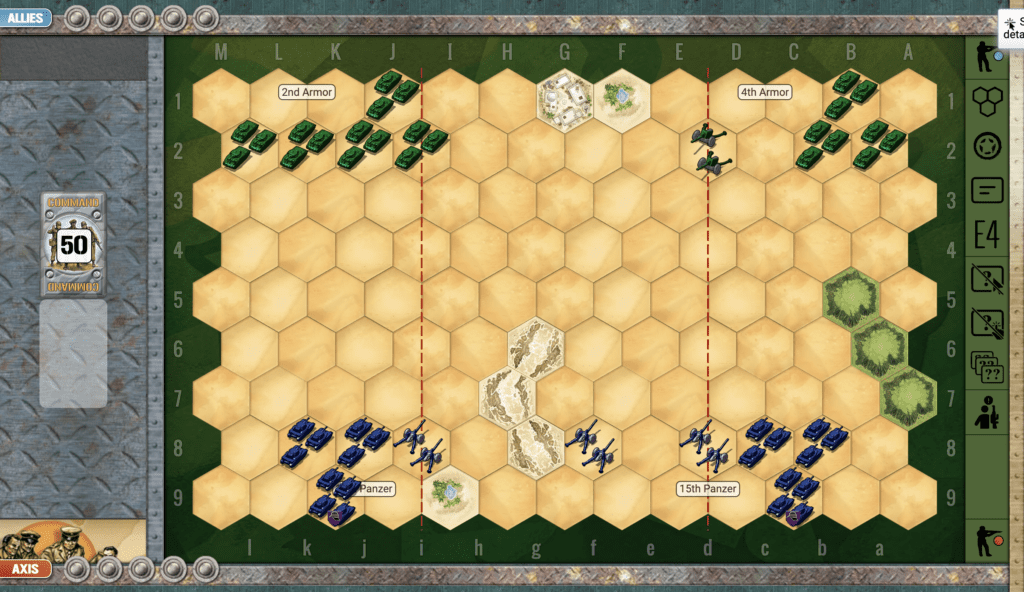
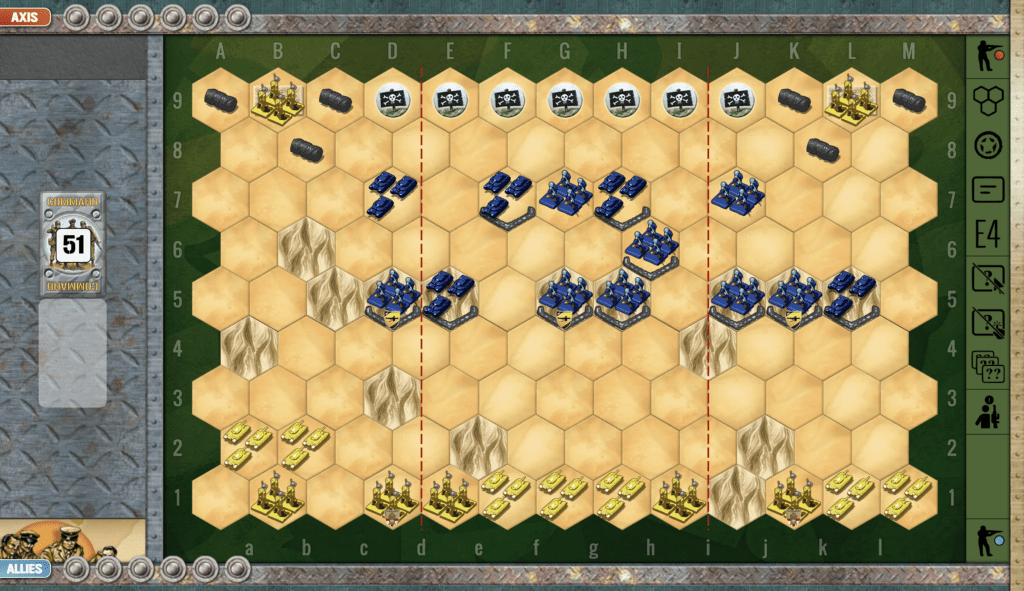
“Listen up! In early June ‘42, out there in that hot Libyan desert at a place they called Knightsbridge, our British allies were in for the fight of their lives. The place was nothing but a road junction, but it was as valuable as gold when the shooting started.

Rommel came at ‘em with his Panzers and those nasty 88s, aiming to cut ‘em off, encircle ‘em, and finish the job. The British Eighth Army fought back with everything they had, but those German guns chewed up their tanks like a buzz saw through dry timber.

Even though the Brits took a beating and left a lot of metal in that desert, Rommel couldn’t crack the line. He overreached, and the whole thing bogged down into a stalemate.

Let that be a lesson, boys—in the desert, mobility is king. You gotta hit hard, move fast, and never let the enemy pin you down. Knightsbridge wasn’t the final blow, but it sure as hell was the warning shot that the real fight was just getting started!”

~~ General Howitzer

5 VP’s

Card Balance:

Allies – 4

Axis – 6

Complexity:

2

Conditions:

Desert

Location:

Libya

Year:

1942

Theater:

Mediterranean Theater

Campaign:

Western Desert Campaign

Context:

Historical

Summary:

Objectives:

5 Victor Points

Battlefields:

Knightsbridge is an almost open desert battlefield in which tanks engage in head-on warfare, interspersed with the occasional artillery fire and infantry assault.

Troops:

Allies – 8 Infantry, 1 Artillery

Axis – 6 Infantry, 3 Artillery

Allied Strategy:

1.  Big picture goal for Knightsbridge, like many desert scenarios is to hit first and hit hard.  

2. The Axis have three Artillery which will assist the Armor if you venture too close.  With your limited movement, it would be best to keep your forces together on your end of the battlefield.

3.  Get to the ridge on your left section as quickly as possible. You cannot move as fast as the Axis, so you need to start right away.  Do not get caught back against the border, or the enemy will wipe you out with the additional flag hits. 

4. You are strong on your right flank, so move your units forward together to defend against the on-coming Axis attack.


Axis Strategy:

1.  Because of the wadi in the middle of your end of the battlefield, your forces are divided.  Your Armor on the left flank is outnumbered five to two, but you do have your artillery.  If you can entice the Allies to move forward, you can get some support from your Artillery fire.

2. Take advantage of the ridgeline on your right flank by parking your units there and wait for the Allies to attack. The height advantage may count in your favor in the ensuring battle. 

3.  Grab the heights on the ridge as quickly as you can. Whoever gets on top of the hill first will gain a 17% hit advantage.


Battle Reports

22
BR - Knightsbridge

Author:

Days of Wonder

Link:


Juno Beach

Juno Beach

The invasion of Juno Beach was part of the Allied D-Day landings on June 6, 1944, during World War II. Juno Beach, one of the five beaches targeted in the Normandy invasion, was assigned to Canadian forces from the 3rd Canadian Infantry Division and the 2nd Canadian Armoured Brigade. Their mission was to secure a beachhead, push inland, and capture key objectives such as the town of Caen.

Juno Beach was no picnic—it was hell from the start. The Canadians hit the shore under rough seas, late and scattered, with German guns pouring lead and shells across the sand. Machine guns, artillery, mines—everything the enemy could throw at them was waiting.

But those Canadians didn’t back off. They regrouped fast, pushed inland with infantry and armor working shoulder to shoulder, and smashed through the fortifications. By nightfall, they hadn’t just taken Juno—they’d driven farther inland than any other Allied unit on D-Day.

They paid dearly in blood, but their victory cracked open Hitler’s wall, anchored the Allied foothold in France, and lit the road that led to the liberation of Europe. Juno Beach proved it plain: Canadian steel and courage could punch just as hard as any force in the world.

~~ General Howitzer

6 VP’s

Card Balance: 

Allies – 6

Axis – 4

Complexity:

2

Conditions:

Beach

Location:

Normandy

Year:

1944

Theater:

Western Front

Campaign:

D-Day

Codename

Summary:

Objectives:

6 Victory Points, including the possibility of four! Objective Medals for the Allies.

Battlefield:

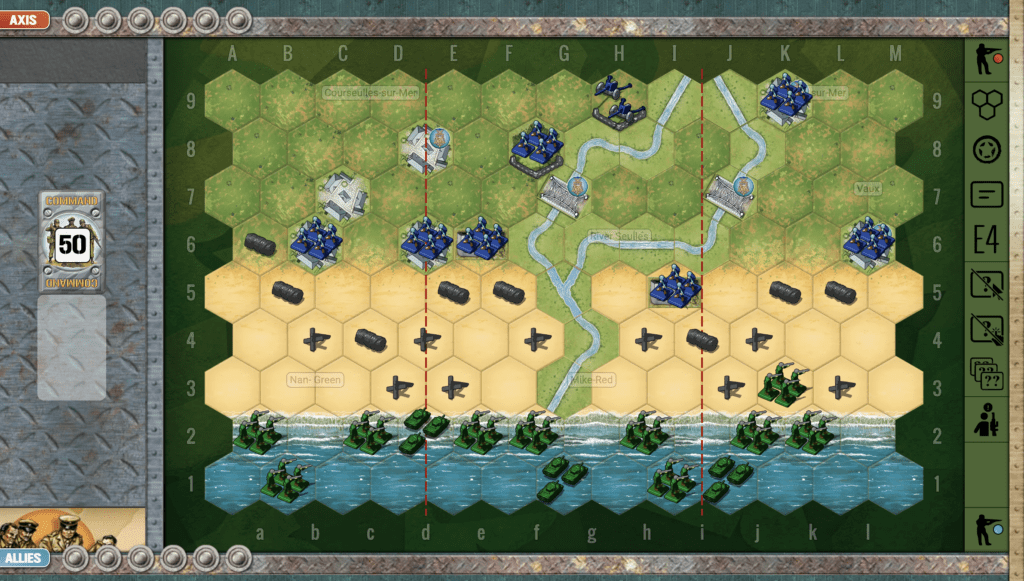
With the River Seulles going through the center of the battlefield, the Juno Beach scenario is almost two different battles taking place at once. There is no beach ridge to slow down the advance of the Allies.

Troops:

Allies – 10 Infantry, 3 Armor

Axis – 7 Infantry, 1 Artillery

Allied Strategy:

1. The Allies need to be aware of the VP goal of six points, and then count up the number of medals and forces on the right side of the map: three Objective Medals (two towns and one bridge) and three infantry. This means, that with the “right” set of cards, an Allied player could win the battle completely just by focusing on the right flank. Now it will rarely happen that such a single-minded focus can occur based on the luck of the cards. But keeping the enemy off-balance by occasional forays on the left flank is a good strategy also. But this scenario reminds us of an important principle, to always keep your overall objectives and plan in mind throughout the battle. And do not deviate unless cards, or circumstances dictate otherwise.

2.  Of course, the left flank is a little more secure, as it is outside the range of the artillery.

3.  With the River Seulles splitting your center section, you will need to make a determination of which direction your troops will head to. This will need to be determined by the cards in your hand.

4.  As you move off the beach, the two Medal Objectives on the bridges look very tempting. But they are quite close to the enemy artillery, so you will not want to take those bridges until near the end of the game, so they cannot be chased away.

Axis Strategy:

1. Your Infantry in the bunker at I5 is in a great location to make some early hits on the enemy while they are still in the water, or backed up against it.

2. Your Infantry unit in the town of Graye-su-Mere in your left flank, is pretty useless in the early stage of the battle. Rather than wait for the action to come to them, at which point it may be too late, you may want to move it forward.

Battle Reports (percentage of Allied victories):
64%

19
BR - Juno Beach

Author:

Days of Wonder

Link:


Japanese Counterattack

Japanese Counterattack

The “Japanese Counter-Attack” phase refers to the counteroffensives launched by Japanese forces in the Pacific Theater.  One notable example occurred during the Battle of Guadalcanal, from August 1942 to February 1943. After U.S. Marines secured a critical airfield on Guadalcanal, known as Henderson Field, the Japanese launched multiple counterattacks to reclaim it. These counteroffensives, involving intense jungle fighting and night assaults, aimed to dislodge the U.S. forces from their foothold. The Japanese committed significant naval and infantry resources, but despite their efforts, they struggled to overcome the U.S. defenses and secure sustained supply lines.

The Japs threw in ships, men, and everything they could float or march—but it didn’t matter. Our defenses held like a steel wall, and without solid supply lines, their fight was doomed from the start. They came in hard, but we broke them harder.

~~ General Howitzer

6 VP’s

Card Balance:

Allies – 6

Axis – 5

Complexity:

4

Conditions:

Jungle

Location:

Guam

Year:

1944

Theater:

Pacific Theater

Campaign

Codename

Summary

The Japanese Counterattack takes place on the same battlefield as the Guam Landings, but the game mechanics are pretty much reversed.

Objectives:
Six VP’s, plus each side has a permanent Objective Medal hex which they can seek.

Battlefield:
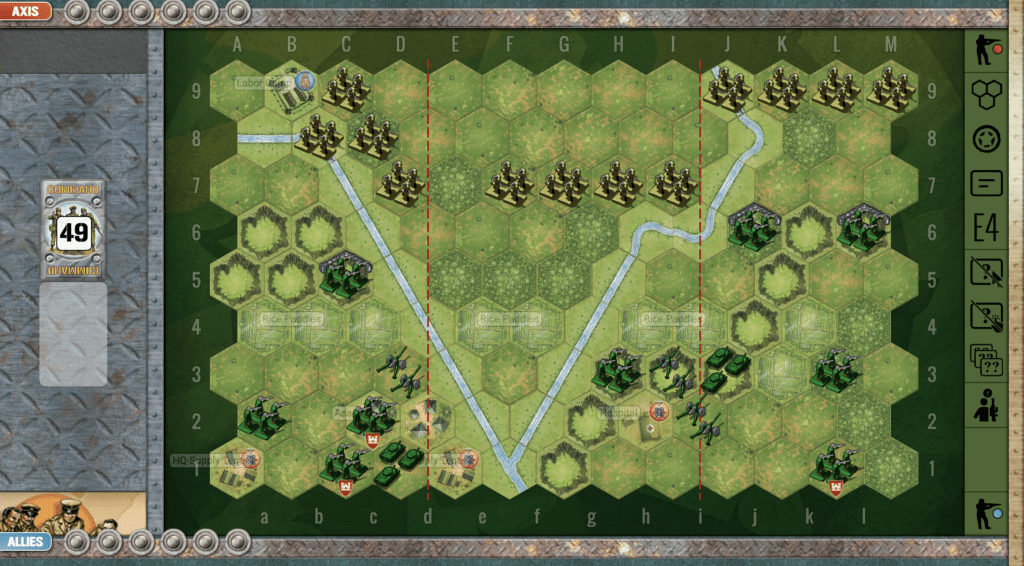
Jungle with a V-shaped river cutting right through the map.

Troops:
Marines – 9 Infantry, 2 Armor, 2 Artillery.
Japanese – 12 Infantry.

Allied Strategy:

1.  With three artillery, and one armor, the Marines have more firepower than the Japanese. But the artillery is limited for much of the game by night visibility rules, which slowly improve throughout the game.  So take your time to get your troops arranged, and your card management under control, to allow more daylight to help your attack and defense.

2. Your tank is stuck back in the left corner of the fight, so take advantage of the early turns to get it into play.

3.  Remember that the Japanese practice the Seishin Kyoiku Doctrine. If they have all four units and are fighting at close combat, they role four! dice, not three.  So during the game, one of the objectives the Marines need to practice is to take off at least one figure per hex. This will actually count as two in terms of reducing the Japanese firepower for subsequent attacks. 

Axis Strategy:

1.  Big picture strategy for the Japanese forces is to quickly overwhelm a flank with infantry forces who are still fully intact so that you can use the Seishin Kyoiku Doctrine against the Marines.  Because of the four! Allied artillery, the center section is kind of a kill box.  So the best hope is to move down one of flanks as the cards dictate.

2.  Night-time conditions are to your advantage because the Allies have so much firepower.  Therefore your best attacks will be immediately, before the dice rolls enough stars to bring out the full ranged artillery attacks.

3.  There are three Permanent Medal Objectives (HQ-Supply & Hospital hexes).  These are deep in enemy territory, but should you get your hands on either Behind Enemy Lines or Infantry Assault cards, there is a possibility you could force your way in to them.

Battle Reports (percentage of Allied victories):

66%

(These are the historical records. For new stats, record your games in the poll to the right.)

20
BR - Japanese-Counter

Author:

Days of Wonder

Link:

Into the Cauldron

Into the Cauldron

Scenario_IntoTheCauldron_start

Rommel’s Panzers had bloodied the British 7th Armoured, but they’d shot their bolt. The Afrikakorps was jammed into what we’d call a pressure cooker—“the Cauldron.” To the south, Bir Hakeim held firm. To thea north, Tobruk was still in enemy hands. East and north, the tattered remains of British armor blocked the way. And to the west, minefields stretched like a wall of steel.

The Brits, blind to how short the Germans were on fuel and shells, failed to strike while the iron was hot. That hesitation let Rommel dig in around the ridges of Sidi Muftah, while his Italian allies clawed through minefields under heavy fire to drag supplies forward. When the British finally counterattacked on June 5th, it was sloppy and ill-timed—broken against the German anti-tank guns. A golden chance to smash the Desert Fox had slipped right through their fingers.

~~ General Howitzer

6 VP’s

Card Balance:

Allies – 4

Axis – 5

Complexity:

3

Conditions:

Desert

Context:

Historical

Location:

North Africa

Year:

1942

Theater:

Mediterranean Theater

Campaign:

Battle of El Almein

Summary:

Objectives:

6 VP’s, plus Exit Hex Medals

Battlefield:

This desert scenario has a series of sand dunes across the center of all three sections on which are perched sandbagged Axis troops ready for battle. The challenge for the Allies is with their greater armored forces are to force their way through to victory.

Troops:

Allies –  7 Infantry, 7 Armor

Axis – 8 Infantry, 5 Armor

Winning as Allies:

1.  The Allies have numerical superiority on the left flank, which can be exploited. Also note that the Allies have a 7 -5 advantage with armor. It is important to quickly take advantage of this superiority, as desert warfare can very quickly turn around with a few well-rolled armor attack dice.

2. Use any attack cards you get, to pull your armor forward one hex, and aim their turrets at the enemy three hexes away on the dunes. In this way, you can start to degrade the enemy attack from the dunes. With some well-rolled dice, you can attack the sandbagged infantry from a distance, and possibly score a quick VP. But be wary of the sandbagged armor units on each flank, which are well protected, and can very quickly knock out your armor units with a few attacks. Also the sandbagged anti-tank units can score against your armor with stars, thus raising the likelihood of a successful armor hit from 33% to 50% per dice roll.

3. You have two units of hexes in bunkers deep in the enemy territory, next to the exit hexes. Be very careful about moving them from the bunkers. Once you do so, all their protection is gone, and since they are surrounded by enemy troops, will be destroyed quickly. But if you keep them in the bunkers and use them as harassment, they can distract the Axis troops from applying all of their fire-power at the unprotected Allied troops trying to make an attack uphill against the sandbagged Axis defenders.

Winning as Axis:

1. One special Victory Point which the Axis can take advantage of is the escape hex through the minefield. Don’t waste a lot of your forces trying to find it, but one unit assigned to opening the escape path while the rest battle the British could be a path to an ‘easy’ VP.

2.  The Allies have a numerical superiority of armor.  Don’t launch an armor attack prematurely.  Use your sandbagged infantry and armor units to slowly degrade the enemy. Be prepared should they try to launch an assault. Keep your responsiveness ready so you are prepared for whichever direction they come.

3.  Watch out for the two enemy infantry units lodged in the bunkers along the backrow. Have an armor unit ready to respond with devastating force should they venture out of the bunkers.

Battle Reports

(percentage of Allied victories):

48%

15
BR - Cauldron

Author:

Days of Wonder

Link: