Hill 112

Hill 112

In early July 1944, during the Normandy campaign, British forces launched Operation Jupiter to seize Hill 112, a dominant height southwest of Caen. Control of this hill was crucial: whoever held it could observe and direct fire across much of the surrounding countryside, making it a strategically vital position.

On 10 July 1944, the British 43rd (Wessex) Infantry Division, supported by armored units including Churchills of the 31st Tank Brigade, attacked German defenses held mostly by elements of the Waffen-SS, including the 9th SS Panzer Division “Hohenstaufen” and 10th SS Panzer Division “Frundsberg.” The fighting was brutal, confused, and close-quarters, with British infantry repeatedly advancing into heavy machine-gun, mortar, and tank fire.

General Howitzer:
Hill 112 wasn’t conquered—but it served its purpose.
It tied down Germany’s best, burned away their strength, and cracked open the German shield around Caen. A brutal ridge that changed the course of the Normandy campaign by simply refusing to be ignored.

6 VP’s

Card Balance:

5 – 5

Complexity:

3

Conditions:

Countryside

Location:

France

Year:

1944

Theater:

Western Front

Campaign

Codename:

Operation Jupiter

Summary:

Objectives

This is a six VP game, so it calls for good positioning, strategic planning, and consistent attack with a goal towards long-term degradation of the enemy.

Battlefield:

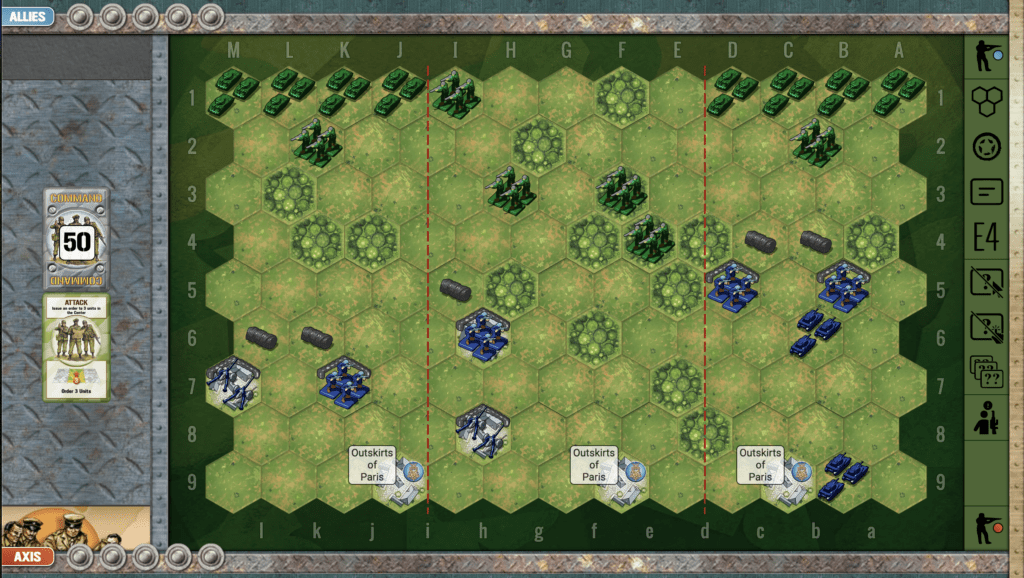
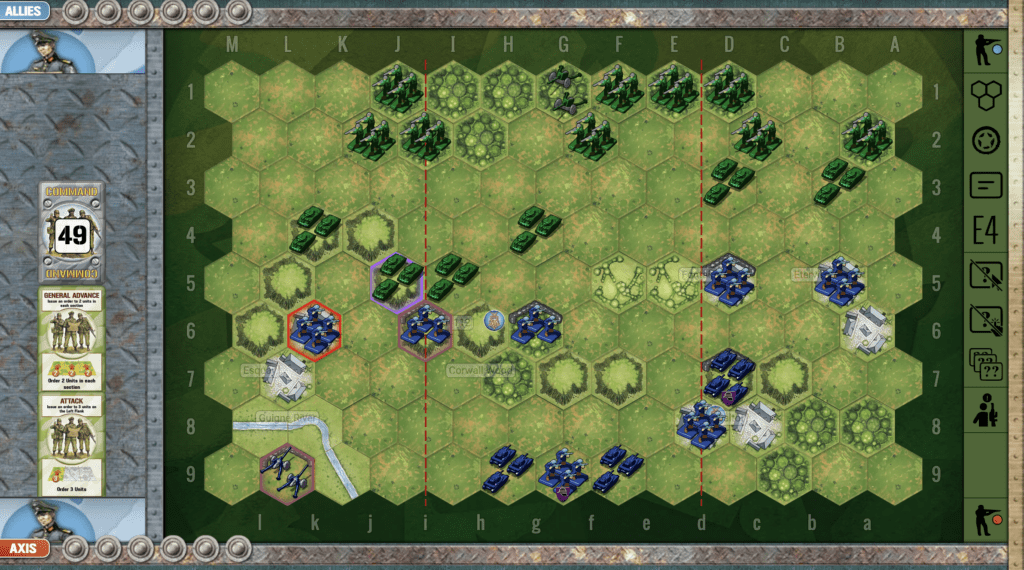
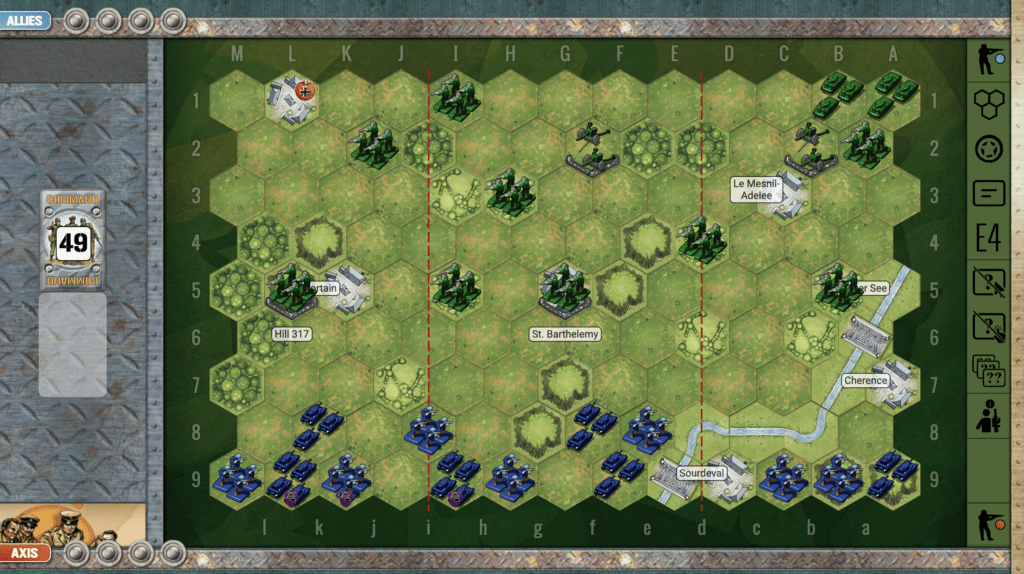
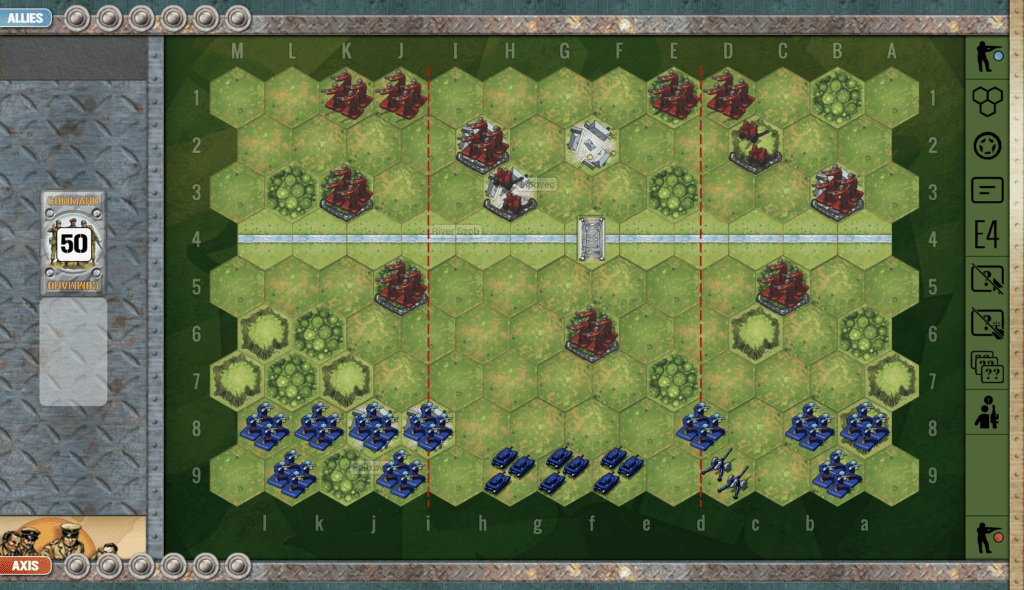
The battlefield has a ridge of hills on one flank, moving into the center.  There is also a set of hedgerows and a town hex right in the middle of the field. The Axis controls much of the board at the beginning of the round, while the Allies are pressed up against the back wall.

Troops:

Allied Strategy:

1. The Allies havae a significant armor advantage with six armor units vs. three for the Axis. Since you do have an armor advantage, make use of it, by getting your units out into the open field for battle where the long distance firepower of your tanks may prevail.

2. Watch out for the Axis artillery in the upper right flank. Although it is locked behind the Guigne River, its range controls much of the flank and part of the center flank.

3. Note that Hill 112 is an Allied medal objective. It is within range of a one-hex artillery attack. So if you grab the objective too early, the enemy will have time to chase you away. But if you time it right, it can be a late-game objective, to perhaps clinch the win.

Axis Strategy:

1. The Axis begin with control of much of the battlefield. If you can get your armor out into the middle of the field, you may perhaps be able to attack some of the Allied units while they are still up against the wall, and thus take advantage of their no-retreat situation.

2. You have an artillery unit trapped in the lower left flank behind the Guigne River. Use it whenever the enemy gets near the medal objective at h6.

11
BR - Hill 112

Author:

Days of Wonder

URL

Gates of Moscow (Typhoon)

Gates of Moscow (Typhoon)

scenario_GatesMoscow_start

Operation Typhoon was the German military campaign to capture Moscow during World War II, launched in early October 1941 as part of their broader invasion of the Soviet Union (Operation Barbarossa). The offensive aimed to deliver a decisive blow by taking the Soviet capital before winter set in.

German forces, under Field Marshal Fedor von Bock, advanced with two large army groups and made initial gains, encircling and destroying significant Soviet forces. However, stiff Soviet resistance, logistical challenges, and worsening weather slowed the German advance. Muddy conditions in October, followed by the onset of harsh winter, further hampered their progress.

By December ’41, the Germans thought they had Moscow in their grip—but Zhukov and his Siberian wolves had other plans. Hardened for winter, those Red Army troops stormed forward in a counteroffensive that drove the Wehrmacht off the city’s doorstep. It was the first time Hitler’s war machine got its teeth kicked in, proof that Blitzkrieg had limits when it slammed into a determined foe with steel in its spine and snow in its veins.

~~ General Howitzer

7 VP’s

Card Balance:

Allies – 5

Axis – 5

Complexity: 

4

Conditions:

Urban

Location:

Russia

Year:

1941

Theater:

Eastern Front

Campaign:

Barbarossa

Codename:

Operation Typoon

Summary:

The Gates of Moscow is a complex scenario which results in a brutal battle with many digital ‘casualties’ on both sides.

Objectives:

7 VP’s, including two Objective Medals for Axis

Terrain:

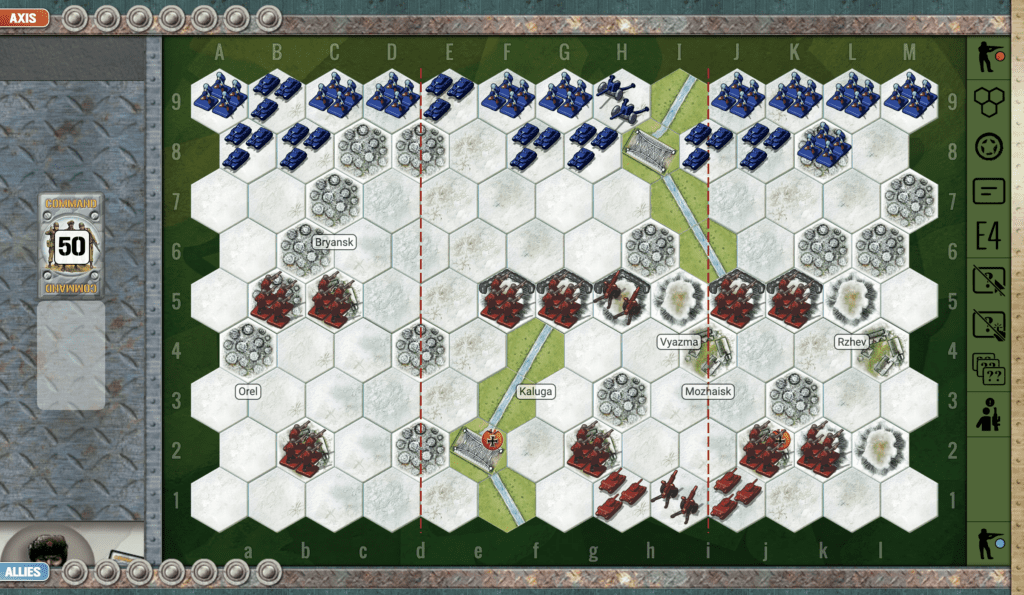
Frozen field with Kaluga river cutting vertically and a ridge of hills cutting across horizontally.

Troops:

Allies – 10 Infantry, 2 Armo, 2 Artillery

Axis – 10 Infantry, 8 Armor, 1 Artillery

Allied Strategy:

1. Big picture strategy for the Allies. This is a defensive scenario, so stay behind your sandbags and defend the two medal objectives.  Move your Artillery and Armor forward into the battle.

2.  Although there is a large Axis force massed against the Allies, the Axis side starts back against the game border. Allies can use this to their advantage, by turning retreat flags into deadly kills. Target the Axis forces which have no retreat available to them. This will increase your odds of a kill by another 17%. This increases the likelihood of an armor hit from 33% to 50%, and an infantry hit from 50% to 67%.

3.  Attack Vector Left Flank:  The enemy forces are congested. If you have a good set of cards, you can move in, and clear out many of the forces, including the armor.

Axis Strategy:

1.  Big picture strategy for Axis is to disperse your bunched-up troops and concentrate your forces on the front-line enemy to eliminate them as quickly as possible before they score too many hits against your forces.

2.  Keep pushing forward as you attack with the goal to eventually be to capture the bridge hex medal (often as a final decisive move to end the game).

3.  This is a long scenario of 7 medals, so you will have to take out the centrally located enemy Artillery. It is sand-bagged on a hill, but it needs to be attacked quickly.

4.  Beware of your armor trapped behind the row of trees on your right flank.  Do not try to take out the enemy infantry in the woods, because they will inflict heavy penalties on such an attempt.  Best option is to get them into the tree line and then out into the open for more fruitful attacks.


Battle Reports (percentage of Allied victories):

34%

(These are historical records. The poll on the right is new results.)

23
BR - Gates

Author:

Days of Wonder

Link:


Gallabat & Metemma

Gallabat & Metemma

The Battle of Gallabat and Metema was a significant engagement in the East African Campaign of World War II, taking place in February 1940. The battle occurred between Allied forces, primarily made up of British and Indian troops, and Italian forces in Ethiopia, near the borders of Sudan and Ethiopia.

General Howitzer summarizes:
We hit Gallabat hard in ’40, punched through and took the damn fort—looked like the start of a fine push into Italian turf. But they had the skies, and their bombers kept pounding us. With no cover from the air and stiff resistance on the ground, we had to pull back. Hell of a fight, but not every swing lands the knockout.

4 VP’s

Card Balance:

4 – 4

Complexity:

3

Conditions:

Countryside

Location:

East Africa

Year:

1940

Theater:

Mediterranean Theater

Campaign:

East Africa Campaign

Codename

Summary:

Objectives:

A short 4-medal game; no territorial medals.

Battlefield:

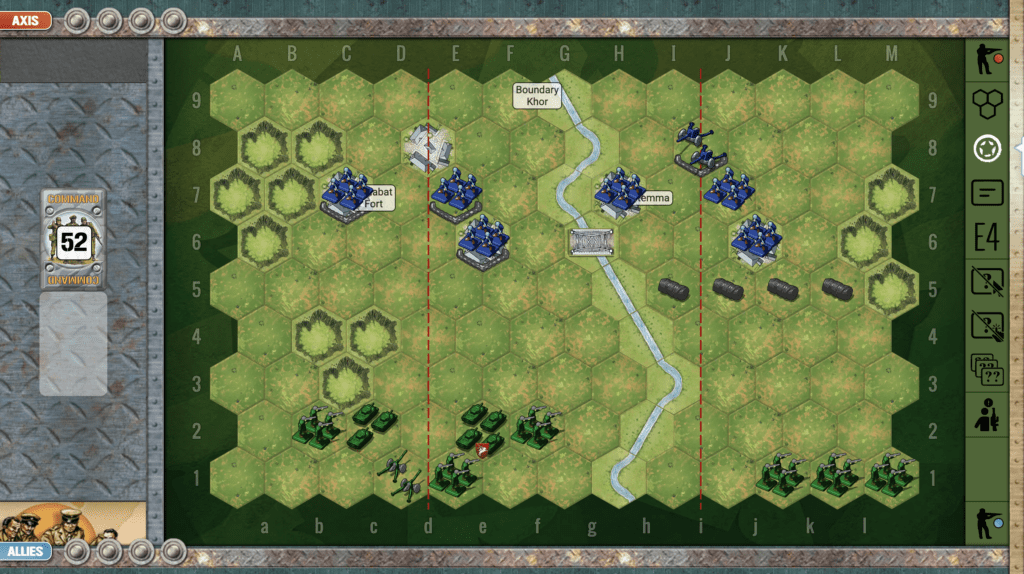
The Gallabat scenario has a river going down the center which seriously blocks troop movement between both sides. Therefore it is almost like two separate battles so plan your movements carefully.

Troops:

Allies 6 Infantry, 2 Armor, 1 Artillery

Axis – 6 Infantry, 1 Artillery

Allied Strategy:

1. For Allies, the troops on the right section should be moved into play only when you have enough movement cards to quickly get you next to the town for attack. The wire surrounding the town will decrease your attack power, so you will need a full set of cards to continue the attack.

2. You only need 4 medals to win. There are three heavily defended Axis units on the left side. With your armor and artillery, you should be able to weaken or destroy them, leaving just one unit medal to win on your right flank.

Axis Strategy:

1.  Your units are heavily defended with sandbags and town and wire protections. This should give you the time you need to assemble a collection of attack cards.

2. Your artillery is centrally-placed. If you can move it forward a bit, do it. Then use it well to take out any forces that attempt to approach your forces.

3.  Possible attack vector:  Your right flank is very weak as three Infantry units are no match for two enemy Armor, one Artillery, and three enemy Infantry. But your left flank has possibilities.  Although outnumbered three Infantry to two, if you can move your Artillery forward, and then get some good cards like Airpower or Barrage, you can weaken the three enemy Infantry.  Then you can move in and take some out. 

DoW Battle Reports (percentage of Allied victories):

59%

24
BR - Gallabat

Author:

Days of Wonder

Link:


Counter-Attack on Mortain

Counter-attack on Mortain

“Alright, boys—here’s the lowdown on that Axis stunt they called Operation Lüttich. Early August ‘44, the Germans thought they’d knock us back on our heels by punching through at Mortain, aiming to cut us off at Avranches and stop our drive into Brittany. Hell of a plan—if we were asleep!

They hit us hard at first, but we didn’t blink. Our boys dug in, held those lines with guts and grit. And don’t forget—our flyboys were on ‘em like hounds on a fox, raining steel and fire from the skies until those Nazis were howling for mercy.

The result? Germany’s counterattack went up in smoke—smashed, scattered, and thrown back with a hell of a lot of their tanks and men left behind in the dust. That’s the way to fight, boys—no retreat, no surrender, and always give ‘em hell!

~~ General Howitzer

4 VP’s

Card Balance:

Allies – 6

Axis – 5

Complexity:

3

Conditions:

Countryside

Location:

France

Year:

1944

Theater:

Western Front

Campaign:

Codename:

Operation Luttich

Summary:

As it was historically, the Allies are very well protected, and controlling most of the field of play.

Objectives:

4 VP’s, and one Objective Medal for Axis

Battlefield:

This scenario has a nice combination of hills, forests, and hedgerows scattered across the battlefield. There is also a river in one corner making it difficult for extra infantry and armor to engage in the war.

Troops:

Allies – 9 Infantry, 2 Armor, 2 Artillery

Axis – 7 Infantry, 6 Amor

Allied Strategy:

1. You have the advantage of terrain control, defensive positions in hedgrows, forests and towns. But you need to take advantage of it by quickly attacking where you can.

2. Your right flank is your weak one, being outnumbered by enemy forces, 5 to 2.  Use your infantry on Hill 317 to attack the no-retreat armor before it moves away.

3.  Note that as long as you have your forces on either of the two hexes of Hill 317, you can use any Recon (on the right) cards to call down Airpower attacks against the Axis. Use it, and bomb them back to Berlin!

4.  Then move your infantry in the back of the right flank forward into the town of Mortain to support your other infantry unit on the hill, and to box in the enemy even more than they are already.

5. If you have the movement points, you can place your infantry at I1 into the village to defend the Objective Medal.

6. Get your armor in your left corner into the action ASAP. If you can get over to the river before the enemy has moved into safety, you can score one or two VP’s by attacking them in their no-retreat positions.

Axis Strategy:

1.  Your forces on the left flank are bunched up, and you have a no-retreat armor ready to get hit by the infantry hidden in the woods. You need to create some mobility on your left and some of your troops into the woods to attack the enemy.

2. Your right flank is equally problematic. You are a sitting duck back against the border. So you need to get those troops into safety into the nearby towns, at least. Even better if you have the cards to move them out into the action. Or else when the enemy armor in the upper right flank becomes mobile, they will make their way down and easily destroy one or two units.

3.  It is going to be difficult to get all four VP’s, so you should target the Objective Medal in the village on your left flank. If your armor can survive the infantry attacks as you make your way there, it will be an important VP for you. 

4. You only need four Medals to win this scenario, and three of them are on your left flank, ready for the taking. Just take out the two Infantry units and roll into the town of St. Hilaire. 

Classic Battle Reports

(percentage of Allied victories):

39%

24
BR - Mortain

Author:

Days of Wonder

Link:

Counter-Attack of the BEF

Counter-Attack of the BEF

Counter-Attack of the BEF

Memoir 44 scenario Counter-Attack of the BEF

France, May ’40—Guderian cuts to the Channel and splits the front. Gort answers with a punch at Arras: Franckforce—Matildas and Durhams—drives south of the city, hits Rommel by surprise, scatters his cyclists, and rolls over light guns like they’re tin. Then Rommel does what winners do—drags up heavy artillery and 88s, fires direct, and stops the thrust. Dusk brings the Luftwaffe; the counterattack bleeds out. By nightfall the BEF falls back, and the only road left is the sea—Dunkirk.

Lesson: shock opens the door, but you hold it with guns and air. Mass your armor, keep your flanks covered, bring the big artillery, own the sky—and don’t stop moving.

~~ General Howitzer

VP’s

12

card

Card Balance

Allies – 6

Axis – 5

Complexity:

4

Conditions:

Countryside

countryside

Location:

France

Year:

1940

Theater:

Western

Campaign

Codename

Summary:

This scenario accurately reflects the difficult job the British had in 1940 to try to stop the Axis onslaught with a courageous Counter-Attack by the British Expeditionary Force (BEF).

medal allies

Allied Strategy:

1.  There are a couple of medal objectives available to you, just beyond the train tracks (row 8) at the towns of Agny and Wailly (row 11).  If you can position two of your forces within movement distance of both of them, you can set yourself up for a final medal capture and win.

2.  Attack Plan: do not cross the railroad tracks on row 8, until you have eliminated all enemy forces on row 7.  Just line up – with appropriate safety spacing – your Armor and Artillery and pick off the Infantry units on that row until they are gone. Deal with any enemy Armor that gets moved into the battle as well.

3.  It is going to be difficult to protect and hold control of the town of Arras at A9.  If you can get enough forces over there in time,  you may be able to put up a good fight.  But you will be in enemy territory the entire time, and it will be difficult to control.  You could consider either a strategic withdrawal, to preserve your Infantry unit, or stay and fight, attempting to take out as many enemy forces as possible before your demise.

4.  Your weak section is your right flank. With the enemy 88 Artillery in the woods, they present a formidable challenge to advance in that sector. You will need to deal with it first.  The way to do this is to get your Artillery unit in the region up to row 4 or 5. You will be out of reach of the 88, and will be able to pick it off. 

5.  Your Artillery units are too far back. Take every opportunity to move them forward.  

medal axis

Axis Strategy:

1.  You can actually win this one without crossing the railroad tracks on row 8. But the BEF must cooperate by attempting to come in for the kill. You can finish them off, and then save your final coup-de-grace for the Medal in the town at A9.

2.  Possible Attack Vector:  Target the town of Arras at A9, which has an Axis Temporary Medal Objective.  Start moving forces up in that direction. It will have two benefits of concentrating your firepower into one sector, and then after a successful destruction of the enemy in that region, you can capture the town of Arras – and hold it – for an additional medal. This attack plan could potentially yield two to three medals, maybe more.

3.  Your Armor is misplaced at the start of the battle. Take every opportunity to move it forward, so it can begin to attack across the railroad tracks at the enemy. 

Battle History Results

13
BR - CounterAttack of BEF

Author.

URL

Counter-Attack at Arras

Counter-Attack at Arras

Counter Attack at Arras

The Counterattack at Arras occurred on May 21, 1940, during the Battle of France in World War II. It was a British and French counteroffensive aimed at halting the rapid German advance during the Blitzkrieg.

Launched by British forces (the 1st Army Tank Brigade and elements of the 50th Infantry Division) and supported by French infantry, the attack targeted German positions around Arras, where General Erwin Rommel’s 7th Panzer Division was advancing. The Allies hoped to disrupt German momentum and relieve pressure on retreating Allied forces.

The counterattack initially achieved surprise, with British Matilda tanks proving highly effective against German anti-tank weapons. However, the Germans quickly regrouped, bringing in heavy artillery and air support to repel the attack. The Allies were eventually forced to withdraw due to superior German numbers and coordination.

General Howitzer summarizes the battle’s impact:
The counterattack didn’t win the day, but it sure kicked sand in the Germans’ gears and bought the time we needed to pull our boys out at Dunkirk. It was a hard lesson in early tank warfare—fast and mean, but still full of cracks if you knew where to hit.

Background

6 VP’s

Card Balance:

Allies – 6

Axis – 5

Complexity:

3

Conditions:

Countryside

Location:

France

Year:

1940

Theater:

Western Front

Campaign:

Battle of France

Codename:

Operation Frankforce

Summary:
This scenario has a set of hills on one flank, and a row of forests on the other flank, with a three-hex town in the center. It is around these obstacles that the battle ensues.

Objectives:

Six VP’s, so strategy comes into play; not just tactics.

Battlefield:

Countryside with the three-hex town of Arras in the center.

Troops:

Allies, 6 Infantry, 5 Armor, 1 Artillery;

Axis, 9 Infantry, 6 Armor,1 Artillery

Allied Strategy:

1.  Axis is very close to Agny, and may secure it quickly. So use your flanks to provide more lucrative avenues of attack. The ridgeline of trees on your left flank give your infantry, and especially your armor great cover to attack the enemy.  On your right flank, secure it with both infantry and armor. Don’t leave infantry behind.

2.  Move your artillery forward one row to have better hit strength on the entire town of Arras.

Axis Strategy:

1. Your Axis forces begin the scenario very close to Agny. Seize control of the town so that the enemy will have to pay dearly to gain it.

2. There is a path between the forest on your right flank. Seize the town at the end of it, to challenge any forces which may attempt to come through the pass. And as the cards allow, use it yourself to attack the enemy armor at the end of that pass.

3.  Move your artillery forward at least one row to gain more dominance in the center section.

4.  Remember that as Axis in this scenario, blitz rules are in effect, so you can use a Recon card to call in an airstrike against adjacent units. This is most useful in the beginning when the Allied forces are still lined up agains the back border. The Axis airpower only drops one dice per hex, but since it is a six VP game, this kind of softening up of the enemy in the beginning can pay dividends later on.

14
BR - Arras

Author:

Days of Wonder / RBorg

URL