TAKING CAMAIORE

TAKING CAMAIORE (BEF)

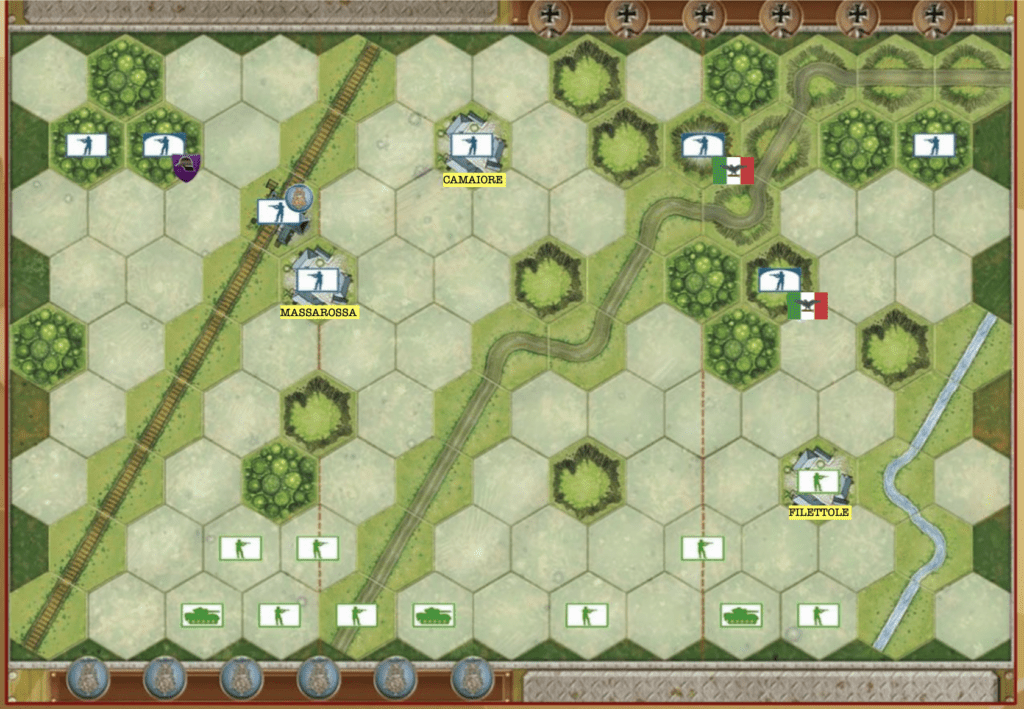
Once settled into their new environment, the FEB faced a baptism of fire on September 16 1944. With the support of 3 armored units of the US 5th Army, they took control of Massarosa and Camaiore, north of Pisa. This gave them access to an important network of roads and railways which served as an arterial supply route in the area. The challenge of maintaining the positions led to the Germans retreating further back into the mountains, to establish more efficient defences.

5 VP’s

Card Balance:
Allies – 4
Axis – 5

Complexity:

3

Conditions:  

Countryside

Context:

Historical

Location:

Italy

Date:

Sept. 16-18, 1944

Theater:

Western

Campaign:

Brazilian Expeditionary Force

Code Name

Context:

Historical

Summary:

Objectives:

5 VP’s, including Temporary Medal Objective

Battlefield:

Battlefield has a railway line, a road, and a river cutting through the field of play at an angle, making movement very interesting.

Troops:

Allies – 8 Infantry, 3 Armor

Axis – 8 Infantry

Allied Strategy

Axis Strategy:

Battle Reports:

0
BR - TAKING CAMAIORE

Author:

Icles Rodriquez & Memoir 44 Japan

Iwo Jima – The Meat Grinder

The Meat Grinder (Iwo Jima)

The “Meat Grinder” on Iwo Jima was not just a nickname—it was exactly what it sounded like. In February ’45, our Marines walked into a hornet’s nest of bunkers, tunnels, and artillery, all dug in by Japanese defenders who were ready to fight to the last man.

Every yard was paid for in blood. Concealed machine guns, artillery, and traps cut men down as they clawed forward. It wasn’t pretty, it wasn’t quick—it was steel against flesh, and the cost was high. But those Marines never quit. Day after day they smashed into that fortress, until finally the defenses cracked.

Taking the Meat Grinder was hell, but it was necessary. With it in our hands, the island opened up, and the road to victory on Iwo Jima was clear. It was proof again that American grit and guts could chew through anything—even the toughest rock the enemy could throw at us.

~~ General Howitzer

 7 VP’s

Card Balance:

Allies – 5

Axis – 5

Complexity:

3

Conditions:

Jungle


Context:

Historical

Location:

Iwo Jima


Year:

1945


Theater:

Pacific


Summary:

Objectives

7 VP’s

Battlefield:

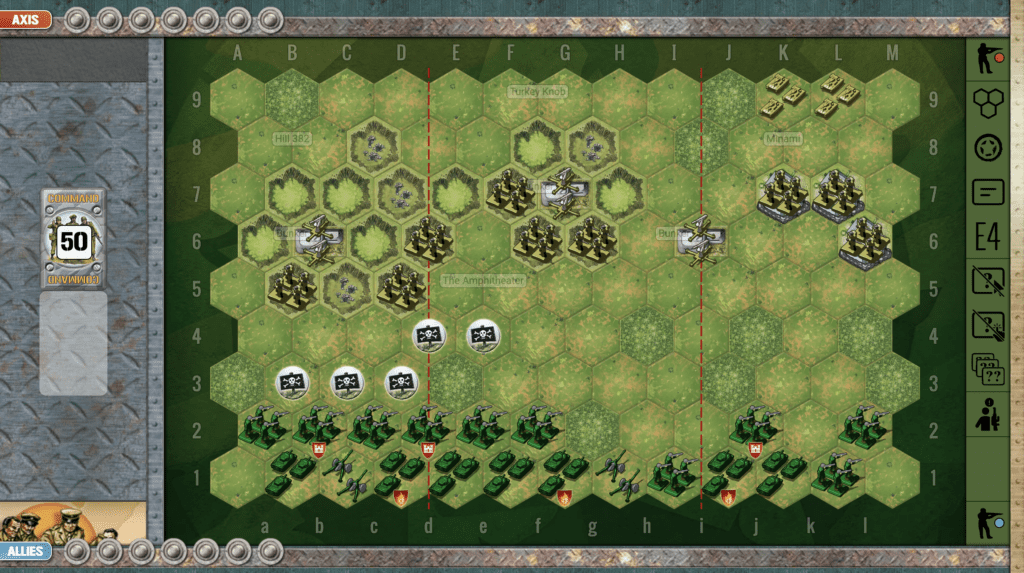
Island jungles and hills with caves, allowing for quick movement by Japanese

Troops:
Allies – 10 Infantry, 7 Armor, 2 Artillery 

Axis –  9 Infantry, 2 Armor, 3 Artillery

Allied Strategy:

1. Because the Engineers can avoid terrain restrictions during close assault, you need to quickly get them up to the sandbagged hills where the enemy are lodged, and dislodge them!

2.  Use your artillery to soften up the enemy before the assault.

3.  You need 7 VP’s to win, so you are going to have to address the artillery and deal with it.

4.  Your forces on the right and center sections are really bunched together. You need to get some early movement for your infantry, or they will be subjected to some no-retreat hits.

Axis Strategy:

1.  You are outnumbered in the center and right sections. Your left flank has more units than the enemy. If you can get your armor into position to defend the open terrain, it will make it difficult for the enemy to move approach.

2.  You outnumer the enemy with artillery, 3-2, so use it to soften up the enemy as they approach.

3. Make good use of your full-powered units through the Seishin Kyoiko Doctrine (SKD), to advance on the enemy and roll the extra dice to quickly knock them senseless.

Classic Battle Reports:

(percentage of Allied victories)

30%

22
BR - Iwo Jima

Author:

Link:

Breakthrough to Gembloux

Breakthrough to Gembloux

Historical Background

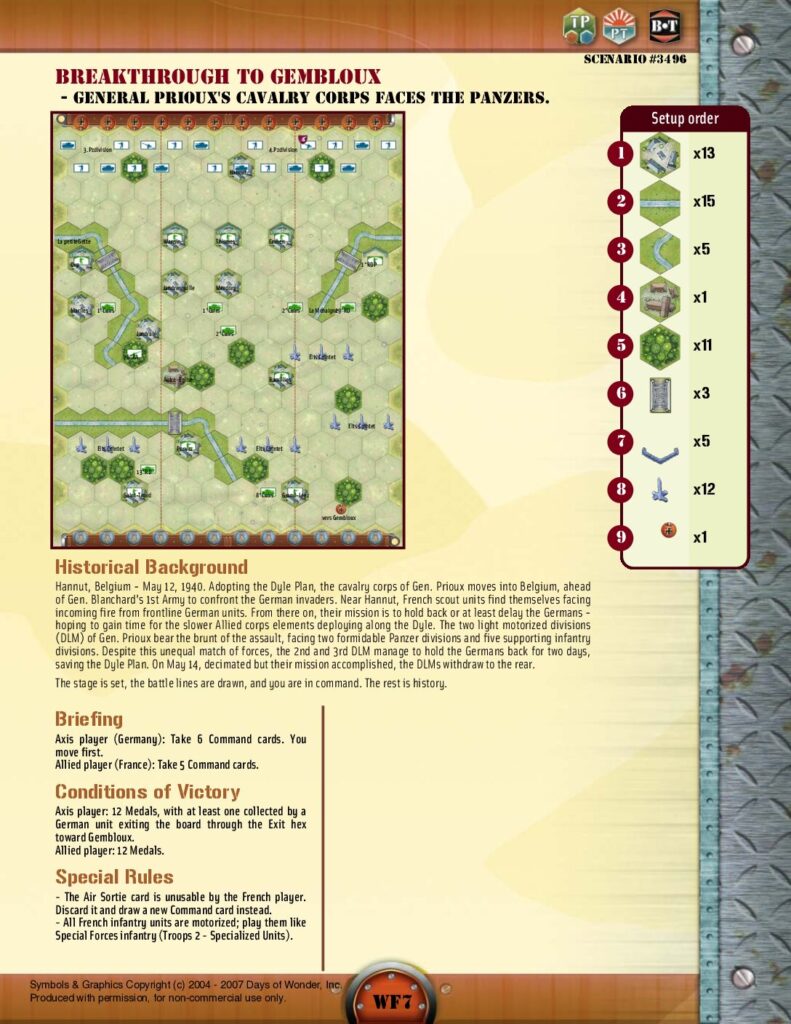
The Breakthrough to Gembloux was part of the early German invasion of Belgium during May 1940, in the larger Battle of France. German Panzer divisions advanced through central Belgium aiming to break Allied lines near Gembloux, where French forces had fortified positions in the so-called Gembloux Gap—one of the few tank-suitable areas in the region.

Fierce fighting erupted between German armored units and French mechanized divisions, resulting in one of the few early confrontations where French forces held their ground and inflicted significant tank losses. However, the battle was ultimately bypassed when German forces broke through further south in the Ardennes, rendering the defense of Gembloux strategically moot.

General Howitzer summarizes:

At Gembloux, the French finally stood their ground and gave the German Panzers a bloody nose—one of the rare times early in the war they didn’t fold. But while they were trading blows up north, the real storm came through the Ardennes. The fight was solid, but it ended up guarding the wrong damn door.

VP’s

12 VPs

Card Balance:

Allies – 5

Axis – 6

Complexity:

4

Conditions:

Countryside

countryside

Context:

Historical

Location:

France 

Date:

May 13, 1940


Theater:

Western

Campaign:

The Battle of France

Codename:

Summary:

Objectives:

12 Victory Points, plus one Exit by an Axis unit

Battlefield:

Deep breakthrough battlefield with countryside terrain

Troops:
Allies – 8 Infantry, 7 Armor, 1 Artillery

Axis –  10 Infantry, 8 Armor, 2 Artillery

Big Picture Strategy

The challenge for the Axis is escaping a unit out the Exit Hex at K1. 
Winning battle is easy; escaping the battlefield is not.

Allied Strategy:

1.  If you want to have any hope of holding out against the Germans, as the French did for two days historically, you will need to hold the line right at the beginning with the three towns on row 13.  Get your armor up their to reinforce your infantry.  The Axis have overwhelming force, so if you retreat, they will be able to pick you off one by one. Make your stand immediately!

2.  Once you get pushed back, the final victory medal for the Axis has to come through escaping on the hex at K1.  Guard that with your armor and infantry, and you have some hope of gaining another medal. 

3. While you may lose a lot of forces as the Axis pushes you back, be sure to have enough forces to make a good stand to guard the final exit hex at K1.  The Axis can be made to suffer much as they try to get one unit out that escape hex.  In fact, once Axis have achieved their 12 victory points,  you can sacrifice as many Allied forces as you need to in order to prevent them from escaping. 

Axis Strategy:

1.  Remember that no matter how many Allied units you destroy, you will have to get one of your units out the exit row at the end of the battlefield.

2.  The very best way to end the game well, and escape your final Axis unit off the board is to save up a Behind Enemy Lines. Then maneuver an infantry within six rows of the border, and make your move. 

Battle Reports:
(percentage of Allied victories)


5
BR - Breakthrough to Gembeloux

Author:

jdrommel

Link:

Withdrawal from Hill 112

Withdrawal from Hill 112

The Withdrawal from Hill 112 occurred during the Normandy Campaign in July 1944, following fierce fighting over the strategically important high ground near Caen. British forces, particularly the 43rd (Wessex) Infantry Division, had initially captured Hill 112 during Operation Jupiter (July 10–11), but the position became untenable due to intense German counterattacks, including the deployment of elite SS Panzer divisions.

General Howitzer:

Gentlemen, take a knee. Let me tell you about the grit it took to fight over a patch of real estate called Hill 112—a miserable piece of Norman countryside south of Caen that chewed up men and machines like a meat grinder.

The British and their armor locked horns with the damned Waffen-SS over this hill, not once, not twice—but for weeks. It wasn’t about the trees or the dirt—it was about elevation. Whoever held that hill could see the whole damn battlefield. The Tommies threw everything they had into it—Churchills, Cromwells, and a hell of a lot of courage.

They held it. Then they lost it. Then they bled to take it again.

But here’s the lesson, boys: sometimes the smart move isn’t holding ground—it’s bleeding the enemy dry while they try to take it. The British made Jerry commit his elite SS Panzer divisions there, keeping them pinned down while the Americans punched through elsewhere. And when the time came, they withdrew—not because they were beaten, but because the job was done. The Germans paid in blood for every inch.

That’s maneuver warfare. That’s using terrain like a blade. And that’s how you break the enemy’s back without breaking your own.

Dismissed.

6 VP’s

Card Balance:
Allies – 5
Axis – 6

Complexity:

3

Conditions:

Countryside

Location:

France

Year:

1944

Theater

Western Front

Codename:

Operation Epsom

Summary:

The primary feature of this battlefield is the Odon River running right through the center section. As it is impassable, it severly limits movement between the two half of the field. There are only two bridges allowing crossover, and they are both controlled by the Allies at the start of the game.

Objectives:
This is a six VP game, so attacks must be managed by positional advantages to protect against painful retaliation. The Axis also have an Objective Medal in the town at j2.

Battlefield:
The battlefield is countryside terrain with forests, hedgerows, and hllls, split down much of the middle by the Odon river. Because of only two bridges, mobility from one side of the field to the other is quite limited. Each set of troops for both sides will pretty much have to fend for themselves with little hope of getting assistance from the other side.

Troops:
This is an infantry and tank battle with no artillery for either side.
Allies have 8 Infantry and 4 Armor.
Axis have 8 Infantry and 6 Armor.

medal allies

Allied Strategy:

1. Because your armor are over-powered by enemy armor in each “half” (due to the Odon River), you will need to play your armor carefully. Open battle will likely result in your losses, just based on statistics of the dice roll and the overwhelming numbers of the enemy units. However, if you can hit his armor in the upper left flank while they are still pressed up against the wall, you will increase your hit rate by 17% due to the no-retreat situation they are in.

2. You have near control of the hills. Hold it with your height advantage to try to offset the enemy armor’s larger armored force.

3.  You will need to protect the town hex at i2, as it has a Temporary Medal Objective for the Axis.

medal axis

Axis Strategy:

1. The Axis begin this scenario with many of their forces crammed into a corner on the left flank. They are vulnerable to Allied attack, and their mobility is limited, without exposing them to further attack. The mission is to get the troops moving immediately to attack the enemy and create some breathing room for the forces.

2. Keep your infantry and armor as a cohesive fighting force. You will need your infantry to breach the hedgerows and towns, which your armor will soften up first.

3.  Your forces are out in the open, but there are many town, forest, and hill hexes which you can move to in order to launch a well-defended attack against the Allies.

4. It is going to be difficult to launch an attack in the middle as the Odon River splits your forces up, so you may need to move them to each flank to support operations in those areas. 

17
BR -Withdrawal Hill 112

Author

Link

Villers-Bocage

Villers-Bocage

The Battle of Villers-Bocage took place on June 13, 1944, during the Normandy Campaign in World War II. It was a significant tank engagement between British and German forces near the town of Villers-Bocage in France, shortly after the D-Day landings.

Listen up, men—this was no parade down the Champs-Élysées. The British 7th Armoured Division—the famed “Desert Rats”—thought they’d found a hole in the German line near Caen and charged in, hungry for glory. But out of the hedgerows came Michael Wittmann and his awesome Tigers, ambushing them in the narrow streets of Villers-Bocage. In minutes, British columns were burning wrecks—armor smashed, morale shaken.

But here’s the thing: Wittmann’s brilliance bought the Germans nothing lasting. The Rats pulled back, regrouped, and the Tigers couldn’t press the advantage. The town lay in ruins, but the campaign rolled on. Villers-Bocage stands as a brutal reminder—urban fighting is hell, and courage alone doesn’t win the day. You need discipline, coordination, and the will to keep moving forward, no matter what roars out of the fog.

~~ General Howitzer

VP’s: 

Allies – 3 medals

Axis – 5 medals

card

Card Balance:

Allies – 3

Axis – 6

Complexity:

3

Conditions:

Countryside

countryside

Location:

Normandy

Year: 

1944

Theater:

Western Front

Campaign:

Normandy Invasion

Summary:

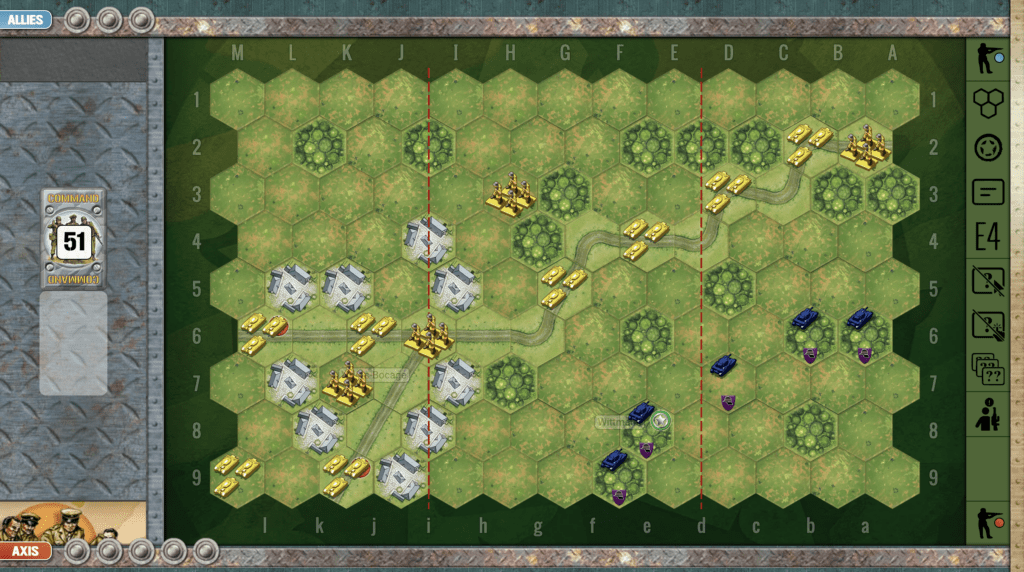
This scenario is really unique with the battle between the just five German Tiger tanks vs. 24! Allied tanks, 16 infantry figures. And yet the battle is fairly balanced.

Objectives:

Allies – 3 Medals

Axis – 5 Medals, including two permanent medal exit objectives 

Terrain:

Countryside with a road cutting across the battlefield at an angle

Troops:

Allies – 4 Infantry, 8 Armor

Axis – 5 Tiger Tanks

medal allies

Allied Strategy

1. The only way you can hope to win is by bunching up your forces. Do not try to take on a Tiger Tank, one at a time.

2.  Attack the units without forest protection first, as you will be able to roll triple the attack power.  

3.  You will need to force them out of the forest. Once they leave the forest hex, they cannot return.  So a one-two punch is the way to go. Your first tank forces can attack, and hopefully roll a Flag, which will force the enemy out into the open. Then your second tank forces can roll a 3D attack and hopefully secure a kill.

4. As long as the Axis forces stay in their woods for protection, you can backoff and move out of attack range, while you get the rest of your forces on your right flank organized and into action. 

medal axis

Axis Strategy

1.  Stay in the woods as long as you can, and keep attacking the enemy from there as long as they are in range.  Because the enemy can only roll one dice against you in the woods, the odds of them rolling a hit, and then a second dice with a grenade are exceedingly low.

2.  One of your Tigers is already out in the open, so plan on moving and attacking with that one first, but stay close to your other Tigers for support.  Do not venture into a forward position where the enemy can surround you from behind. 

16
BR - Villers

Author:

Days of Wonder

URL

Utah Beach

Utah Beach

The invasion of Utah Beach was part of the Allied D-Day landings on June 6, 1944, during World War II. Utah Beach was the westernmost landing area, assigned to U.S. forces, primarily the 4th Infantry Division, under Major General Raymond O. Barton. The objective was to secure the beachhead, push inland, and link up with airborne troops dropped earlier to capture key roads and bridges.

Strong currents caused some landing craft to drift about a mile south of the intended target area. This accidental landing proved advantageous, as it placed the troops in a less heavily defended section of the beach. The U.S. forces quickly overwhelmed the German defenses, suffering relatively few casualties compared to other D-Day beaches.

Listen up.

At Utah we hit fast, secured the sand, and drove inland until we shook hands with the paratroopers. That link-up turned a strip of beach into a springboard—men, guns, and fuel pouring ashore to feed the advance. With the beachhead anchored, momentum was ours. That’s how you start a liberation: seize, link, expand—and keep moving.

~~ General Howitzer

5 VP’s

Card Balance:

Allies – 6

Axis – 4

Complexity:

3

Conditions:

Beach

Location:

Normandy

Year:

1944

Theater:

Western Front

Campaign:

D-day Invasion

Codename

Summary:

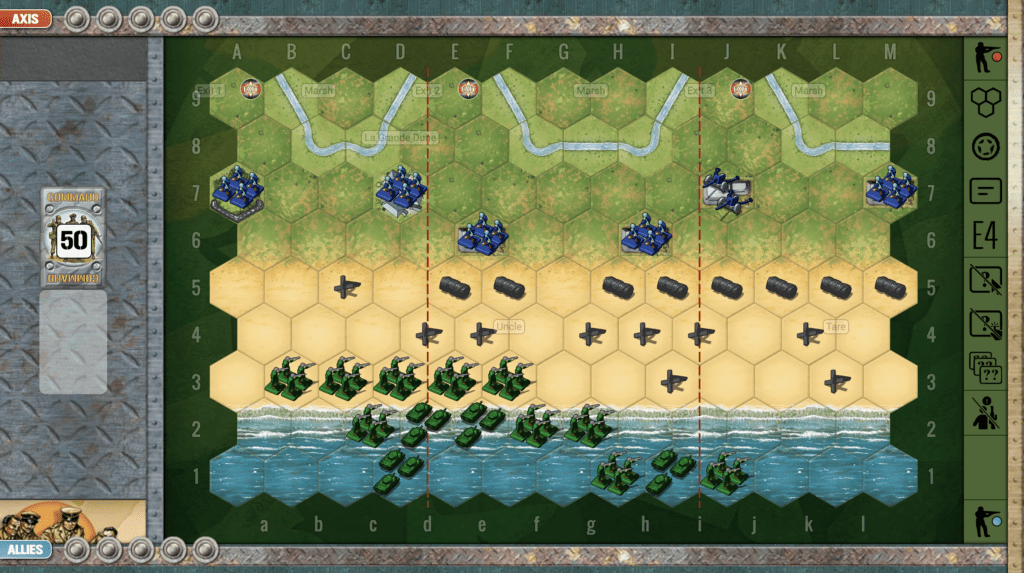
The challenge for the Allies in this scenario is to get off the beach as quickly as possible, and exit out one of the three exit hexes. The Axis are protected in towns and bunkers in order to slow down the advance of the Allies.

1. Objectives

This is a 5 VP game, so it moves rather quickly, and the Allies will need to minimize losses while they pick away at the Axis forces inside their bunkers, all the while making their way towards the exit hexes.

2. Battlefield

There are three exit hexes at the top of the battlefield. The Allies can seek two objectives: First to destroy enemy units, Second to exit out the back.

3. Troops

Allies – 10 Infantry, 4 Armor

Axis – 5 Infantry, 1 Artillery

Allied Strategy:

1. Allies begin with their forces congested together in the left and center sections. This is not all bad, as they need to stay away from the artillery in the right flank. But they do need to disengage their forces from one another and create some separation from the shores of the beach.

2. Keep attacking! As you approach the enemy forces in their bunkers, you may be tempted to pause and amass more forces for the attack. This depends on your circumstances. If you are out in the open and under enemy attack with two-dice attacks, you need to just keep attacking with those forces. Create the beachhead by continuing to attack, attack, attack.

3. You can expect to receive a fair number of casualties as you progress up the beach. But as soon as you get your armor out of the water, things will change for any enemy units unfortunate enough to be found outside their bunkers.

4.  The big picture strategy for Utah Beach is to: Stay Left, Take Out the Infantry, Escape out the back.  The scenario only needs 5 VP’s.  All five of those are available to you on the left and middle section.  Take out the three infantry for your first three points; then send two units out the escape hexes, and you are golden!

Axis Strategy:

1. The general rule for this scenario, is to stay in your bunkers! With no hilly ridge slowing the movement of the Allies onto the beach, they are able to very quickly reach your bunkers and begin attacking. If you make a fool-hardy rush forward in an attempt to knock out a few more figures, they will make you pay with an overwhelming retaliation of their forces. The only exception to this is your infantry unit in the bunker at M7 on your left flank. The Allies are going to avoid much of that section due to your artillery at J7, so it is best to get that unit into play in the central section as soon as you can. Also, there are so many wire bails in your left flank, that they will severely slow down any troops who try to come in there, allowing your artillery to demolish them.

2. The goal for Axis is to slow down their movement. Besides actual hits, retreat flags on the Allies are your friend, as it will push them back and give you more time to build up your deck with powerful attack cards. A last ditch effort, if needed would be to move your infantry onto or in front of the exit hexes, to prevent the Allies from escaping before you have given them a good beating.

3. Your one saving grace as the Axis player is your artillery. Use it as much as you can, especially while the enemy is still in the water, where retreat flags count as hits.

18
BR - Utah

Author:

Days of Wonder

Link: