Vassieux – Defensive Consolidation

What would you do as your first move?
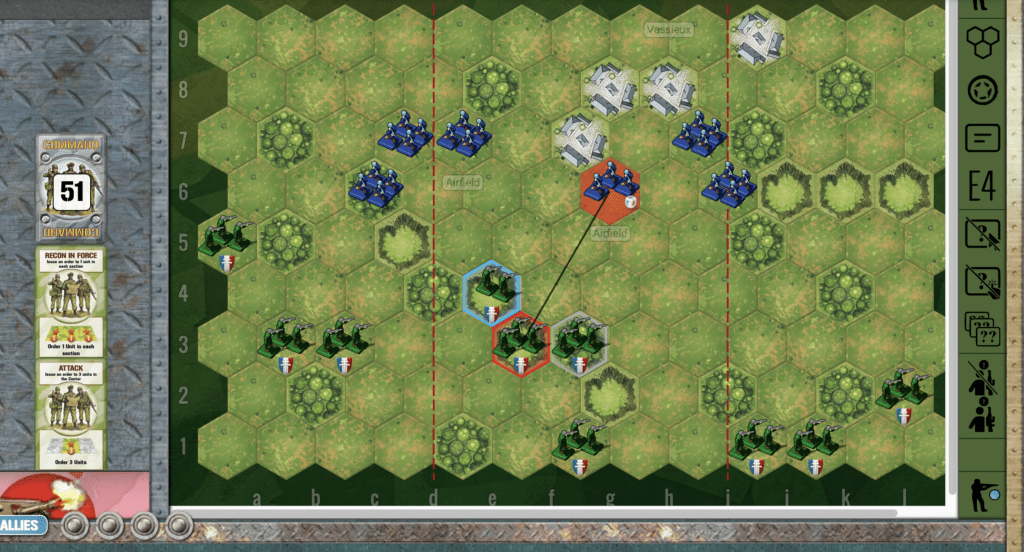
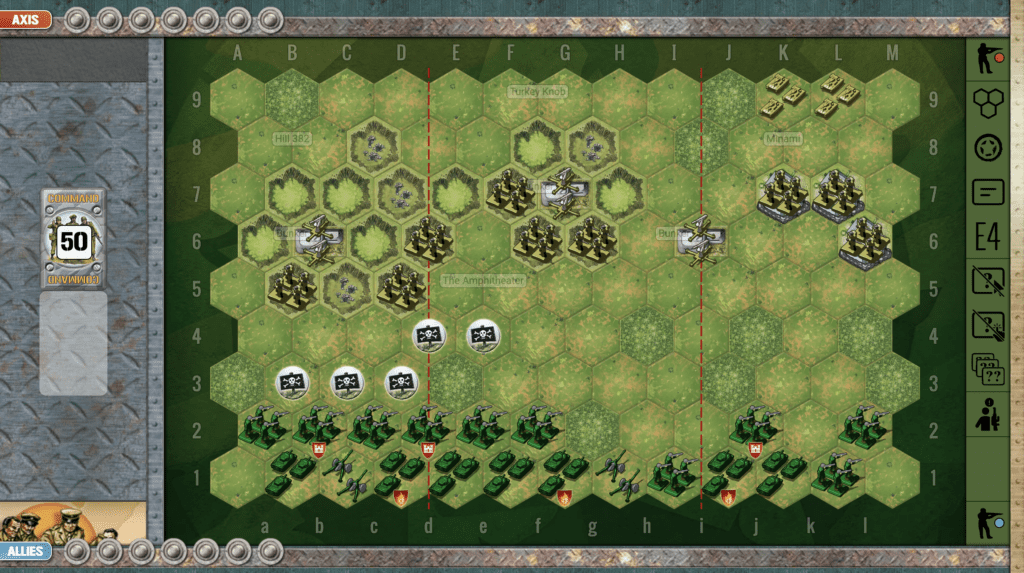
So my very first action as Allies, was to pull back my forces. The Axis were coming in hot with six hexes of infantry against my group of three. 

So I pulled back my already half-power infantry at d5 to the hill at E4. And my three-quarter power infantry at F4 to the hill at F3; and my third infantry which was actually only two hexes away from the enemy Infantry at G6, to the forest at G3.   
The end result was that all three of my infantry were able to make 1D attacks, resulting in only a loss for the enemy of 1 figure.  

But my forces were secure for the next enemy attack. And since I was outnumbered, I thought that placement in defensive positions on the hills and forest was the best spot from which to battle. 

Agree or Disagree? Do you think I should have moved forward and attacked, in the hopes of taking out one unit? Or backup and fight more slowly and less powerfully?

~~ General Howitzer.
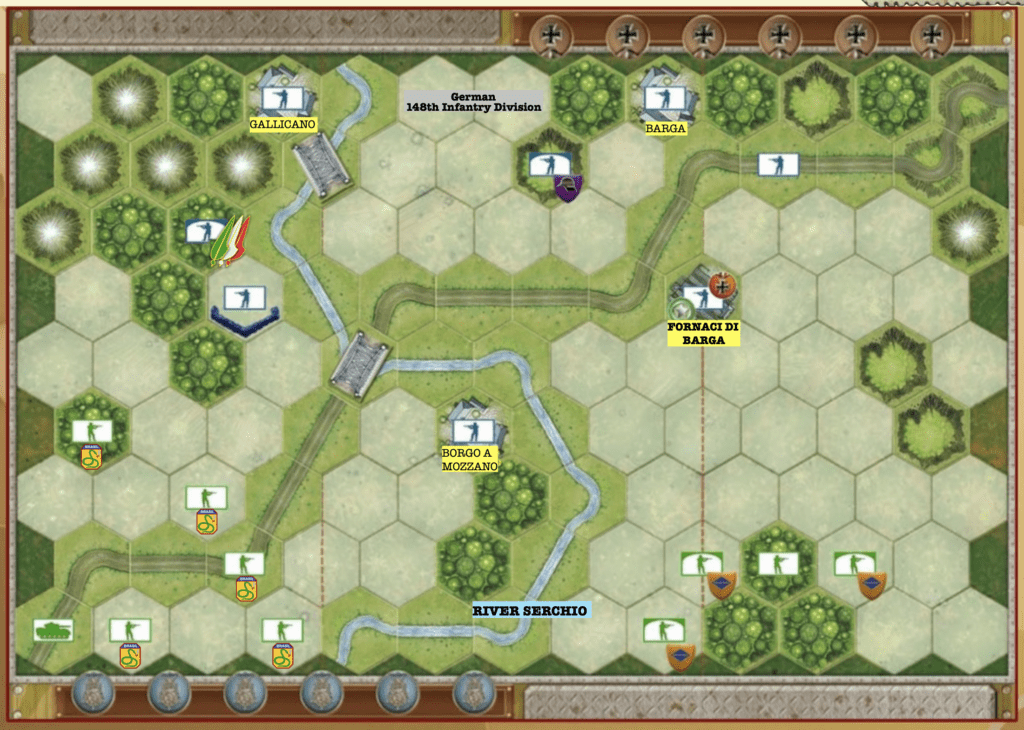
FROM BORGO A MAZZANO TO BARGA

From Borgo a Mazzano to Barga (BrEF)

After victories in the Massarosa, Camaiore and Monte Prana, the Brazilian troops were directed towards the village of Borgo a Mozzano. Aware in advance of the location and capabilities of the Germans in this stretch of the Gothic Line, the US command ordered the Brazilians to follow a course parallel to the Serchio River. While US troops proceeded on the opposite side of the river. By entering the Serchio River valley the FEB could avoid the expected German defences of the Gothic Line. It was discovered however that much of the line in that area had already been abandoned by the Axis, who had retreated about 9 miles to the north.

Further on, crossing the river, the FEB came across a factory of ammunition and aeronautical materials in Fornaci, which the Germans abandoned intact (but tried to recover in a counterattack.) The FEB then headed north to liberate Gallicano and Barga. In the process of doing this they clashed with the battle hardened veterans of the 148th German Division.

5 VP’s

Card Balance:
Allies – 5
Axis – 4

Complexity:

4

Conditions:  

Countryside

Context:

Historical

Location:

Italy

Date:

Sept. – Oct. 1944

Theater:

Western

Campaign:

Brazilian Expeditionary Force

Code Name

Context:

Historical

Summary:

Objectives:

5 VP’s

Battlefield:

Battlefield has a road and a river cutting across each other in an x-shape, with a couple of bridges.

Troops:

Allies – 9 Infantry, 1 Armor

Axis – 8 Infantry

Allied Strategy

Axis Strategy:

This scenario is something a little different. It’s an Axis tactical withdrawal across a bridge and then a regroup in a factory. A well deployed Behind Enemy Lines Card for the Axis can deliver a crushing blow on the Smoking Snakes on the Axis right flank. This can then be followed up with a dash across the bridge. [ Marcus Wallis ]

Battle Reports:

0
BR - BORGO

Author:

Icles Rodriquez & Memoir 44 Japan

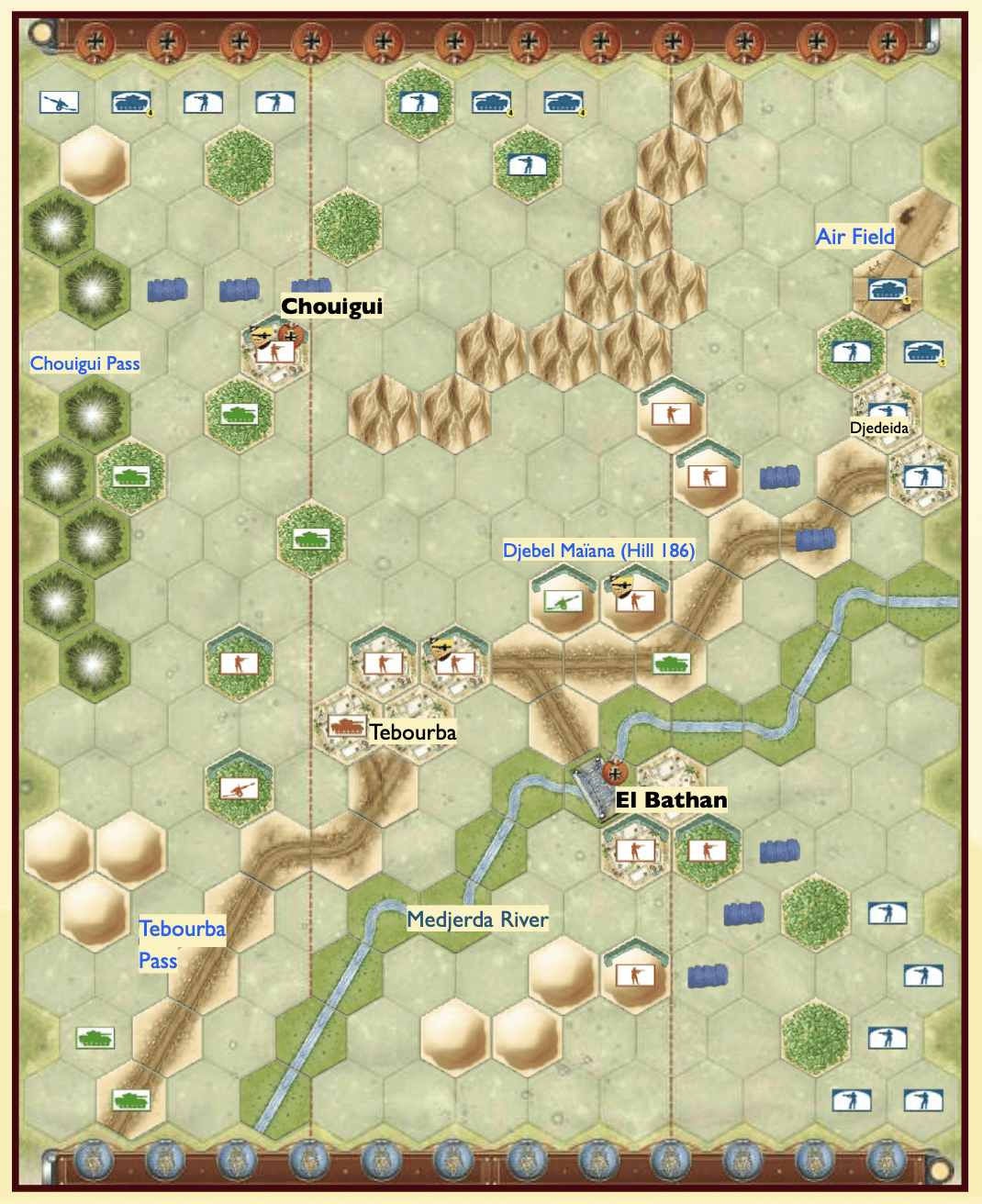
Battle of Tebourba

Battle of Tebourba (Tigerfibel)

On the November 28 1942, the US led Blade Force failed in its attack on the city of Djedeida.
However, the British controlled Tebourba, Djebel Maïana (Hill 186), the bridge on the Medjerda River, El Bathan and the village of Chouigui.
German Generalleutnant Wolfgang Fischer, commander of the 10th Panzer Division, was ordered to clear the threat on Djedeida.

Initially 3 Tigers and 4 Panzer III’s went into action in the Battle of Tebourba. They were later joined by 3 more Tigers on December 1 1942. By the time the Germans had won the battle on December 5 1942, the Allies, under General Kenneth Anderson, had lost 55 tanks, hundreds of vehicles, and more than 1000 troops had been captured. The Tigers had been devastating, and were responsible for knocking out most of the Allied tanks. The Allied troops were forced to evacuate Tebourba.

12 VP’s

Card Balance:
Allies – 6
Axis – 6

Complexity:

4

Conditions:

Context:

Historical

Location:

Date:

Nov/Dec 1942

Theater:

Western

Campaign:

Code Name

Context:

Historical

Summary:

Objectives:

12 VP’s

Battlefield:


Troops:

Allies – 

Axis – 

Allied Strategy

Axis Strategy:

Battle Reports:

0
BR - Tebourba

Author:

Memoir 44 Japan

( Download )

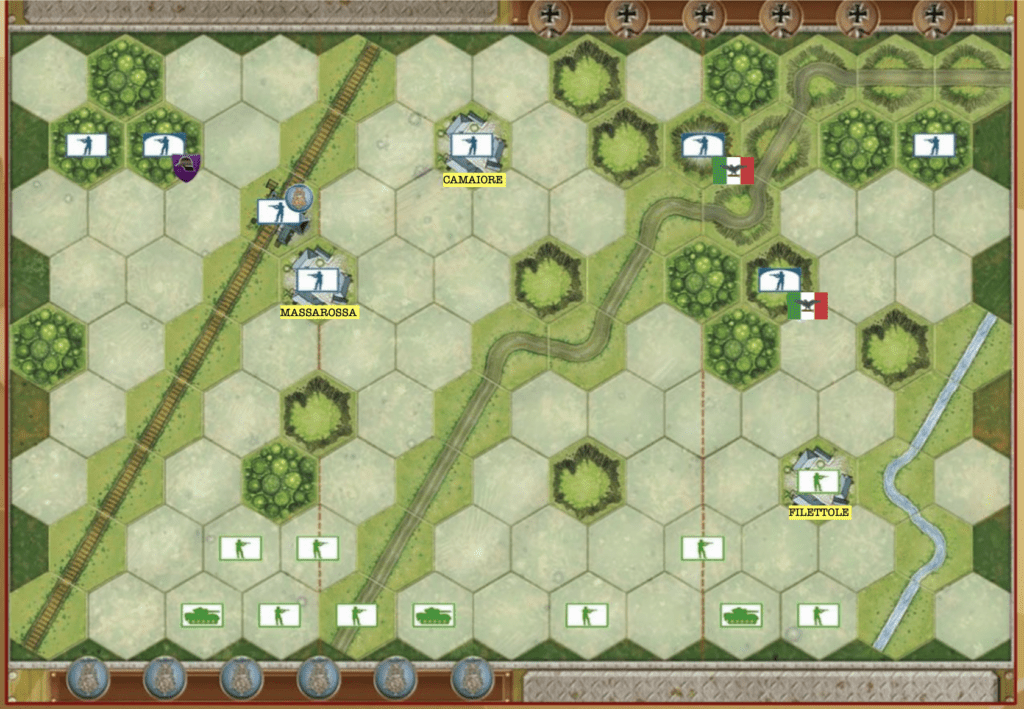
TAKING CAMAIORE

TAKING CAMAIORE (BEF)

Once settled into their new environment, the FEB faced a baptism of fire on September 16 1944. With the support of 3 armored units of the US 5th Army, they took control of Massarosa and Camaiore, north of Pisa. This gave them access to an important network of roads and railways which served as an arterial supply route in the area. The challenge of maintaining the positions led to the Germans retreating further back into the mountains, to establish more efficient defences.

5 VP’s

Card Balance:
Allies – 4
Axis – 5

Complexity:

3

Conditions:  

Countryside

Context:

Historical

Location:

Italy

Date:

Sept. 16-18, 1944

Theater:

Western

Campaign:

Brazilian Expeditionary Force

Code Name

Context:

Historical

Summary:

Objectives:

5 VP’s, including Temporary Medal Objective

Battlefield:

Battlefield has a railway line, a road, and a river cutting through the field of play at an angle, making movement very interesting.

Troops:

Allies – 8 Infantry, 3 Armor

Axis – 8 Infantry

Allied Strategy

Axis Strategy:

Battle Reports:

0
BR - TAKING CAMAIORE

Author:

Icles Rodriquez & Memoir 44 Japan

Iwo Jima – The Meat Grinder

The Meat Grinder (Iwo Jima)

The “Meat Grinder” on Iwo Jima was not just a nickname—it was exactly what it sounded like. In February ’45, our Marines walked into a hornet’s nest of bunkers, tunnels, and artillery, all dug in by Japanese defenders who were ready to fight to the last man.

Every yard was paid for in blood. Concealed machine guns, artillery, and traps cut men down as they clawed forward. It wasn’t pretty, it wasn’t quick—it was steel against flesh, and the cost was high. But those Marines never quit. Day after day they smashed into that fortress, until finally the defenses cracked.

Taking the Meat Grinder was hell, but it was necessary. With it in our hands, the island opened up, and the road to victory on Iwo Jima was clear. It was proof again that American grit and guts could chew through anything—even the toughest rock the enemy could throw at us.

~~ General Howitzer

 7 VP’s

Card Balance:

Allies – 5

Axis – 5

Complexity:

3

Conditions:

Jungle


Context:

Historical

Location:

Iwo Jima


Year:

1945


Theater:

Pacific


Summary:

Objectives

7 VP’s

Battlefield:

Island jungles and hills with caves, allowing for quick movement by Japanese

Troops:
Allies – 10 Infantry, 7 Armor, 2 Artillery 

Axis –  9 Infantry, 2 Armor, 3 Artillery

🔥 Winning as Allies

1. Because the Engineers can avoid terrain restrictions during close assault, you need to quickly get them up to the sandbagged hills where the enemy are lodged, and dislodge them!

2.  Use your artillery to soften up the enemy before the assault.

3.  You need 7 VP’s to win, so you are going to have to address the artillery and deal with it.

4.  Your forces on the right and center sections are really bunched together. You need to get some early movement for your infantry, or they will be subjected to some no-retreat hits.

🔥 Winning as Axis

1.  You are outnumbered in the center and right sections. Your left flank has more units than the enemy. If you can get your armor into position to defend the open terrain, it will make it difficult for the enemy to move approach.

2.  You outnumer the enemy with artillery, 3-2, so use it to soften up the enemy as they approach.

3. Make good use of your full-powered units through the Seishin Kyoiko Doctrine (SKD), to advance on the enemy and roll the extra dice to quickly knock them senseless.

Classic Battle Reports:

(percentage of Allied victories)

30%

Scales-Axis-Weighted
28
BR - Iwo Jima

Author:

Link: