Taukkyan Roadblock

Taukkyan Roadblock

Taukkyan-Roadblock

The Battle of the Taukkyan Roadblock? That was a brutal wake-up call in the jungles of Burma.

It was April 1942, and the British were pulling out of Rangoon, trying to stay one step ahead of a fast and ruthless Japanese advance. But they weren’t sitting back—they were moving like ghosts through the jungle, and they slammed a roadblock right down at Taukkyan, a vital choke point on the only damn road out.

It was a classic ambush—sliced right through the retreating columns. Trucks jammed, units scattered, and bullets flying like hellfire. The 17th Indian Division fought like lions to break through, but the jungle was tight, the fire was heavy, and the enemy was dug in and deadly.

A lot of brave men didn’t make it. That roadblock caused chaos, real chaos. It wasn’t just a firefight—it was the kind of sharp, surgical move that the Japanese were damn good at: fast, quiet, deadly. It wasn’t just a fight—it was a message.

The collapse at Taukkyan was a key reason why southern Burma slipped right through our fingers. It forced the Allies to fall back all the way into India. But mark my words—every inch we lost, we learned from. And when we came back, we came back with fire in our guts and iron in our fists.

~~ General Howitzer

5 VP’s

Card Balance:

Allies – 5 + 2 Combat Cards

Axis – 5 + 2 Combat Cards

Complexity:

3

Conditions:

Jungle

Context:

Historical

Location:

Burma

Year:

1939

Theater:

Pacific

Campaign:

Burma Campaign

Codename:

Summary:

Objectives:

5 VP’s

Battlefield:

Jungle with two intersecting roads, a roadblock, a village, and some hills.

Troops:

Allies  – 8 Infantry, 4 Armor

Axis (Japan) – 9 Infantry with some machine guns and anti-tank special weapons.


Allied Strategy:

1.  Big Picture: while you do not have to get through the roadblock, it does present a challenge for the British as a rallying point for the enemy.

2.  Before you attempt an Infantry attack, use your Armor units to attack the Japanese units at a distance, and reduce each unit by at least one figure, in order to eliminate their Seishin Kyoiku Doctrine power. 

3.  You have some powerful forces on your right section.  Get the Infantry moved forward and into the nearby jungle, so that the roadway is clear to allow your Armor to advance and get into the attack.

 Axis Strategy

1.  Big Picture Strategy:  with their special weapons of machine guns and anti-tank guns, plus the roadblock present a significant opportunity for the Japanese to hold off the Brits.

2.  Because of the British tanks, you cannot just stay behind your sandbags the whole time. They will slowly pick you off, and degrade your attack ability.  You will have to deal with the tanks, perhaps through specialized cards such as Barrage, Air Power, Behind Enemy Lines, or the Combat Card ‘Giretsu’, the Japanese BEL card. 

3.  With the right set of cards, and as long as most all of your forces are still at full ‘Seishin Kyoiku Doctrine’ strength, a full scale assault on your right flank could prove successful.   

Battle Reports

2
BR - Taukkyan

Author:

Days of Wonder

Link:

Guadalcanal [Overlord]

Guadalcanal

Guadalcanal. August ’42 to February ’43. The place where the tide started to turn in the Pacific—and where the United States Marine Corps showed the world exactly what American grit looks like.

The Japanese thought they were building themselves a nice little airfield to dominate the Solomon Islands and choke off our lifeline to Australia. Big mistake. We hit that island hard, landed the U.S. Marines, and made damn sure that airstrip—Henderson Field—was going to fly our planes, not theirs.

It wasn’t a cakewalk. It was jungle rot, mud, bugs, no sleep, and short supplies. The enemy threw everything they had at us—infantry assaults, air raids, naval bombardments. But we held. We bled. And we broke them.

By the time it was over, the Japanese were down thousands of men, ships, and planes. They’d lost their shot at controlling the Pacific, and we took the initiative. From then on, it was our war to win, and we were going to take it island by island, all the way to Tokyo.

Guadalcanal wasn’t just a battle—it was a message: The United States doesn’t back down. We plant our flag, we dig in, and we don’t leave until the job’s done.

~~ General Howitzer

13 VP’s

card

Card Balance:

Allies – 9

Axis – 7

Complexity:

5

Conditions:

Jungle

Context:

Historical

Location:

Solomon Islands

Year:

1943

Theater:

Pacific

Campaign:

Guadalcanal Campaign

Codename:

Operation Watchtower

Summary:

This is an Overlord game, so make use of the Jungle Command cards, two per side.

Objectives:

13 Medals including Territorial Control, and Exit Row medals and a sudden death hex all for the Japanese.

Terrain:

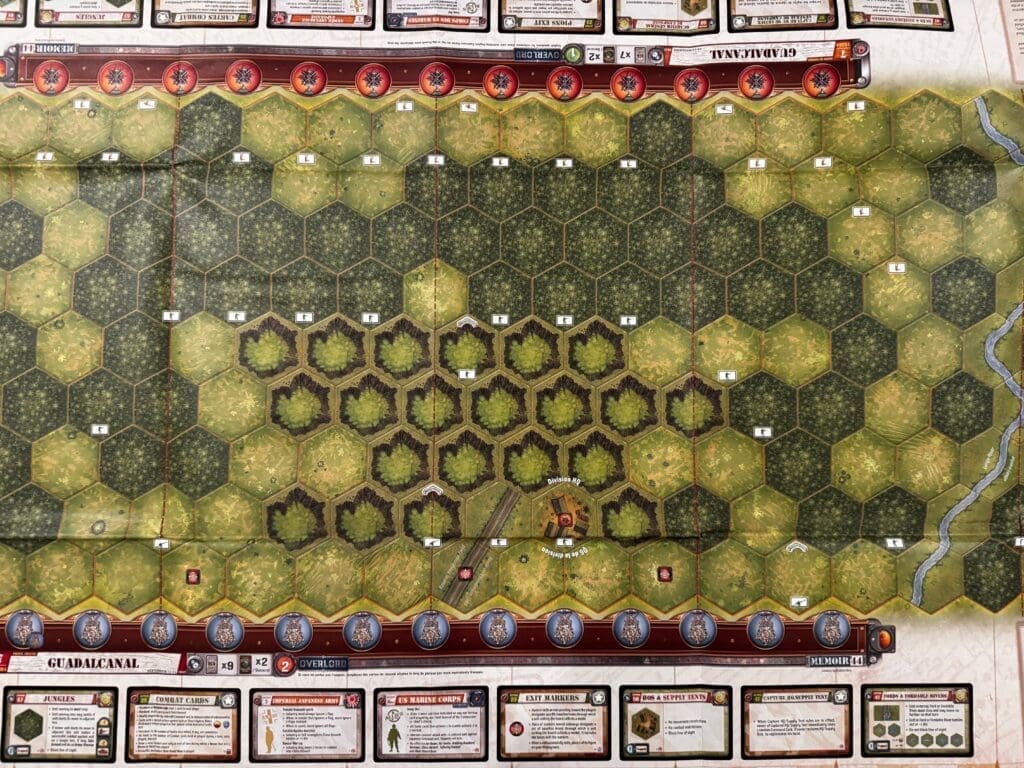
Jungle terrain with a 21-hex hill in the center which is a majority-control objective for one medal. 

Troops:

Allies – 21 Marine Infantry, 3 Artillery

Axis – 24 Japanese Infantry, 3 Artillery

Special Rules:

1. Majority  Temporary Territorial Control  – whomever controls most of the 21-hill hexes gains 1 Medal

2.  Exit Row Medals – to any Japanese forces that exit

3.  Sudden Death Hex – to any Japanese forces that maintain control of the hex at the start of their next turn, total win for the Japanese


medal allies 

🔥 Winning as Allies

1. Big Picture Plan when defending against the Japanese onslaught, is to reduce every full-power unit by at least one hit in order to cancel our their Seishin Kyoiku Doctrine. 

2.  Because of the special Rules, it is imperative that the Marines defende the center section, and prevent the Japanese forces from overwhelming the hill, to gain that point; or exiting out the back, to get those points, or most importantly, never let them gain access to the sudden death hex. 

medal axis

🔥 Winning as Axis

1.  Big Picture Strategy for Axis; while the flanks provide an excellent attack possibility, if you have the cards, they should always be considered secondary to your primary objective of overwhelming the 21-hex hill and gaining all the extra win points associated with it, and the exit hexes, and the sudden death hex.

2.  When given the opportunity on your flanks, move your forces towards the central section to continue to put pressure on the enemy and eventually overrun his position.

3
BR - Guadalcanal

Author:

Days of Wonder

Link:

Clearing Matanikau River

Clearing Matanikau River

scenario_ClearingMatanikauRiver_start

The Battle of the Matanikau River was a series of engagements during the Guadalcanal Campaign in late 1942, part of the Pacific Theater in World War II. The battles focused on clearing Japanese forces from the Matanikau River area on Guadalcanal to secure the perimeter around the strategic Henderson Field airbase, held by U.S. Marines.

In several operations between September and November 1942, U.S. Marines, supported by naval and aerial bombardment, launched attacks against well-entrenched Japanese positions along the river. These actions disrupted Japanese attempts to launch counterattacks against the American-held airfield.

General Howitzer’s summary:
We swept the jungle clean—rooted out every last Japanese fighter and locked down the western flank of Henderson Field. Those clearing fights weren’t just mop-up—they were the nail in the enemy’s coffin on Guadalcanal. That island was the start of our long march west, and by God, it was the turning point that broke their back in the Pacific.

5 VP’s

card

Card Balance:

Allies – 6

Axis – 5

Complexity:

2

Conditions:

Jungle

Context:

Historical

Location:

Gaudalcanal

Year:

1943

Theater:

Pacific

Campaign:

Guadalcanal

Summary:

Objectives:

5 VP’s

Terrain:

The Matanikau River cuts horizontally across the battlefield.

Troops:

Allies – 10 Infantry, 2 Artillery

Axis – 9 Infantry, 1 Artillery


medal allies

🔥 Winning as Allies

1.  Big Picture Strategy: your job is to clear the Matanikau River of all enemy belligerents.  This will require advancing across the river, but do not do so until your two Artillery units have softened up the enemy forces.  This primarily means to hit each unit at least once, thus eliminating the Seshin Kyoiku Doctrine with their powerful plus 1D attack powers.

2.  Once they have been sufficiently softened up, and you have the right card combination in hand for an attack, then advance and win! 

3.  Be aware that the enemy infantry on your left flank at a4 is both a danger and an opportunity: a danger, because they are close enough to attack and gain a tactical medal win;  but an opportunity, because they are trapped across the river, separated from their forces without a quick escape.

medal axis

🔥 Winning as Axis

1.  Big Picture Strategy: As you are outnumbered, this is primarily a defensive scenario for the Axis.  But if you can build up the cards to mount an attack in on one side, you should do it.  For example, your Infantry at a4 on your right flank is within striking distance of the enemy Artillery, if you had a Behind Enemy Lines card.

2. Be wary of the powerful Allied Artillery, which historically, was able to turn the tide in many engagements in the Pacific. Keep at least five hexes away from them until you are ready.

3. Make use of your Seishin Kyoiku Doctrine and the Banzai War Cry to overwhelm the enemy when they get too close.

Scales-Allies-Weighted
28
BR - Clearing Matanikau

Author:

Days of Wonder

Link:

Hlegu Burma

Hlegu Burma

Hlegu-Burma

The engagement at Hlegu in March 1942 was a minor yet notable skirmish during the British retreat from Rangoon amid the Japanese invasion of Burma in World War II.

As part of the broader Battle of Pegu, British forces, including the 7th Queen’s Own Hussars equipped with Stuart “Honey” light tanks, advanced toward Hlegu, only to find it occupied by Japanese troops who had established a roadblock. The Japanese defenders employed Molotov cocktails, successfully disabling one British tank. Despite this resistance, the British forces ultimately overcame the roadblock, forcing the Japanese to retreat under heavy fire. 

This encounter was part of a strategic effort by the British to delay the Japanese advance and facilitate the evacuation of Rangoon. Although the city fell shortly thereafter, the actions at Hlegu exemplify the determined resistance offered by British and Commonwealth forces during the challenging Burma campaign.

6 VP’s

Card Balance:

Allies – 6 + 2 Combat Cards

Axis – 4 + 2 Combat Cards

Complexity:

2

Conditions:

Jungle

Context:

Historical

Location:

Burma

Year:

1942

Theater:

Pacific

Campaign:

Codename:

Summary:

Objectives:

5 VP’s, plus a Sudden Death Exit Hex for the Allies.

Battlefield:

A jungle scenario with a road running vertically through the map, with a roadblock in the center.

Troops:

Allies – 8 Infantry, 3 Armor

Axis – 9 Infantry

Special Rules:

Roadblock Rules in “Hlegu, Burma”

According to the Terrain Pack Rulebook, roadblocks have the following effects:1j1ju

  • Movement: Only Infantry units may enter a hex containing a roadblock. Upon entering, the Infantry unit must stop and cannot move further that turn.

  • Combat:

    • A unit positioned on a roadblock hex is protected on all sides.

    • When attacked by Infantry or Armor, the attacking unit rolls one fewer Battle die.

    • Artillery attacks are unaffected; they roll their normal number of Battle dice.

    • A unit on a roadblock hex may ignore the first flag rolled against it.

  • Line of Sight: Roadblocks do not obstruct line of sight

medal allies

🔥 Winning as Allies

1. The Allies have a Sudden Death Exit Hex Objective Medal. If a unit begins the turn on the hex and exits, a victory is declared for the Allies. 

2.  You have Armor units, and the enemy has none.  Use them to good effect, but don’t get too close or they will hit you with Molotov cocktails.

medal axis

🔥 Winning as Axis

1. At all costs, defend the Exit Hex.

2.  The roadblock is your best chance to surround and destroy the enemy.  As they try to cross it, bring all your Infantry to bear against them.

Battle Reports

0
BR - Hlegu Burma

Author:

Days of Wonder

Link:

Burma Troops

Courtesy of Imperial War Museum

Payagyi Burma

Payagyi Burma

Payagyi-Burma

The Battle of Payagyi occurred in early March 1942 during the Burma Campaign of World War II. British forces, specifically ‘B’ Squadron of the 7th Queen’s Own Hussars, engaged Japanese troops near the village of Payagyi, north of Pegu. The British operated American-made M3 Stuart light tanks, while the Japanese fielded Type 95 Ha-Go light tanks.

Upon arrival, the British encountered Japanese forces already present in the village. Despite poor visibility and challenging radio communications, the British launched an attack. In the ensuing combat, they destroyed two Type 95 tanks, disabled two more, and captured four Japanese anti-tank guns. However, the British also suffered losses, including the disabling of a Stuart tank by enemy fire.

The Battle of Payagyi exemplifies the intense and fluid nature of the early stages of the Burma Campaign, highlighting the challenges faced by Allied forces in the face of the Japanese advance.

6 VP’s

Card Balance:

Allies – 6 + 2 Combat Cards

Axis – 4  + 2 Combat Cards

Complexity:

3

Conditions:

Jungle

Context:

Historical

Location:

Burma

Year:

1942

Theater:

Pacific

Campaign:

Burma Campaign

Codename:

Summary:

Objectives:

6 VP’s, plus the building hex as a  Temporary Medal objective for the Allied forces, and the bridge hex is a Last to Occupy Temporary Medal Objective for both sides.

Battlefield:

A jungle map with jungle, rice paddies, hills, and a river cutting across the entire map, and intersecting roads which come together at the bridge hex.

Troops:

Allies – 8 Infantry, 4 Armor

Axis – 9 Infantry, 3 Armore


medal allies

🔥 Winning as Allies

1.  The key objective for the Allies is to capture the bridge hex, and then as a bonus the building hex. 

2.  Your Armor is back on the left flank. You will need to get it into action as soon as you can. This will be hampered by the river,so while some may breach the river, some other Armor units will need to head toward the road in the center to support the approach and capture of the bridge hex, and its accompanying Medal.

medal axis

🔥 Winning as Axis

1.  The Axis begin the scenario with control of the building hex and its Last to Occupy Temporary Objective Medal.  Maintain this territory, and push to the Bridge Hex Medal Objective when you are ready. But do not do so prematurely, or your forces will be destroyed by the British counter-attack.

2.  Your Armor is stuck in the corner on the right flank. You will need to get them and the nearby Infantry up into the action right away.

Battle Reports

0
BR - Payagyi Burma

Author:

Days of Wonder

Link:

Indian-Troops-17th-Division-Payagyi-1945

Courtesy of National Army Museum

Battle of Bataan

Battle of Bataan: Abucay Line

Scenario_Battle-Bataan_setup

On January 7th, 1942 Japan invaded the Philippines. Under orders from General MacArthur American troops and their allies retreated to a defensive line that stretched from Mt. Bataan to the China Sea. The American troops, although outnumbering Japan, were of mixed quality and had low morale. After three months of hard fighting and with American supplies dwindling, the line broke and thousands of American troops were forced to surrender.

6 VP’s

2 victory metals are placed at the bottom of the American line. Japanese units who make it to the hexs between the metals count as a victory point and are moved to the Japanese players victory stand.

Card Balance:

Allies – 5

Axis – 6

For the Air Power card Japan will roll 2 dice and America will roll 1

Complexity:

2

Conditions:

Jungle

Context:

Historical

Location:

Year:

1942

Theater:

Pacific Theater

Campaign:

Codename:

Summary:

Requires base Memoir ’44 and Pacific Theater Expansion. Imperial Japanese army command rules are in effect. Marine rules are in effect for units marked with the Marine emblem. Units marked with Chindits emblem are Philippino guerilla fighters and follow same rules as French resistance.

Objectives:

This is a six VP scenario, with Medal Objectives

Battlefield:

Jungle

Troops:

(There is no indication from the author of the troop deployments.)

Allies – 

Axis –     

Allied Strategy:

Axis Strategy:

Author:

Fan Creation

Link: