Counter-Attack of the BEF

Counter-Attack of the BEF

Counter-Attack of the BEF
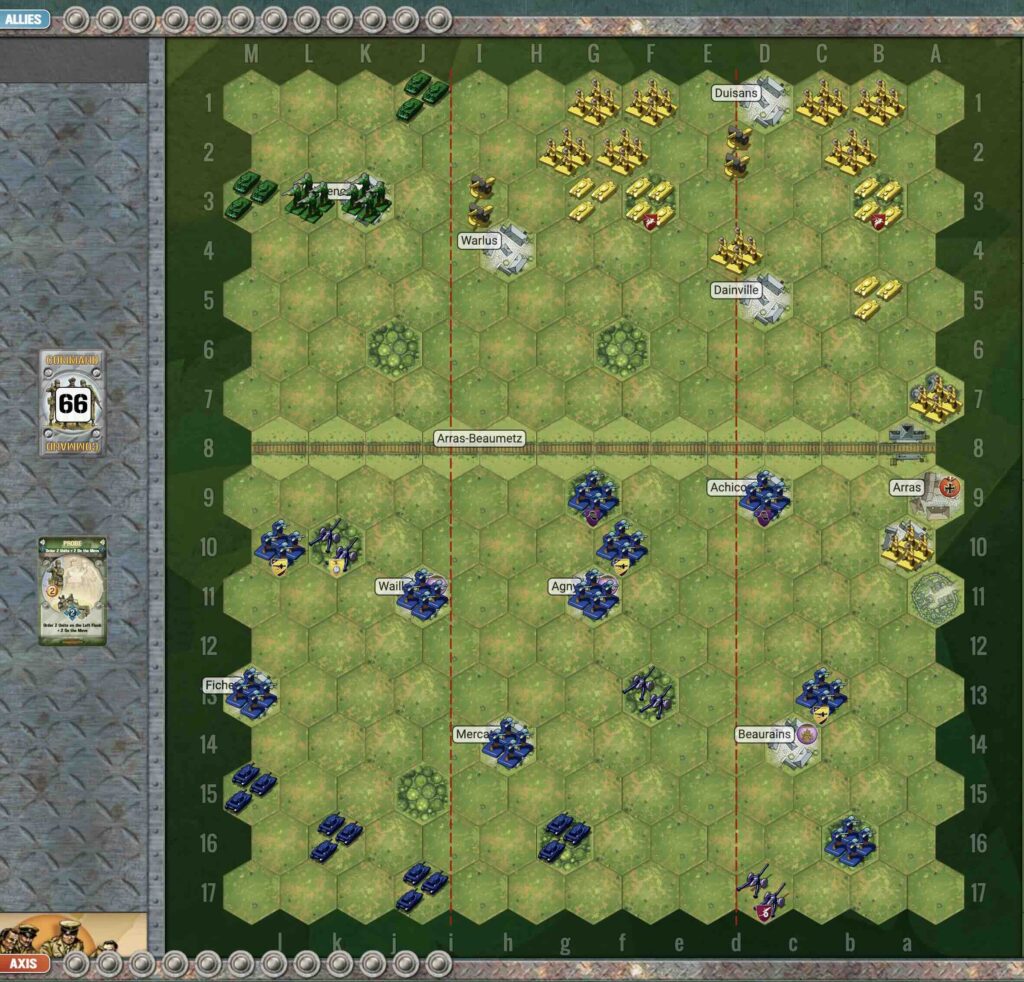
Memoir 44 scenario Counter-Attack of the BEF

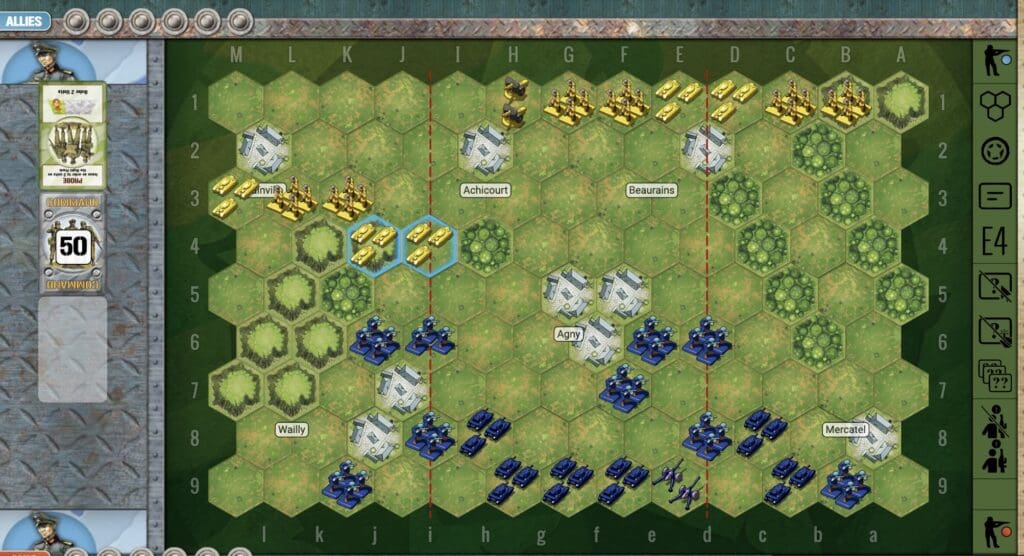
France, May ’40—Guderian cuts to the Channel and splits the front. Gort answers with a punch at Arras: Franckforce—Matildas and Durhams—drives south of the city, hits Rommel by surprise, scatters his cyclists, and rolls over light guns like they’re tin. Then Rommel does what winners do—drags up heavy artillery and 88s, fires direct, and stops the thrust. Dusk brings the Luftwaffe; the counterattack bleeds out. By nightfall the BEF falls back, and the only road left is the sea—Dunkirk.

Lesson: shock opens the door, but you hold it with guns and air. Mass your armor, keep your flanks covered, bring the big artillery, own the sky—and don’t stop moving.

~~ General Howitzer

VP’s

12

card

Card Balance

Allies – 6

Axis – 5

Complexity:

4

Conditions:

Countryside

countryside

Location:

France

Year:

1940

Theater:

Western

Campaign

Codename

Summary:

This scenario accurately reflects the difficult job the British had in 1940 to try to stop the Axis onslaught with a courageous Counter-Attack by the British Expeditionary Force (BEF).

medal allies

🔥 Winning as Allies

1.  There are a couple of medal objectives available to you, just beyond the train tracks (row 8) at the towns of Agny and Wailly (row 11).  If you can position two of your forces within movement distance of both of them, you can set yourself up for a final medal capture and win.

2.  Attack Plan: do not cross the railroad tracks on row 8, until you have eliminated all enemy forces on row 7.  Just line up – with appropriate safety spacing – your Armor and Artillery and pick off the Infantry units on that row until they are gone. Deal with any enemy Armor that gets moved into the battle as well.

3.  It is going to be difficult to protect and hold control of the town of Arras at A9.  If you can get enough forces over there in time,  you may be able to put up a good fight.  But you will be in enemy territory the entire time, and it will be difficult to control.  You could consider either a strategic withdrawal, to preserve your Infantry unit, or stay and fight, attempting to take out as many enemy forces as possible before your demise.

4.  Your weak section is your right flank. With the enemy 88 Artillery in the woods, they present a formidable challenge to advance in that sector. You will need to deal with it first.  The way to do this is to get your Artillery unit in the region up to row 4 or 5. You will be out of reach of the 88, and will be able to pick it off.

5.  Your Artillery units are too far back. Take every opportunity to move them forward.

medal axis

🔥 Winning as Axis

1.  You can actually win this one without crossing the railroad tracks on row 8. But the BEF must cooperate by attempting to come in for the kill. You can finish them off, and then save your final coup-de-grace for the Medal in the town at A9.

2.  Possible Attack Vector:  Target the town of Arras at A9, which has an Axis Temporary Medal Objective.  Start moving forces up in that direction. It will have two benefits of concentrating your firepower into one sector, and then after a successful destruction of the enemy in that region, you can capture the town of Arras – and hold it – for an additional medal. This attack plan could potentially yield two to three medals, maybe more.

3.  Your Armor is misplaced at the start of the battle. Take every opportunity to move it forward, so it can begin to attack across the railroad tracks at the enemy.

Battle History Results

13
BR - CounterAttack of BEF

Author.

URL

Counter-Attack at Arras

Counter-Attack at Arras

Counter Attack at Arras

The Counterattack at Arras occurred on May 21, 1940, during the Battle of France in World War II. It was a British and French counteroffensive aimed at halting the rapid German advance during the Blitzkrieg.

Launched by British forces (the 1st Army Tank Brigade and elements of the 50th Infantry Division) and supported by French infantry, the attack targeted German positions around Arras, where General Erwin Rommel’s 7th Panzer Division was advancing. The Allies hoped to disrupt German momentum and relieve pressure on retreating Allied forces.

The counterattack initially achieved surprise, with British Matilda tanks proving highly effective against German anti-tank weapons. However, the Germans quickly regrouped, bringing in heavy artillery and air support to repel the attack. The Allies were eventually forced to withdraw due to superior German numbers and coordination.

General Howitzer summarizes the battle’s impact:
The counterattack didn’t win the day, but it sure kicked sand in the Germans’ gears and bought the time we needed to pull our boys out at Dunkirk. It was a hard lesson in early tank warfare—fast and mean, but still full of cracks if you knew where to hit.

Background

6 VP’s

Card Balance:

Allies – 6

Axis – 5

Complexity:

3

Conditions:

Countryside

Location:

France

Year:

1940

Theater:

Western Front

Campaign:

Battle of France

Codename:

Operation Frankforce

Summary:
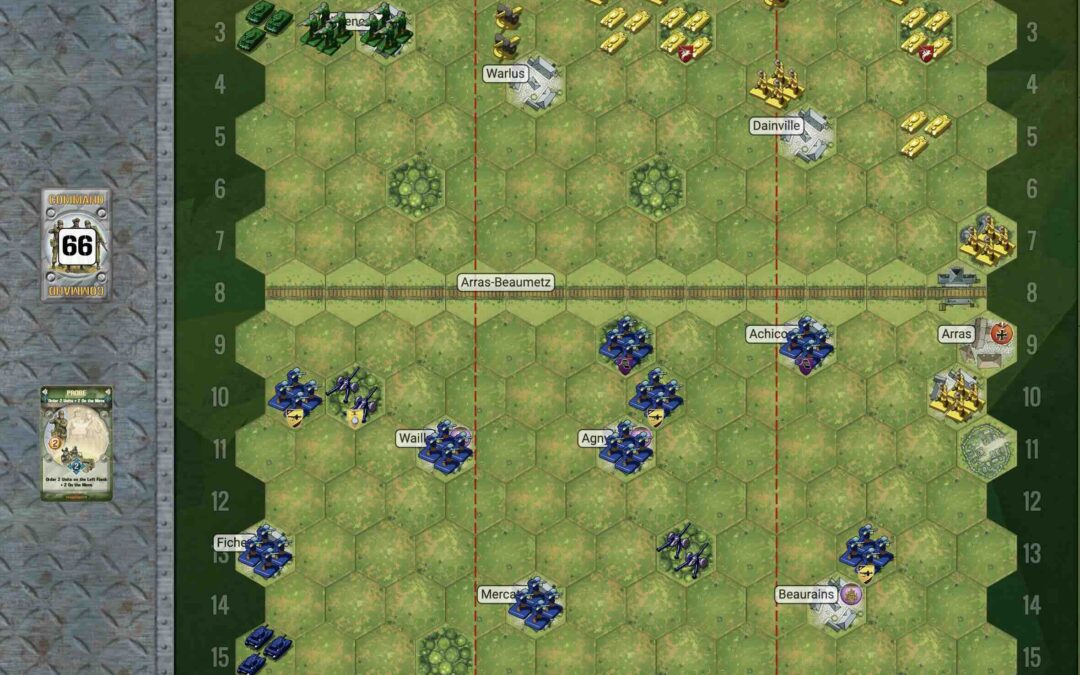
This scenario has a set of hills on one flank, and a row of forests on the other flank, with a three-hex town in the center. It is around these obstacles that the battle ensues.

Objectives:

Six VP’s, so strategy comes into play; not just tactics.

Battlefield:

Countryside with the three-hex town of Arras in the center.

Troops:

Allies, 6 Infantry, 5 Armor, 1 Artillery;

Axis, 9 Infantry, 6 Armor,1 Artillery

🔥 Winning as Allies

1.  Axis is very close to Agny, and may secure it quickly. So use your flanks to provide more lucrative avenues of attack. The ridgeline of trees on your left flank give your infantry, and especially your armor great cover to attack the enemy.  On your right flank, secure it with both infantry and armor. Don’t leave infantry behind.

2.  Move your artillery forward one row to have better hit strength on the entire town of Arras.

🔥 Winning as Axis

1. Your Axis forces begin the scenario very close to Agny. Seize control of the town so that the enemy will have to pay dearly to gain it.

2. There is a path between the forest on your right flank. Seize the town at the end of it, to challenge any forces which may attempt to come through the pass. And as the cards allow, use it yourself to attack the enemy armor at the end of that pass.

3.  Move your artillery forward at least one row to gain more dominance in the center section.

4.  Remember that as Axis in this scenario, blitz rules are in effect, so you can use a Recon card to call in an airstrike against adjacent units. This is most useful in the beginning when the Allied forces are still lined up agains the back border. The Axis airpower only drops one dice per hex, but since it is a six VP game, this kind of softening up of the enemy in the beginning can pay dividends later on.

Scales-Axis-Weighted
22
BR - Arras

Author:

Days of Wonder / RBorg

URL

Matanikau River (Guadalcanal)

Matanikau River

scenario_Matanikau_start

The battle near the Matanikau River in 1942 was a key engagement during the Guadalcanal Campaign in the Pacific Theater of World War II. It involved several clashes between the United States Marines and Imperial Japanese forces as the Marines sought to secure their perimeter around Henderson Field, a critical airstrip on Guadalcanal.

Listen up. September to November ’42, the Matanikau was the hinge of Guadalcanal. The enemy tried to shove our Marines into the sea; our answer was simple—cross the river, hit hard, and keep hitting. We used infantry up front, artillery and naval guns on call, and fighters overhead to hammer every position that dared resist. Result: their strength bled away, our foothold stiffened, and the initiative swung to us. Lesson—seize the crossing, smash the flank, keep air on the target, and don’t stop until the island is yours.

~~ General Howitzer

5 VP’s

Card Balance:

Allies – 6

Japanese – 6

Complexity:

3

Conditions

Location:

Guadalcanal

Year:

1942

Theater:

Pacific Theater

Campaign

Summary:

This scenario is pretty much an infantry battle with a bit of artillery support.

Objectives:

Five VP’s, plus Exit hexes

Battlefield:

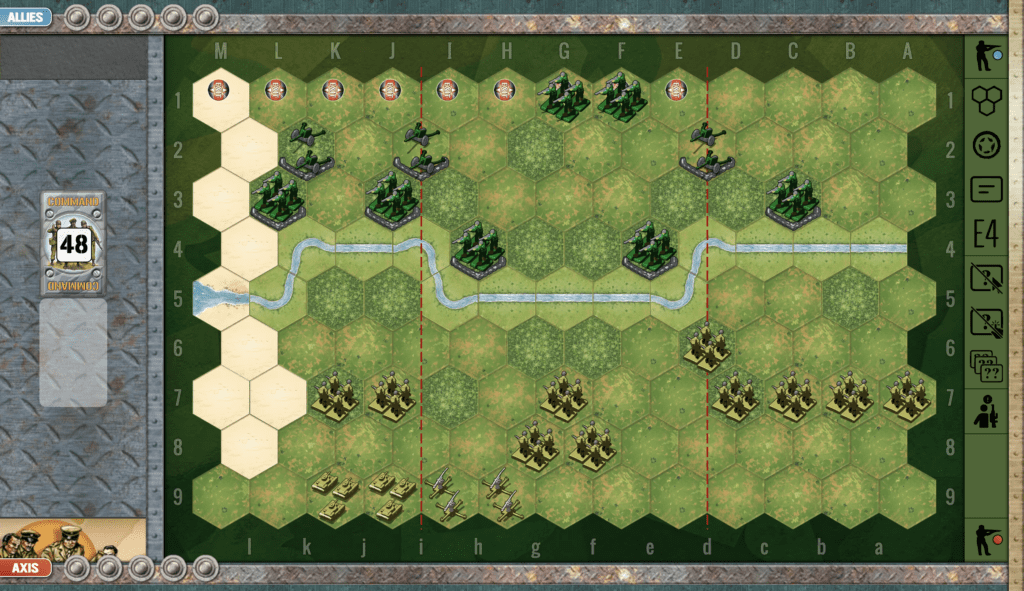
The Matanikau River cuts across the battlefield and presents a challenge for both forces as they try to maneuver and attack one another. And there are series of beach hexes along one flank which provides a rapid transit path for attacks.

Troops:

Allies – Infantry 7, Artillery 3

Axis – 10 Infantry, 2 Armor, 2 Artillery

🔥 Winning as Allies

1.  Your forces are outnumbered by the Japanese, so unless you have the cards for it, stay behind the sandbags.

2.  You have three artillery, so use them whenever you can.

3.  Protect the backrow from any Japanese forces that may try to escape.

4.  Remember that as Marines, you get the ‘Gung Ho’ advantage, so every section card allows you to move one extra unit than the card states. Remember that advantage, and use it – you will need it.

🔥 Winning as Axis

1.  You have a strong presence on the right flank. If you get the cards, you should push forward and take control.

2.  If you are able to advance all the way across the battlefield, you may be able to help some troops escape.

3.  You have armor and the Allies do not, so move them in and make them feel your firepower!  Armor are good candidates for escape across the back line. So if you move in close, you may be able to attack and then escape.

4.  You also have two artillery, so if you can move them forward,  you will be able to throw 2D attacks across the river.

Battle Reports (percentage of Allied victories):

67%

Scales-Allies-Weighted
26
BR - Matankau

Author:

Days of Wonder

Link:

Capturing the Crossing

Capturing the Crossing

scenario_CapturingTheCrossing_start

“Capturing the Crossing” refers to a World War II battle during the Normandy campaign, focused on securing a key bridge over the Odon River in late June to early July 1944.

Brief Summary:

  • Context:
    Part of Operation Epsom, launched by British forces to outflank Caen and push westward. The Odon River valley was a natural defensive barrier held by the Germans.

  • The Battle:
    British units, fought to capture and hold the bridge crossings over the Odon River.  German SS Panzer divisions mounted fierce counterattacks to repel the advance and regain control.

  • Tactics:
    The British used coordinated infantry, armor, and artillery to secure the crossings under heavy fire and poor weather conditions. Engineers rushed to reinforce and repair bridges under fire.

  • Outcome:
    British forces successfully captured and held key crossings, enabling a bridgehead south of the Odon. However, they faced continued German resistance and did not achieve a full breakthrough.

  • Significance:
    The battle was part of the slow Allied grind toward Caen, tying down German armor and paving the way for later operations like Goodwood and Cobra.

General Howitzer’s Summary:

“Boys, let me tell you about the push across the Odon in the summer of ‘44. It was part of Operation Epsom, the British aiming to outflank Caen and punch westward. The Odon River valley was no picnic—it was a natural fortress that the Germans, including those damn SS Panzer divisions, were ready to die defending.

The British didn’t flinch—they threw in everything they had: infantry, tanks, artillery, and those hard-as-nails engineers. They fought like devils in the mud and the rain, grabbing those bridge crossings under heavy fire and refusing to let go.

The Germans counterattacked like rabid dogs, but the British held firm. They didn’t smash through to Caen, but they sure as hell got a bridgehead south of the Odon, and that put Jerry on the back foot. That bridgehead was the key to bigger things—Goodwood and Cobra wouldn’t have happened without it.

So remember, men: sometimes it ain’t about the breakthrough—it’s about digging in, holding on, and bleeding the enemy dry!

6 VP’s

Card Balance:

Allies – 6 

Axis – 5

Complexity: 3

Conditions:

Countryside

Context:

Historical

Location:

France

Year:

1944

Theater:

Western Front

Campaign:

The Battle for Caen

Codename:

Operation Epsom

Summary:

Objectives:

6 VP’s, and a territorial objective medal for the Allies

Terrain:

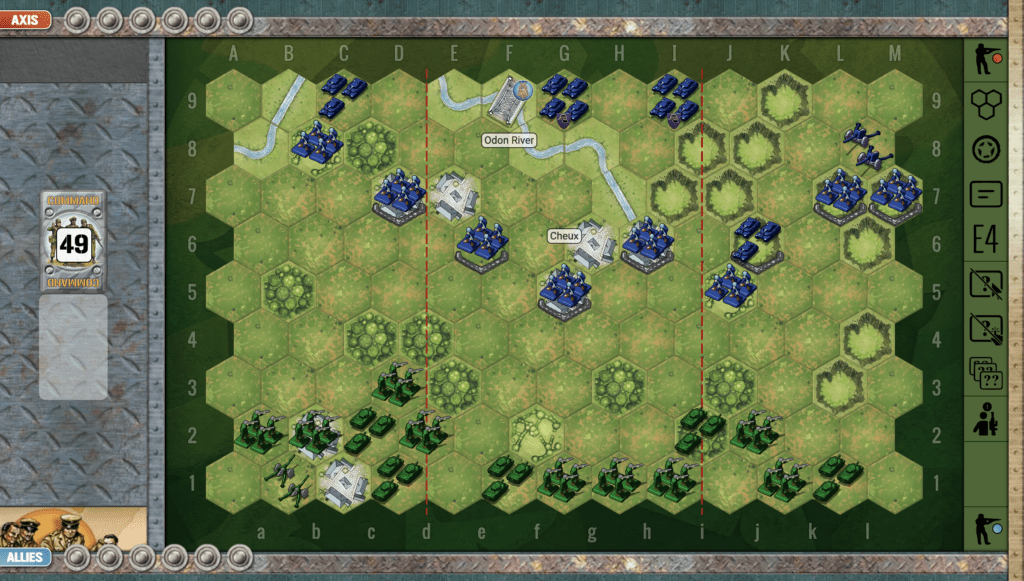
Countryside with forests, hills, some villages and the Odon River.

Troops:

Allies – 9 Infantry, 5 Armor, 1 Artillery

Axis – 8 Infantry, 4 Armor, 1 Artillery

medal allies

🔥 Winning as Allies

1.  Your left flank is strong. Your right flank is weak. The center section is more balanced. You have a bit more firepower, but the enemy has well protected Infantry in hedgerows.  You will need to take up secure positions in the woods facing the enemy and begin to degrade their defensive positions before you launch a frontal attack.

2.  Your artillery in the left corner should be moved forward into the nearby town to increase its effectiveness.

3.  Be aware that an armor battle from your position at L3 to j6 is likely to be lost due to the fact that the enemy Armor is sandbagged. You will need to bring in your additional Armor at i2 into the fray to even out the battle.


medal axis

🔥 Winning as Axis

1.  The Odon River presents a mobility challenge for the armor units behind it, forcing them to angle to the left flank or cross the bridge before they can engage the enemy in the center or right flanks. You will need to get them mobile as soon as you can.

2.  The enemy has you at a disadvantage with slightly more Infantry and Armor, and one additional card, thus increasing their responsiveness.  You will need to compensate with strategic care and precision, and not waste resources on ill-conceived attacks.

3.  Your right flank is weak. Your left flank is strong. The center section is a little more balanced. Allies have a bit more firepower, but your sandbagged infantry will be hard to dislodge.

11
BR - Capturing the Crossing

Author.

URL

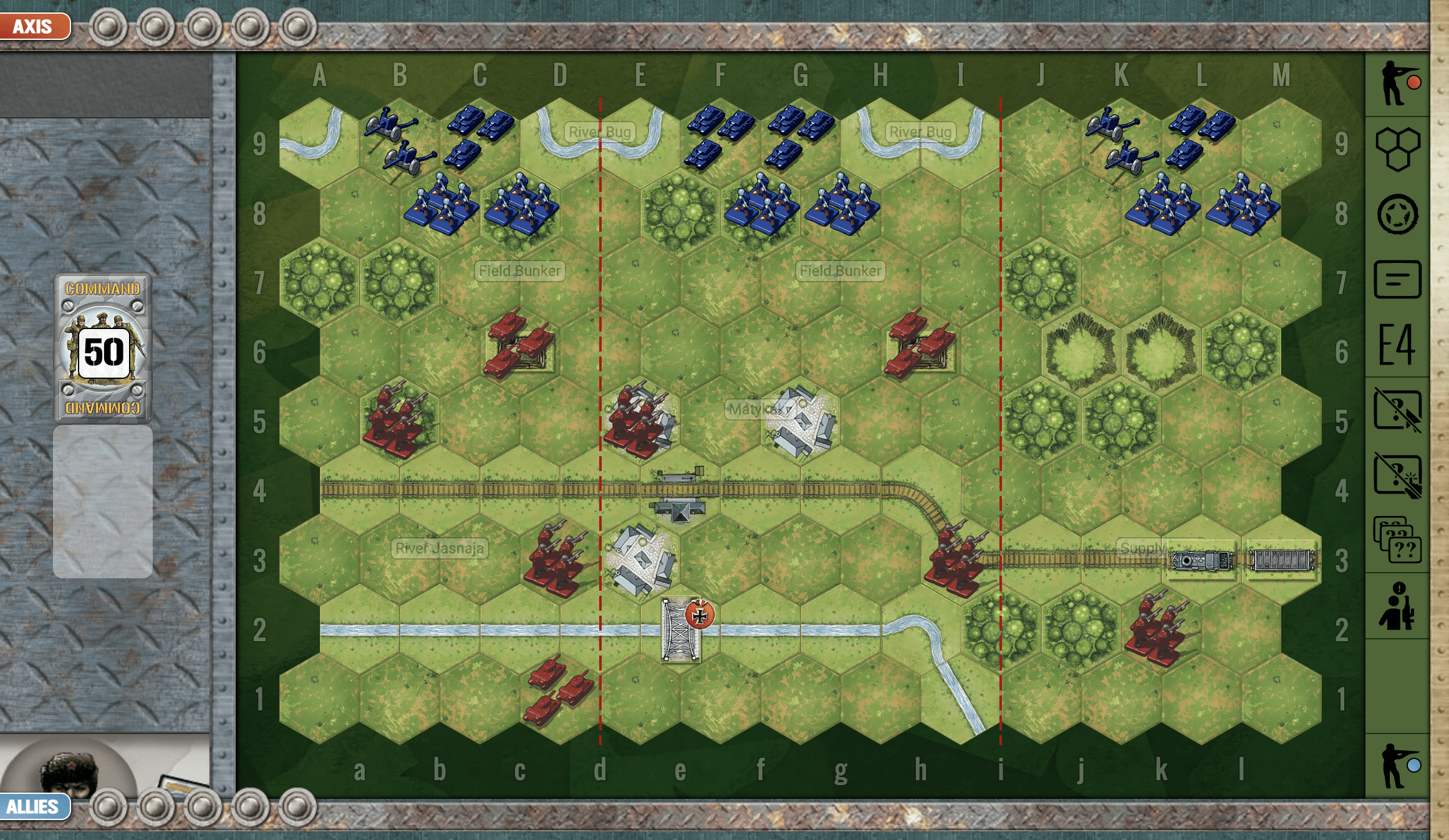
Bug River

Bug River

a memoir 44 game field

The Battle of the Bug River was the opening crack of thunder in the great storm called Operation Barbarossa, June 1941. When the Germans hurled their legions eastward, the Bug River stood before them—not just a line of water, but the first Soviet shield guarding their vast frontier. That river marked the edge of two empires, a tense, steel-cold border between Nazi-occupied Poland and the Red giant beyond.

But rivers don’t stop armies with purpose. At dawn, the German assault troops slammed across the Bug with the kind of ruthless precision that defines a well-oiled war machine. Pioneers threw down bridges under fire, infantry surged across in rubber boats, and armored columns rumbled forward the moment the crossings held. The Soviets, caught between disbelief and the sheer violence of the assault, fought hard in pockets, but they were hit before they could fully wake to the scale of the invasion.

What happened on the Bug wasn’t just a crossing—it was the first thrust of a colossal campaign, a declaration that the Germans intended to carve their way deep into the Soviet heartland. The river was supposed to be a barrier. Instead, it became the starting line for one of the most brutal struggles in human history.

~~ General Howitzer

5 VP’s

Card Balance:

Allies – 3
Axis – 6

Allies are seriously impaired on their card management options in this scenario.

Complexity:

4

Conditions:

Countryside


Location:

Russia

Year:

1941

Theater:

Eastern Front

Campaign:

Operation Barbarossa

Codename

Summary:

The Axis are making an attack against a fairly well-defended Russian army. It is a countrside terrain with forests and bunkers. There is also a supply train which can drop off additional defenders if it gets to its depot safely. This adds an interesting element to the battlefield game.

Objectives:
There are five VP’s in this scenario. There is also a bridge medal objective for the Axis to attain. Proper hits on the train will also gain VP’s for the Axis.

Battlefield:
The Russians begin with solid control of two sections. In fact their armor are poised in field bunkers only two hexes from Axis infantry which have no retreat available to them. The train tracks cut across the field also impairing movement. The Bug River weaves across the backline in Axis territory, hampering movement and preventing retreats.

Troops:
The Axis possess 6 infantry, 4 armor, and 2 artillery.
The Russians have 5 infantry, 3 armor, no artillery. Plus possibly two more infantry if the train reaches its destination.

🔥 Winning as Allies

1. As the Russian Allied commander, you need to seek your VP’s. You need 5 and there are six enemy Infantry, which you can target initially. Then as the battle develops, see if any armor or artillery become candidates for attack.

2.  Note that the artillery is pressed up against the backwall with no retreat, so you can seek the chance to hit it with a three-dice armor attack. Your odds will be 33% per dice roll, vs. 16%. Take the chance to hit no-retreat artillery whenever you can. A Barrage card early in the game comes in very handy.

3.  Recognize that your armor in the field bunkers are going to get quickly overwhelmed by the larger Axis forces coming your way. The question is how much you can make them pay for it, before they do so.

🔥 Winning as Axis

1.  You have four infantry hexes which have no retreat and are a mere two hexes away from enemy armor in bunkers. You should attack them immediately and quickly move in on them to maximize your attack. You may be able to neutralize one of the armor units before they do a lot of damage.  With a card like Move Out! you will be able to advance four infantry immediately and nearly surround both field bunkers for a series of two-dice attacks.  In just a couple of turns the enemy should be eliminated.

2.  Do not let the Allied Transport Train get to the train station. Because once they do, they will unload additional forces to fight.

3.  Use your two Artillery as much as possible to attack the enemy Armor in the field bunkers.

12
BR - Bug

Author:

Days of Wonder

URL