Tenaru

Tenaru

“Listen up! In August ‘42 on Guadalcanal, those Japanese under Colonel Ichiki thought they’d just waltz in and knock the Marines off their perch at Henderson Field. Hell, they didn’t know what they were walking into!

The Marines were dug in deep along the Ilu River, machine guns at the ready and artillery on call. When the Japanese hit the line, they slammed into a wall of hot lead and cold steel. All night those Marines fought like hell, and by dawn, the Japanese were stacked up like cordwood.

That wasn’t just another scrap, boys—that was a message. The Japanese learned the hard way that the U.S. Marines don’t back down, and we sure as hell don’t run. The Battle of Tenaru was the first big test on Guadalcanal, and the Marines passed it with flying colors.

That’s how you win a campaign, boys—you dig in, you hold the line, and you don’t let the enemy push you back an inch!

~~ General Howitzer

6 VP’s

Card Balance:

5 – 5

Complexity:

3

Conditions:

Jungle

 

Location:

Guadalcanal

Year:

1942

Theater:

Pacific

Campaign:

Guadalcanal Campaign

Codename

Summary:

Objectives:

6 VP’s

Battlefield:

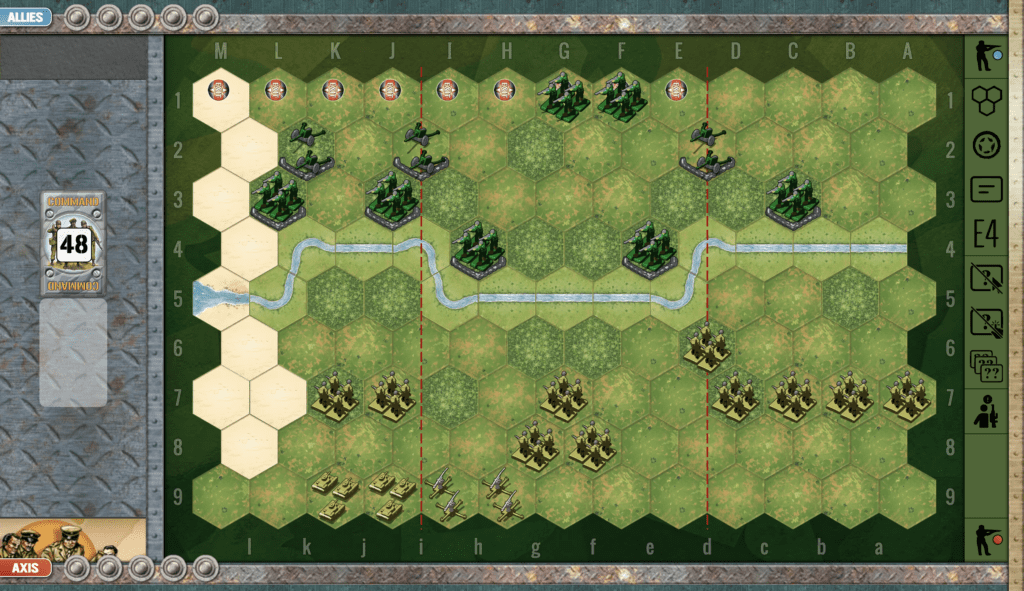
The primary strategic elements to consider in the Tenaru scenario is the navigable river going across the battlefield, and the beach hexes along one flank which allows for rapid troop movement. But the most formidable element of this scenario are the two American artillery units on the beach section.

Troops:

Allies – 9 Infantry, 1 Armor, 2 Artillery

Axis – 12 Infantry

Allied Strategy:

1. Use your Artillery at every opportunity. The enemy will be able to make rapid progress along the beach, so you need to attack while you can.

2.  You have one Armor, but it starts off in the back. You need to get it into play as soon as possible, so that you can attack the enemy forces from a distance and diminish their attack ability.

3.  Do what you can to destroy at least one figure in every Japanese Infantry unit, in order to nullify the Seishin Kyoiku Principle advantage. 

Axis Strategy:

1. Because this is a long scenario, you may need to consider destroying the American artillery near the beach. Fortunately, the beach allows for rapid progress of the Japanese infantry to its objectives.

2.  However, it is possible for the Axis to win this scenario if they focus their energies to the left and center sections.  

3.  Take advantage of the Banzai War Cry, and the Seishin Kyoiku principle to rapidly attack and destroy the enemy. 

20
BR - Tenaru

Author:

Link:

Sugar Loaf and Half Moon

Sugar Loaf and Half Moon

The Battle of Sugar Loaf and Half Moon took place during the Battle of Okinawa in May 1945, one of the final and bloodiest battles of World War II. Sugar Loaf Hill and Half Moon Hill were heavily fortified Japanese positions that U.S. Marines needed to capture to advance on the island.

Listen up. Sugar Loaf and Half Moon weren’t just two lumps of dirt on Okinawa—they were the kind of fortified hellholes the enemy turns into a butcher shop. The Japanese were dug in deep, with bunkers you couldn’t see and tunnels you couldn’t count, and they poured out artillery, machine-gun fire, and counterattacks like they had an endless supply of men and steel.

Our Marines fought inch by inch, bleeding for every blasted ridge. They stormed those heights again and again, under fire hot enough to melt the paint off a helmet. Casualties were heavy, but the boys never broke. After days of slugging it out—crawling, climbing, charging—they took both hills and tore the heart out of the enemy’s northern line.

Seizing Sugar Loaf and Half Moon opened the door to Okinawa’s southern defenses, and it proved a cold, hard truth: fighting in the Pacific demanded guts, grit, and sacrifice on a scale few can imagine. And it was a grim preview of what it might have taken if we’d ever had to storm Japan itself.

~~ General Howitzer

6 VP’s

Card Balance:

USA – 6

Japanese – 4

Complexity:

2

Conditions:

Jungle


Location:

Pacific

Year:

1945

Theater:

Pacific

Campaign:

Battle of Okinawa

Codename:

Summary:

Objectives:

6 VP’s
(Special Rule: Note that if the Marines clear out an entire section of Japanese forces, it counts as a temporary VP.)

Battlefield:

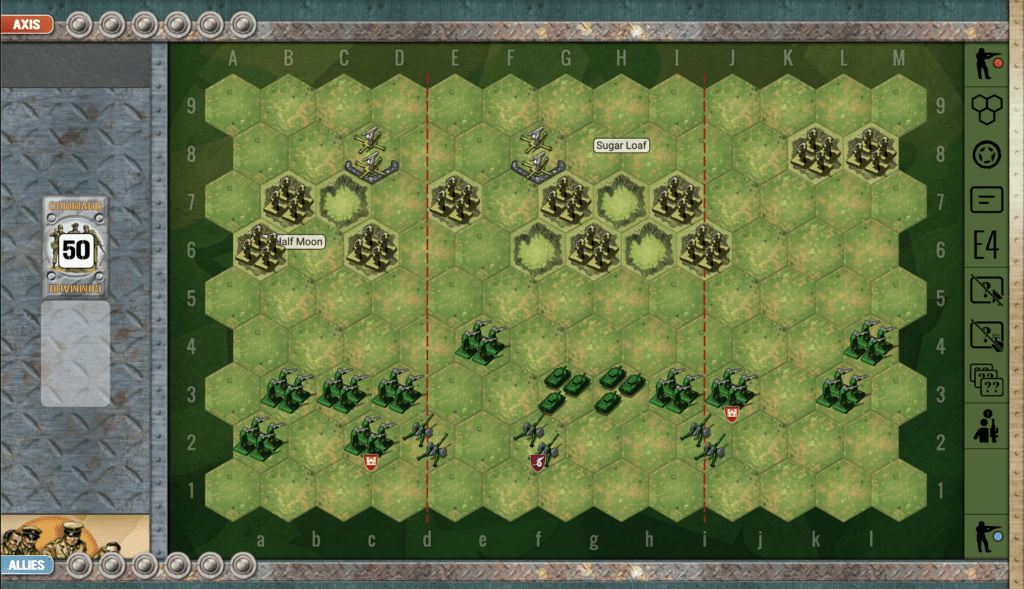
This scenario begins with both forces arrayed across the battlefield and ready to engage in immediate warfare. It is a countryside with hills and caves spread across all three sections. The caves allow for rapid movement of Japanese troops.

Troops:

Allies – 10 Infantry, 2 Armor, 2 Artillery

(Infantry practices the Gung-Ho! rule.)

Axis – 10 Infantry, 2 Artillery

(Japanese Infantry practices the Seishin Kyoiku Doctrine (SKD), and the Yamato Damashi Concept, and the Banzai War Cry.)

Allied Strategy:

1. The enemy is weak on your right flank. They have no artillery protection on half the flank. With your artillery, you have a slight numeric advantage. If you can work up the cards, you could launch an attack on tht side, and gain half the VP’s you need. Once you overwhelm that section, your remaining forces can combine with your center section troops to finish off the job and gain your final three VP’s.

2.  Use your Artillery to hit every full force Infantry unit at least once in order to cancel out the SKD advantage they have.

3.  Note that one of your artillery is mobile, so you can move in and fire. But do not move in too close prematurely, or the Japanese forces will overwhelm you with their SKD power.

4.  Strategic consideration based on this special rule:
“When all the Japanese units in a section of the battlefield (right, center or left) are eliminated, the Marines gain one Victory Medal.”  This means that if you can concentrate all of your attacks in one section, you will gain not only the medals for eliminating units, but also one extra Victory Medal for clearing out the section. Your most likely focus for this is the right section, since there are no enemy Artillery to eliminate.

Axis Strategy:

1.  Use the Banzai War Cry combined with the Seishin Kyoiku Doctrine to quickly advance your full-power Infantry units to attack any enemy who are within striking range. With the additional dice roll that SKD provides, you can quickly weaken the enemy.

2. Remember to use the tunnel system to quickly move infantry from hill to hill to get your forces into the action.

3. Use your artillery at every opportunity on any enemy forces that approach.

4.  Your Infantry are sitting mostly on Cave on a Hill hexes, which give a massive defensive advantage of minus 2 (only one dice attack), for normal attacks.  This allows you to fend off many attacks. And when they get weak, you can do a quick swap out with fresh units using the cave system.  So do not be quick to leave such a defensive position unless you can launch a decisive attack.

Battle Reports

(classic percentage of Allied victories):

68%

25
BR - SugarLoaf

Author:

Days of Wonder

Link:

Slopes of Mount Austen (Gaudalcanal)

Slopes of Mount Austen

scenario_SlopesMtAusten_start_Allies

The Battle of the Slopes of Mount Austen (December 1942–January 1943) was a critical engagement during the Guadalcanal Campaign in the Pacific Theater of World War II. Mount Austen, a strategic high point on Guadalcanal, was vital for controlling the surrounding terrain and protecting Henderson Field, a key Allied airbase.

The battle involved intense fighting between U.S. forces, primarily the Americal Division, and entrenched Japanese defenders, including the elite Ichiki and Kawaguchi Detachments. The Japanese had fortified positions on the rugged slopes, including a stronghold known as the Gifu.

The fight for Mount Austen was no Sunday stroll—it was a slugfest in choking jungle against an enemy dug in like ticks and mean as hell. The Japs were camouflaged, stubborn, and ready to die where they stood. But our boys hammered them with infantry, blasted them with artillery, and pounded them from the air until every inch was ours. By mid-January ’43, we owned that mountain and the ground around it—breaking their grip on Guadalcanal and shoving the whole damned campaign toward victory.

~~ General Howitzer

5 VP’s

card

Card Balance:

Allies – 6

Axis – 5

Complexity:

2

Conditions:

Jungle

Location:

Gaudalcanal

Year:

1943

Theater:

Pacific Theater

Campaign:

Guadalcanal Campaign

Codename

Summary:

Objectives:

5 VP’s

Battlefield:

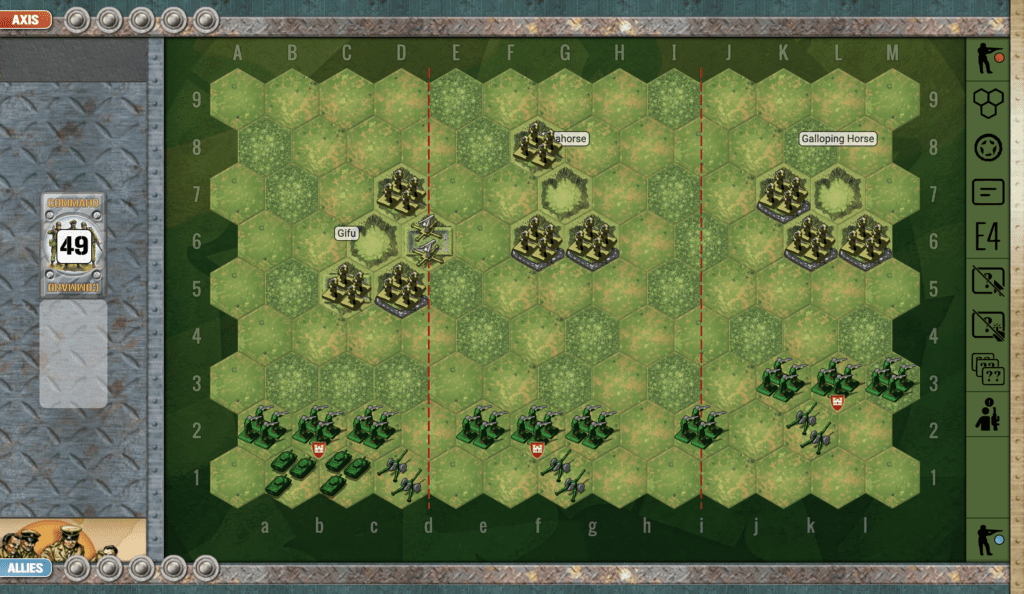
The battlefield is pretty wide open, except for three hilly hexes spread across all three sections.

Troops:

Allies – 10 Infantry, 2 Armor, 3 Artillery

Axis – 9 Infantry, 1 Artillery 

Allied Strategy:

1.  The right flank has no artillery defending, so it presents a possible path for attack for the Allies.

2. The Allies have three artillery. This is a powerful assist to the Marines. Use the artillery to soften the Japanese forces. The goal is to knock out at least one figure per hex, in order to elminate the Seishin Kyoiku advantage.

3. Get your armor into fire positions as soon as you can. The open pathway between the jungle hexes will provide you with the quickest access to the enemy.


Axis Strategy:

1.  Make use of your artillery on the right flank. There are a couple of Allied units with no retreat, which you can hit with 2D attacks.

2.  You have a couple of infantry units that are well behind the field of play.  Bring them forward so that they can have some fun too!

Classic Battlefield Reports

(percentage of Allied victories):

63%

21
BR - Mount Austen

Author:

Days of Wonder

Link:

Japanese Counterattack

Japanese Counterattack

The “Japanese Counter-Attack” phase refers to the counteroffensives launched by Japanese forces in the Pacific Theater.  One notable example occurred during the Battle of Guadalcanal, from August 1942 to February 1943. After U.S. Marines secured a critical airfield on Guadalcanal, known as Henderson Field, the Japanese launched multiple counterattacks to reclaim it. These counteroffensives, involving intense jungle fighting and night assaults, aimed to dislodge the U.S. forces from their foothold. The Japanese committed significant naval and infantry resources, but despite their efforts, they struggled to overcome the U.S. defenses and secure sustained supply lines.

The Japs threw in ships, men, and everything they could float or march—but it didn’t matter. Our defenses held like a steel wall, and without solid supply lines, their fight was doomed from the start. They came in hard, but we broke them harder.

~~ General Howitzer

6 VP’s

Card Balance:

Allies – 6

Axis – 5

Complexity:

4

Conditions:

Jungle

Location:

Guam

Year:

1944

Theater:

Pacific Theater

Campaign

Codename

Summary

The Japanese Counterattack takes place on the same battlefield as the Guam Landings, but the game mechanics are pretty much reversed.

Objectives:
Six VP’s, plus each side has a permanent Objective Medal hex which they can seek.

Battlefield:
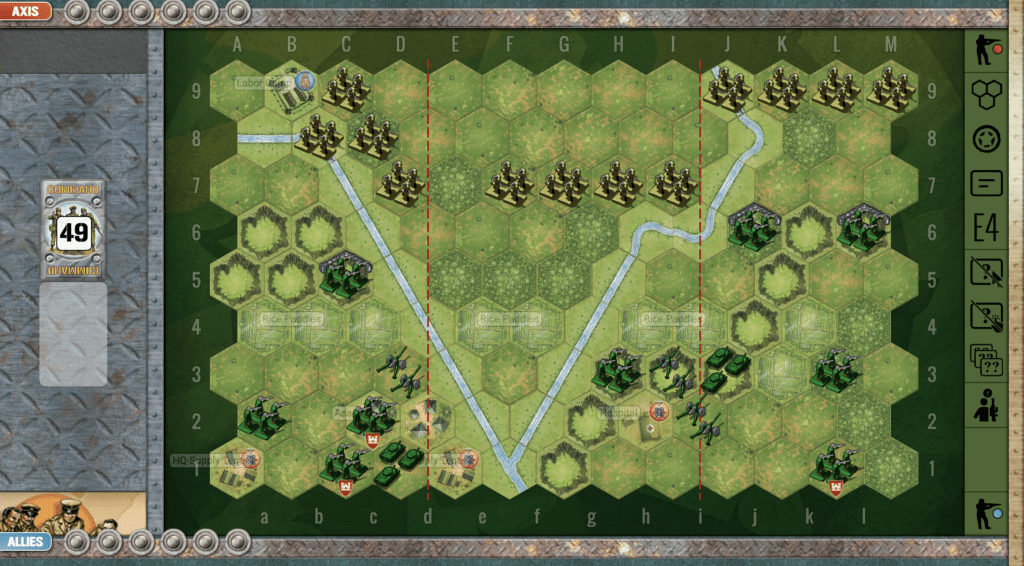
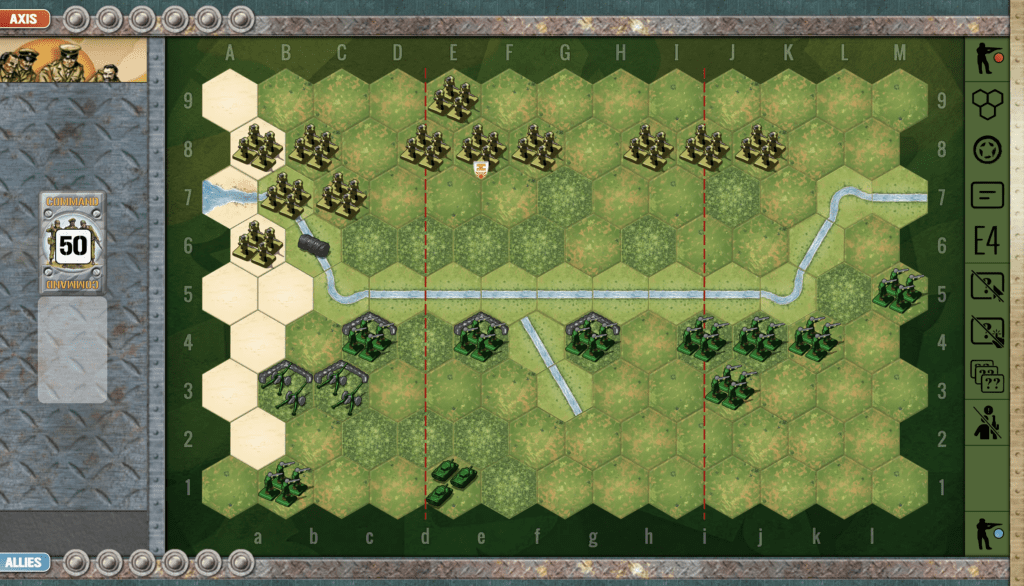
Jungle with a V-shaped river cutting right through the map.

Troops:
Marines – 9 Infantry, 2 Armor, 2 Artillery.
Japanese – 12 Infantry.

🔥 Winning as Allies

1.  With three artillery, and one armor, the Marines have more firepower than the Japanese. But the artillery is limited for much of the game by night visibility rules, which slowly improve throughout the game.  So take your time to get your troops arranged, and your card management under control, to allow more daylight to help your attack and defense.

2. Your tank is stuck back in the left corner of the fight, so take advantage of the early turns to get it into play.

3.  Remember that the Japanese practice the Seishin Kyoiku Doctrine. If they have all four units and are fighting at close combat, they role four! dice, not three.  So during the game, one of the objectives the Marines need to practice is to take off at least one figure per hex. This will actually count as two in terms of reducing the Japanese firepower for subsequent attacks. 

🔥 Winning as Axis

1.  Big picture strategy for the Japanese forces is to quickly overwhelm a flank with infantry forces who are still fully intact so that you can use the Seishin Kyoiku Doctrine against the Marines.  Because of the four! Allied artillery, the center section is kind of a kill box.  So the best hope is to move down one of flanks as the cards dictate.

2.  Night-time conditions are to your advantage because the Allies have so much firepower.  Therefore your best attacks will be immediately, before the dice rolls enough stars to bring out the full ranged artillery attacks.

3.  There are three Permanent Medal Objectives (HQ-Supply & Hospital hexes).  These are deep in enemy territory, but should you get your hands on either Behind Enemy Lines or Infantry Assault cards, there is a possibility you could force your way in to them.

Battle Reports (percentage of Allied victories):

66%

(These are the historical records. For new stats, record your games in the poll to the right.)

Scales-Allies-Weighted
24
BR - Japanese-Counter

Author:

Days of Wonder

Link:

Guam Landings

Guam Landings

“Alright, listen up, boys! The Guam Landings in the summer of ‘44 were a hell of an operation—an amphibious smash right into the gut of the Japanese defenses in the Marianas. The island was crawling with enemy troops, but that didn’t stop our boys from hitting the beaches on July 21st and driving straight inland.

They fought through thick jungles, coral ridges, and all the damn bunkers the enemy could build, pushing those defenders back inch by inch until Guam was ours by August 10th. We didn’t just take an island—we seized a launchpad for bigger things, setting the stage for bombing Japan into rubble.

That’s how you take the fight to the enemy, boys—you land, you fight, and you don’t stop until the flag is flying over every square inch!

~~ General Howitzer

6 VP’s

Card Balance:

Allies – 6

Axis – 5

Complexity:

4

Conditions:

Historical

Location:

Guam

Year:

1944

Theater:

Pacific Theater

Campaign:

Pacific Campaign

Codename

Summary:

There is a massive invasion force of Marines coming on shore with infantry, armor and artillery.

Objectives:

6 VP’s and one Objective Medal for the Marines.

Battlefield:

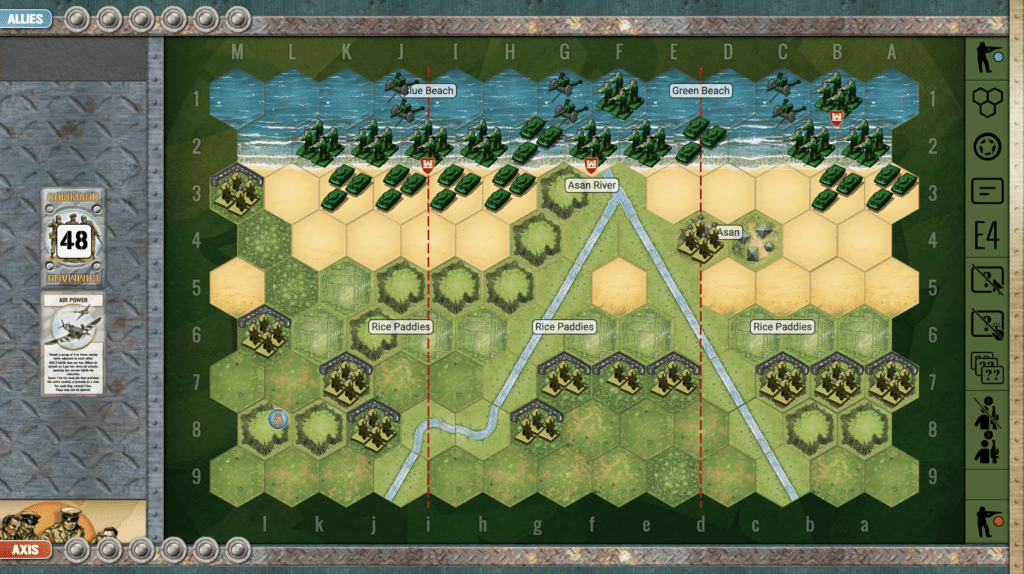
The battlefield is marked by a v-shaped river flanked on one side by a series of hills, and on the other by rice paddies. 

Troops:

Allies – 10 Infantry, 8 Armor, 3 Artillery

Axis – 11 Infantry

🔥 Winning as Allies

1.  You have an overwhelming force to assist you. You have a lot of armor. Start with that and attack the sandbagged enemy from a distance. You will be able to wipe out several front-line units very quickly using your armor.

2.  There is a Medal Objective on your right flank. You can target it, but will need to deal with the enemy infantry unit close to the beach at hex M3.

3.  Deal with the two enemy infantry units right on the beach first, or they will be able to score a hit on every retreat flag they throw against your forces.

🔥 Winning as Axis

 1. The Japanese are well-protected behind sandbags, and would need a pretty good reason to break cover, while they wait for the Marines to attack.

2.  You have a forward unit in the village of Asan, which you can use to take out some figures, maybe a full unit before you are destroyed.

3. And you have a forward unit in the jungle and sandbagged at M3, which you can also use for some quick hits against the enemy.

Battle Reports (percentage of Allied victories):

67%

Scales-Allies-Weighted
28
BR - Guam Landings

Author:
Days of Wonder

URL:

Matanikau River (Guadalcanal)

Matanikau River

scenario_Matanikau_start

The battle near the Matanikau River in 1942 was a key engagement during the Guadalcanal Campaign in the Pacific Theater of World War II. It involved several clashes between the United States Marines and Imperial Japanese forces as the Marines sought to secure their perimeter around Henderson Field, a critical airstrip on Guadalcanal.

Listen up. September to November ’42, the Matanikau was the hinge of Guadalcanal. The enemy tried to shove our Marines into the sea; our answer was simple—cross the river, hit hard, and keep hitting. We used infantry up front, artillery and naval guns on call, and fighters overhead to hammer every position that dared resist. Result: their strength bled away, our foothold stiffened, and the initiative swung to us. Lesson—seize the crossing, smash the flank, keep air on the target, and don’t stop until the island is yours.

~~ General Howitzer

5 VP’s

Card Balance:

Allies – 6

Japanese – 6

Complexity:

3

Conditions

Location:

Guadalcanal

Year:

1942

Theater:

Pacific Theater

Campaign

Summary:

This scenario is pretty much an infantry battle with a bit of artillery support.

Objectives:

Five VP’s, plus Exit hexes

Battlefield:

The Matanikau River cuts across the battlefield and presents a challenge for both forces as they try to maneuver and attack one another. And there are series of beach hexes along one flank which provides a rapid transit path for attacks.

Troops:

Allies – Infantry 7, Artillery 3

Axis – 10 Infantry, 2 Armor, 2 Artillery

🔥 Winning as Allies

1.  Your forces are outnumbered by the Japanese, so unless you have the cards for it, stay behind the sandbags.

2.  You have three artillery, so use them whenever you can.

3.  Protect the backrow from any Japanese forces that may try to escape.

4.  Remember that as Marines, you get the ‘Gung Ho’ advantage, so every section card allows you to move one extra unit than the card states. Remember that advantage, and use it – you will need it.

🔥 Winning as Axis

1.  You have a strong presence on the right flank. If you get the cards, you should push forward and take control.

2.  If you are able to advance all the way across the battlefield, you may be able to help some troops escape.

3.  You have armor and the Allies do not, so move them in and make them feel your firepower!  Armor are good candidates for escape across the back line. So if you move in close, you may be able to attack and then escape.

4.  You also have two artillery, so if you can move them forward,  you will be able to throw 2D attacks across the river.

Battle Reports (percentage of Allied victories):

67%

Scales-Allies-Weighted
28
BR - Matankau

Author:

Days of Wonder

Link: