Breakout to Lisyanka

Breakout to Lisyanka
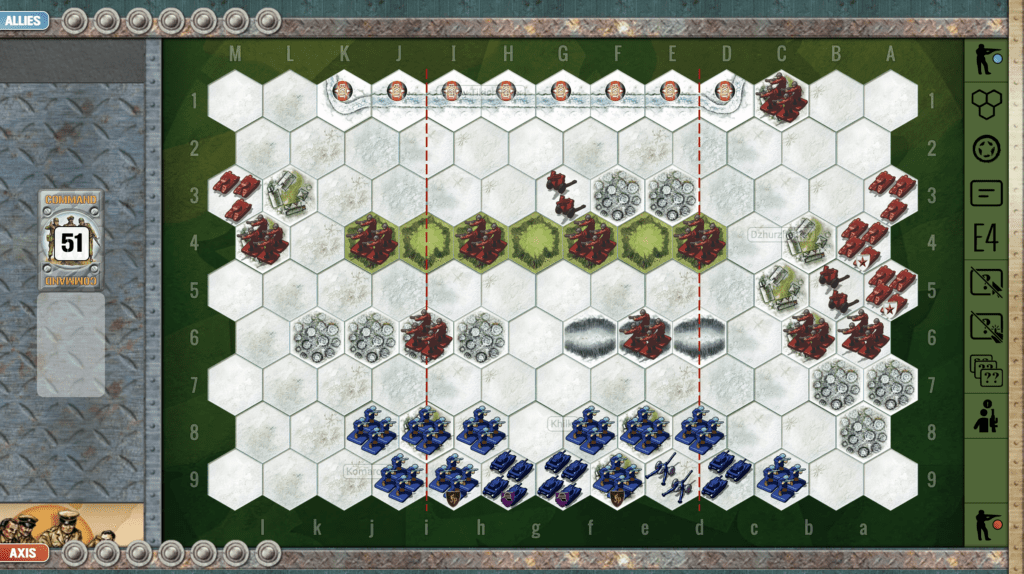
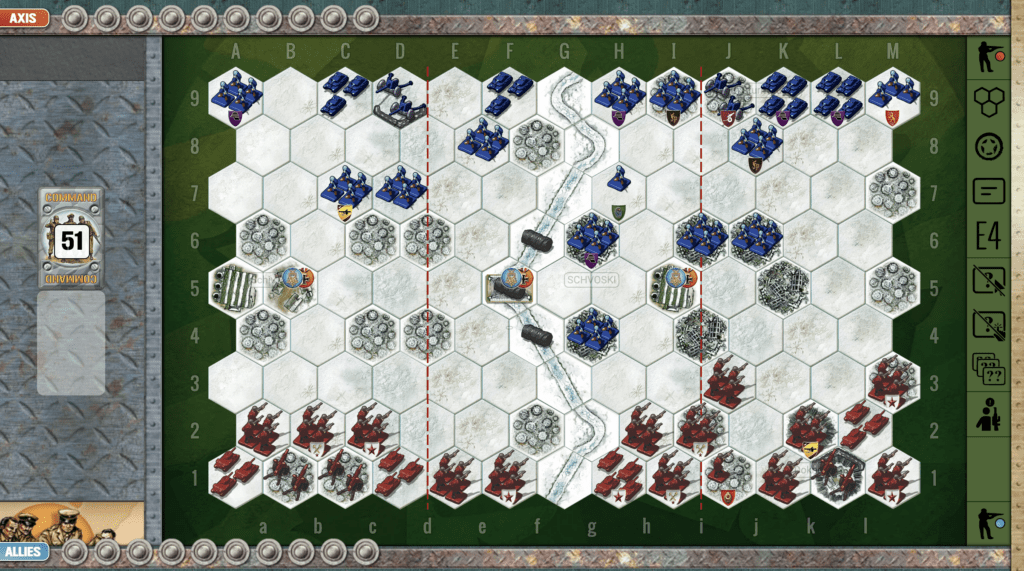
The Breakout to Lisyanka was a key engagement during World War II, fought in early 1944 on the Eastern Front. The battle saw Soviet forces encircling a large German force. The Germans attempted to break out from the encirclement to link up with their reinforcements near Lisyanka, with fierce fighting as they sought to escape Soviet attacks.

While some German units managed to break through, the escape was costly, with heavy losses in men and equipment. The Soviet success significantly weakened German capabilities in Ukraine, contributing to the broader Soviet advance in the region. The battle is often highlighted as a key moment in the Soviet efforts to liberate occupied Ukraine.

General Howizer summarizes it this way:

The Breakout to Lisyanka was a blood-soaked slugfest where the Soviets slammed the trap shut, and while some of the doomed Germans clawed their way out, they left behind a graveyard of men and machines—crippling their grip on Ukraine and fueling the Red steamroller westward.

7 VP’s

Card Balance:

Allies – 4

Axis – 5

Complexity:

3

Conditions:

Winter

Location:

Ukraine

Year:

1944

Theater:

Eastern Front

Campaign

Codename

Summary:

The goal for the Axis is to breakthrough, as the name implies, over the hilly ridge and across the river exits. For Allies, the goal is to of course prevent this. The forces begin in a non-symmetrical dispersion, which makes for a fun scenario.

Objectives:

7 VP’s, plus the Axis have Exit Medals they can try for.

Battlefield:

There is a ridge of hills going across the center, plus some ravines to provide a bit of cover to infantry.

Troops:

Allies – 10 Infantry, 4 Armor, 2 Artillery

Axis – 9 Infantry, 3 Armor, 1 Artillery

Allied Strategy:

1.  As the Allies you must defend against three objective medal locations, the two-hex towns of Golyadi, and Nekrasino, each worth one VP, there is also the frozen river exits along the bottom of the battlefield. Your objectives however, are simply to destroy six enemy units. There are seven enemy infantry units to target and some armor and artillery, if they give you the chance.

2. Be aware that the Axis have Combat Engineers who can attack your infantry in the trenches at close range – with no combat restrictions. So make it one of your early goals to finish them off.

3. Make good use of your artillery in the middle section to defend your troops in the trenches.

Axis Strategy:

1.  Attack with your frontline infantry right away, to create some movement space for your armor, and also to neutralize the nearby enemy who will quickly attack from close range.

2. Try to avoid your right flank which is packed with enemy forces ready to pounce with both armor, infantry, and artillery. You may have better luck on your left flank which has less enemy artillery power. 

3. You can also quickly overwhelm the enemy infantry at i6, to provide a proving ground for your forces to prepare for the breakout.

4.  Remember that if you get any of your Infantry across the Exit hexes, you will earn two! Medals per Infantry (and one for Armor).  So if you get a Behind Enemy Lines, this will provide you with the distance to move in, attack the enemy, and then quickly escape out the back row for an easy two medals.

Classic Battle Reports:

(percentage of Allied victories)

52%

Battle Reports:
18
BR - Lisyanka

Author:

Link:

Braskir Offensive

Braskir Offensive

scenario_BraskirOffensive_start

Here is General Howitzer’s summary of this fictious battle:

The Braskir Offensive was a brutal winter clash between Axis and Allied forces fought amid snow-covered city ruins. The battlefield centered on three key objective territories, each representing vital control points.

The Allies began congested, bottled up in the eastern ruins, struggling to break out under heavy Axis fire. The Axis initially dominated the field, and using fortified positions to hammer any Allied advance.

Through grinding urban combat, flanking maneuvers, and coordinated assaults, the Allies sought to push past the chokepoints, seize the objectives, and turn the tide. The frozen, rubble-strewn city made every advance costly, turning the Braskir Offensive into a battle of attrition where each medal marked blood, grit, and survival.

~~ General Howitzer

VP’s

10

card

Card Balance:

Allies – 5

Axis – 4

Complexity:

4

Conditions:

Winter

winter

Context:

Fictional

Location:

The Baltics

Year:

1944

Summary:

Victory Points:

10, including some objective medals for the church, the Schiv, and the bridge.

Terrain:

There is a lot of complexity to this scenario, with city ruins, factory complexes, a navigable river, and forests. With 10 VP’s needed to win, each side must plan out a long, strategic campaign to degrade enemy forces until victory is achieved.

Troops:

Allies – 14 Infantry including 1 Sniper, 4 Armor, 3 Artillery

Axis – 13 Infantry including 1 Sniper, 4 Armor, 2 Artillery

medal allies

Allies:

1.  Your forces begin in a very congested configuration in the left and right corners. You need to get them mobile ASAP, to be prepared for the coming enemy attack.

 2.  The key to winning this battle is to soften the targets near the medal objectives, and then to position your infantry to take control of the targets in a final push. This will require you to save one card in reserve which allows for multi-sectional attacks, such as a Recon in Force, or Move Out!, or Direct from HQ.

medal axis

Axis:

1. The three Objective hexes in the center, can be quickly gained with some rapid infantry movements. Once gained the Allies will have to fight hard to take them from Axis control, resulting in many losses for them. This can start the Axis at as much as a 3 VP advantage from the first turn.

2. But do not take them too early. If you do not have the support forces around you, any advance forces that grab Objective hexes will get pummeled. This scenario is really about bringing all of your forces to bear upon your attack objectives.

12
BR - Braskir

Author.

URL

Bastogne Corridor West

Bastogne Corridor West

scenario_BastogneCorridorWest

Let me tell you something: Bastogne Corridor West was a knockout punch thrown in a snowstorm, and our boys delivered it with grit frozen to their faces.

In late December ’44, the Germans came crashing in from the west, hell-bent on slicing through the lifeline that kept Bastogne alive. They thought they could slam the door shut before the Third Army reached the paratroopers. Well, they were wrong.

Patton’s tankers, infantry, gunners, and flyboys stood their ground in the worst winter Europe had seen in years. The enemy hit hard—armor, guns, the works—but our men hit harder. Through drifts, smoke, and steel, they held that corridor like it was the spine of the whole damn war—because it was.

By beating back that counterattack, we kept Bastogne supplied, kept the line unbroken, and broke the enemy’s last real chance to split our forces. It was a turning point in the Bulge, and it proved once again: when the Allies are cornered, they don’t fold—they fight their way out.

~~ General Howitzer

6 VP’s 

including some territorial objective medals.

card

Card Balance:

5 – 5

Complexity:

3

Conditions:

Winter

winter

Location:

Belgium

Year:

1944

Theater: 

Western Front

Campaign:

Ardennes

Codename:

it was part of the larger Battle of the Bulge (German codename: Unternehmen Wacht am Rhein, or Operation Watch on the Rhine)

Summary:

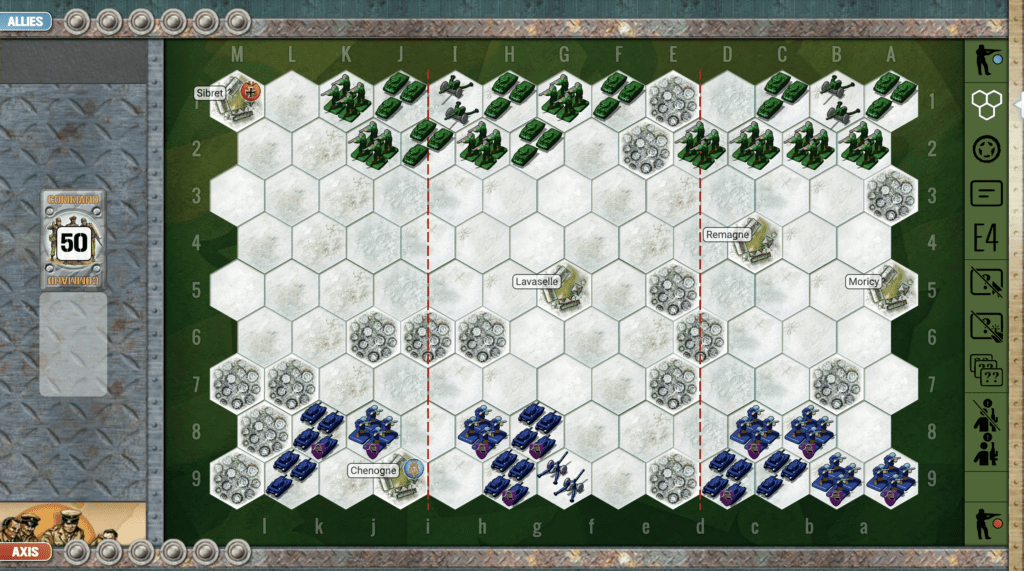
This is a reverse of the Corridor East scenario. But in this scenario both forces are pressed up against their respective borders. The scattered forests in the center of the battlefield are up for grabs to whomever can get to them first.

Objectives:

6 medals including territorial medals for each side by controlling their town objectives.

Terrain:

Winter, wooded, with open plains for fun tank battles

Troops:

Allies – 8 Infantry, 7 Armor, 2 Artillery

Axis – 6 Infantry, 6 Armor, 1 Artillery

Allies:

1.  Big picture strategy for Allies is to quickly mobilize your forces before the enemy armor moves in for attack.  Get your Infantry into defensive positions in the towns of Moricy, Remagne, Lavaselle, and Sibret if you can.  This will slow the Axis attack while you mobilize your own Armor.

2. You have two Artillery.  If the enemy moves forward quickly, you can begin using them immediately. If they delay advancement, you can move your own Artillery forward one or two hexes. Air Power cards are played as Artillery Bombardment, so it will be good to have your Artillery in a forward position, should that card become available.

 3.  The Axis have the advantage of being closer to the forests. So they will be able to place their Armor in there, and blast you if you try to make a frontal assault out in the open middle section. Your best attack vector is your left flank, where your forces can move forward under the protection of the towns and forest’s on that side. 

4.  Wait them out in the center section until either they come out from the forests, or you have the cards for a massive assault.  Of course, if you can capture the forests first, that is the way to go.


Axis:

1.  Big picture strategy is to move your Infantry into the forests, and mobilize your Armor rapidly for some early hits against the enemy before they have had a chance to mobilize.

2. Because there are a lot of open spaces, and a lot of Armor, this can become very much a tank battle. So choose your section and focus of attack carefully. The center section gives your forces the most mobility.

 3.  Capture the center forest hexes. Then begin moving your artillery and your right flank forces forward to put pressure on the enemy.

4.  Keep the pressure on your left flank. If you get close enough to the town of Sibret, in the corner, near the end of the game you can grab that as your last Medal.


18
BR - Bastogne West

Author:

Days of Wonder

URL

Arracourt

Arracourt

scenario_Arracourt_start_Axis

The Battle of Arracourt (September 18–29, 1944) was one of the largest tank engagements on the Western Front — a dramatic clash between the U.S. 4th Armored Division and German Panzer forces near the village of Arracourt, in northeastern France.

After the breakout from Normandy, U.S. forces under General Patton’s Third Army raced across France, outpacing their supply lines. The German High Command, desperate to halt the advance, launched a counteroffensive using newly arrived Panzer brigades from the 5th Panzer Army. Their goal was to cut off the American spearhead and regain the city of Nancy.

By the end of September, the Germans had lost over 200 tanks and assault guns, compared to about 25 U.S. tanks. The American victory at Arracourt shattered the Panzer brigades, halted the German counterattack in Lorraine, and confirmed the U.S. Army’s growing mastery of combined-arms tactics.

Listen up—Arracourt was no accident. That fight proved what I’ve said all along: steel alone doesn’t win battles—men do. When you’ve got training in your bones, clear orders on the radio, and the guts to move fast and hit hard, you can take on any tank the Krauts can throw at you.

Our boys out there turned the rolling fields of Lorraine into a graveyard for German armor. Outnumbered? Maybe. Outclassed? Never. We didn’t dig in and wait—we maneuvered, struck from the flanks, and crushed them before they knew what hit ’em.

Arracourt wasn’t just a victory—it was a lesson to every soldier in this Army: brains, speed, and discipline beat brute strength every damn time.

~~ General Howitzer

6 VP’s

Card Balance:

Allies – 6
Axis – 4

Complexity:

4

Conditions:

Location:

France

Year:

1944

Theater:

Western Front

Campaign

Codename

Summary:

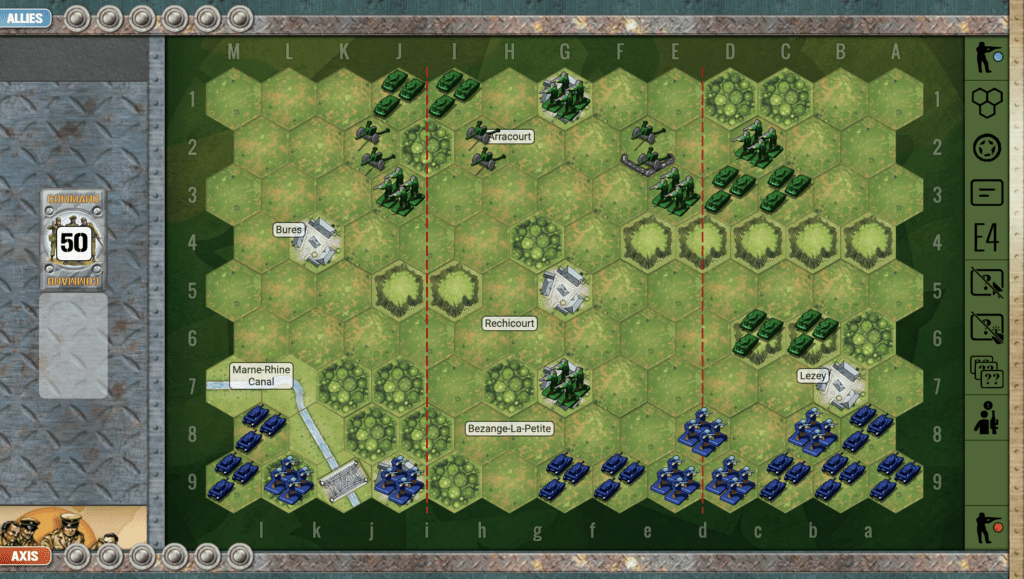
The Arracourt scenario is dominated by a hilly ridge of five hexes which cut across a flank and into the central section, and another smaller ridge in front of that. When the armor comes over the ridge, it becomes a mighty tank battle.

Allied Strategy:

1.   Be careful to not launch a premature attack on the left flank. If you are not ready, you will be entering a kill box. It may be wiser to pull back to the secondary row of ridges, to get prepared for attack.

2. The Axis forces are together in the upper right section behind the Marne-Rhine Canal. If you can move in with your armor and some artillery attacks, you are may be able to score at least one medal before they can respond.

3. You have three artillery. Use them to your advantage. If you can move your center one forward a bit, it will improve your attack and control of the center section.


Axis:

1.  Your right and center sections are strong; the left units stuck behind the canal is your weak side. As you are able, get them out of harms way, or they will be easy pickings for the Allies.

2.  Grand Strategy for Axis: the battle will be fought on your right flank with the armor from both sides on the two ridges and the valley between.  You need to get your tightly condensed and no-retreat armor out into the open so you can battle well. If you stay backed up against the border on the right flank, your troops will be destroyed.

3.  Early goal: eliminate the enemy Infantry at G7, or they will do unnecessary harm to your forces in the center section. 


Battle Reports:

(percentage of Allied victories)

 60%

19
BR - Arracourt

Author:

Link: View Here


Arnhem Bridge

Arnhem Bridge

Scenario_ArnhemBridge_start

Listen up! Arnhem Bridge was no Sunday stroll — it was a fight for the throat of Germany. Market Garden was a bold gamble, a thrust straight through Holland to end the war by Christmas. The plan was simple: grab those bridges, roll our armor across, and cut into the Reich’s belly.

But Arnhem was the lynchpin, the prize. The British Red Devils dropped in with guts and steel, holding that bridge like bulldogs against tanks, artillery, and everything the Germans could throw at them. For days they fought, house to house, street to street, under constant fire. Outnumbered, outgunned, and cut off, they refused to quit.

In the end, the bridge could not be held, and the operation fell short of its lofty goal. But don’t mistake it for failure — Arnhem showed the world the courage of men who held their ground against impossible odds. They didn’t just fight for a bridge; they fought for honor, and you know what? They earned it.

~~ General Howitzer

5 VP’s

Card Balance:

6 – 6

Complexity:

3

Conditions:

Countryside

Location:

Netherlands

Year:

1944

Theater:

Western Front

Codename: 

Operation Market Garden

Context:

Historical

Summary:

Despite its apparent simplistic appearance, this scenario presents some interesting strategy, as it really is all about the Arnhem bridge crossing.

Objectives:

This is a five VP scenario, with no other objective medals.

Battlefield:

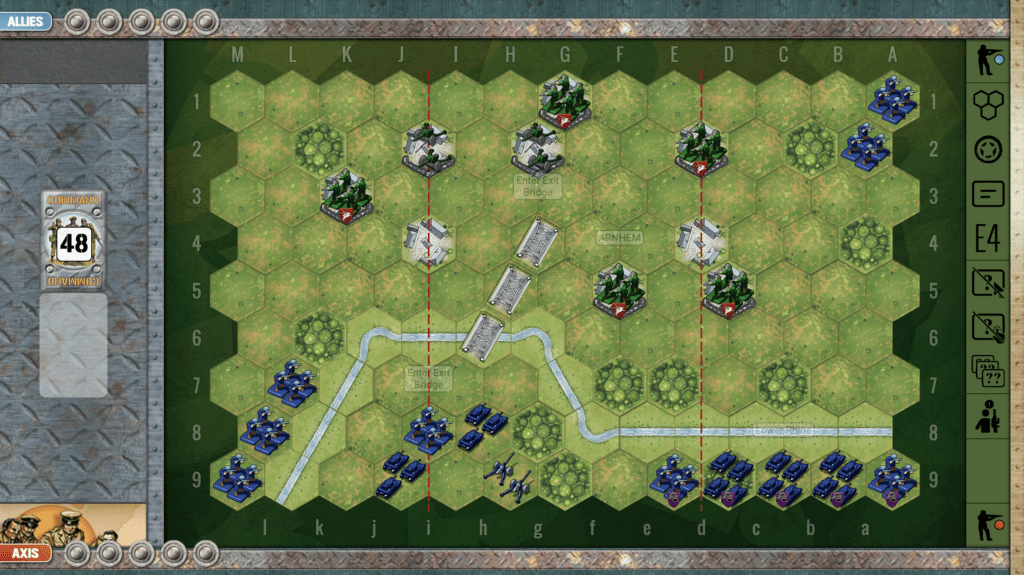
The principle battle field characteristics are the lower Rhine River cutting across the width of the field, and of course, Arnhem Bridge which is the focus on the planned Axis invasion.

Troops:

Although the Axis have more forces, many of them are trapped in the right flank behind the impassable Rhine River.

Allied Strategy

1.  Your artillery will be your most powerful defensive protection in this scenario. Use your center Section cards to keep pounding the enemy. Make sure that you always keep at least one central section card in reserve, should the enemy try to make a run across the bridge.

2.  When you are not defending against a bridge run in the center, use your long-range artillery to slowly degrade the forces on each wing. Because if they come at you with full force, you will have a difficult time holding them off.

3.  Do your best to keep your infantry safely behind the sandbags until you are totally ready to come out for an attack. Although your most forward infantry can become easy prey to the enemy still behind the river, so if you can move that infantry back towards your side of the battlefield, do so. That will provide you with one extra infantry force to attack the enemy in the flanks.

Axis Strategy

1.  The main problem: Axis must get out from behind the river blockade, by crossing the Arnhem bridge without being destroyed, once across.

2.  Flank Attacks: The extra infantry in each corner can be used to maximum advantage to clear out the enemy, or at least distract them, while you cross the bridge. But you will need to wait until you have the right combination of cards to be able to launch an attack from one of the flanks.

3.  Do not rush it: while you remain on the far side of Arnhem Bridge you are generally safe from enemy attacks unless they get an extraordinary collection of Combat cards. The principle mistake made by Axis is to rush out too quickly across the bridge and then to get slaughtered in the kill box which awaits you across the Arnhem Bridge. So take your time to assemble your forces, and move extra troops into the central section, ready to cross the bridge.

4.  With the right combination of cards, you can begin an attack on one (or both!) flanks, while you attempt to cross the bridge. The goal is to distract the enemy, and force them to divide their defensive energies so that your forces can cross the bridge successfully.

Class Battlefield Reports:

(percentage of Allied victories)

81%

26
BR - Arnhem

Author:

Days of Wonder

Link: