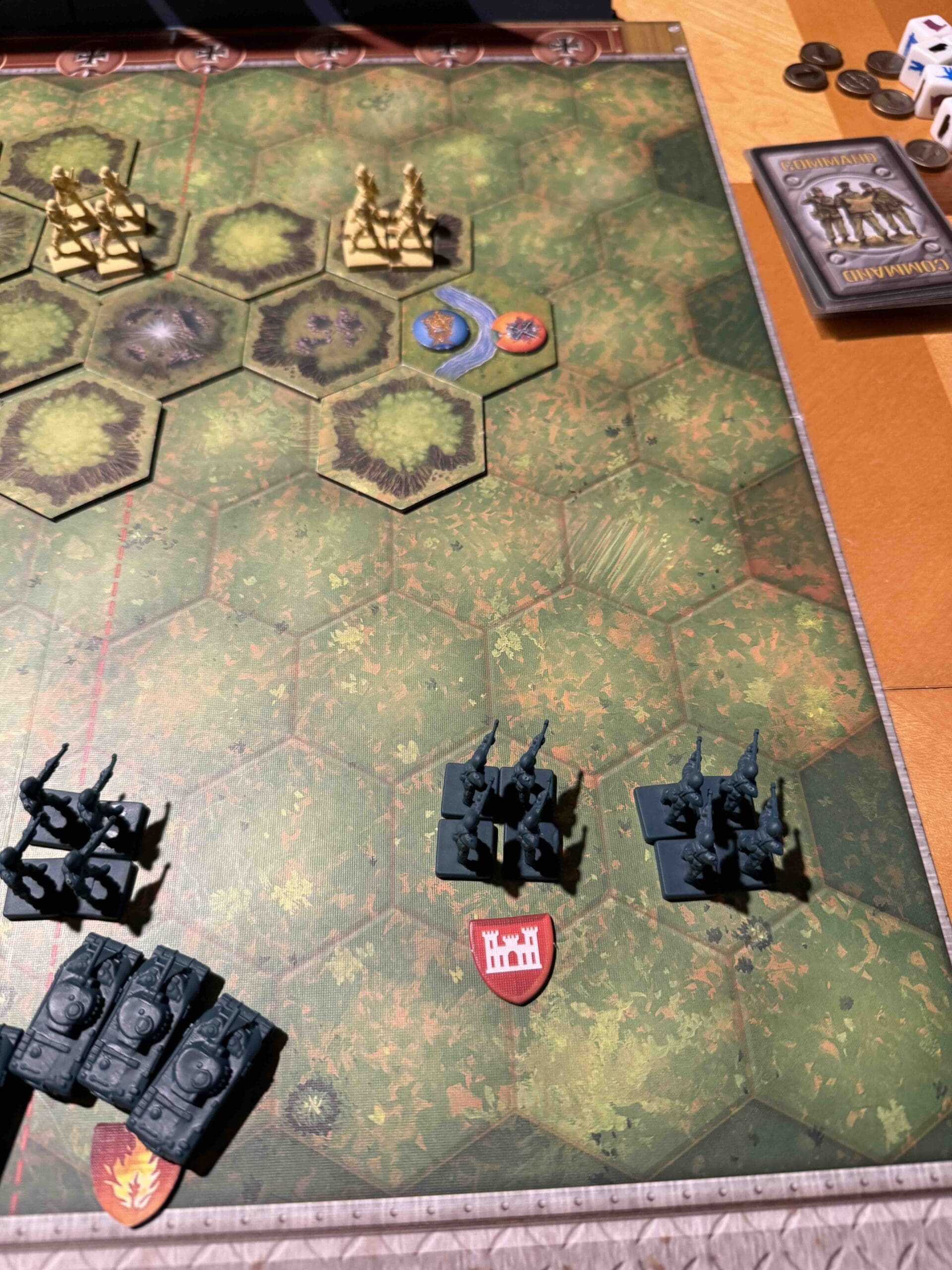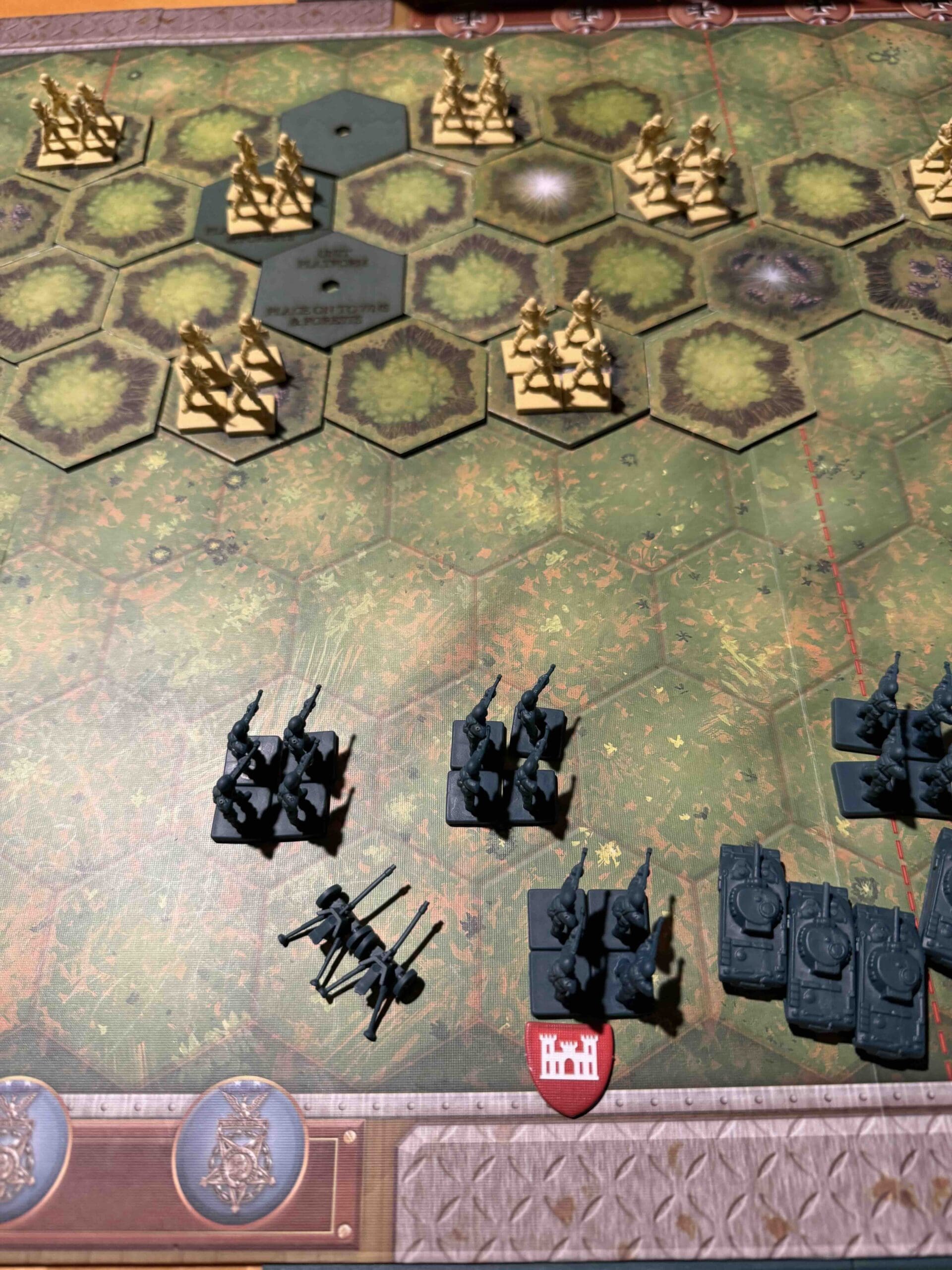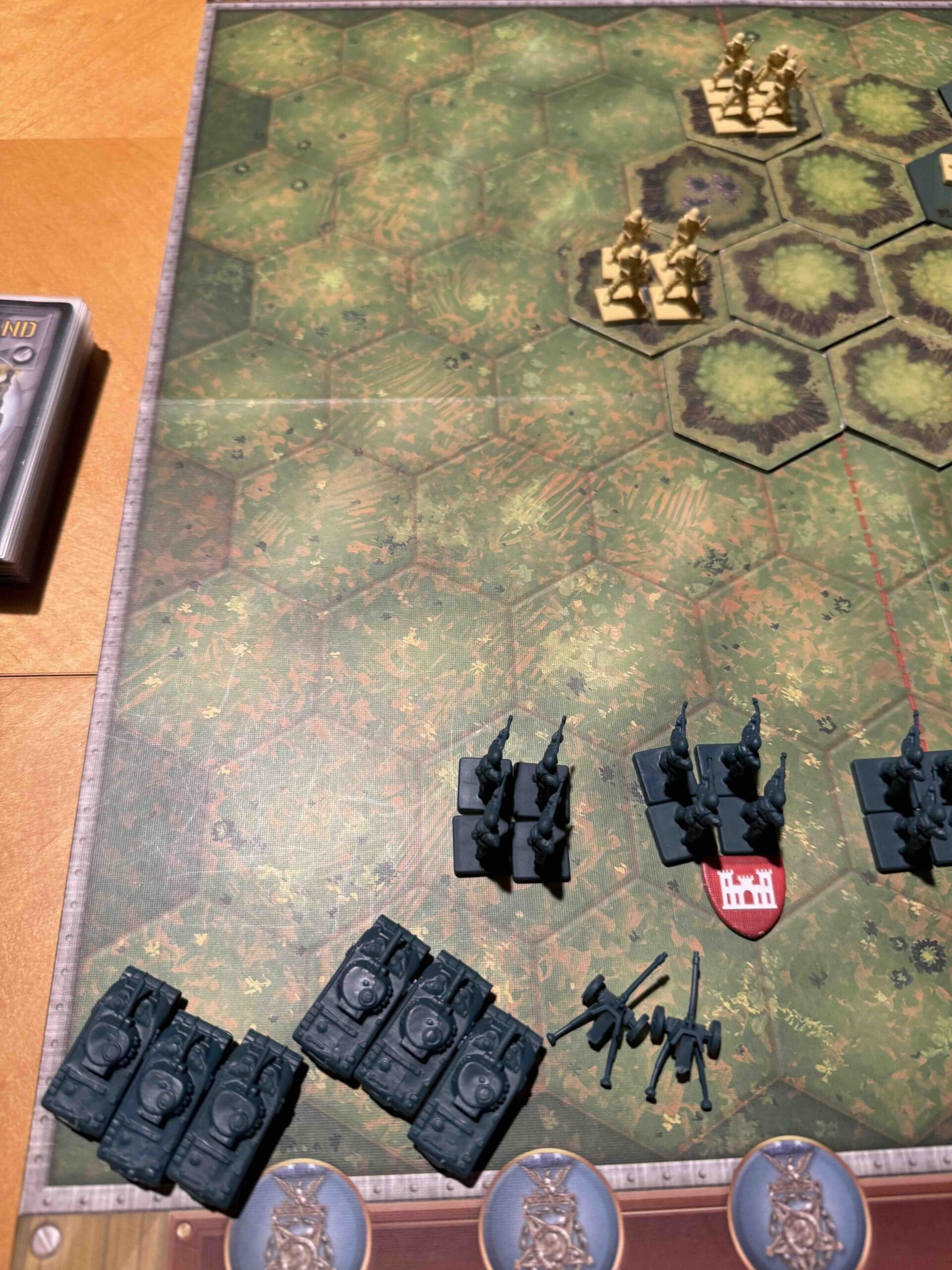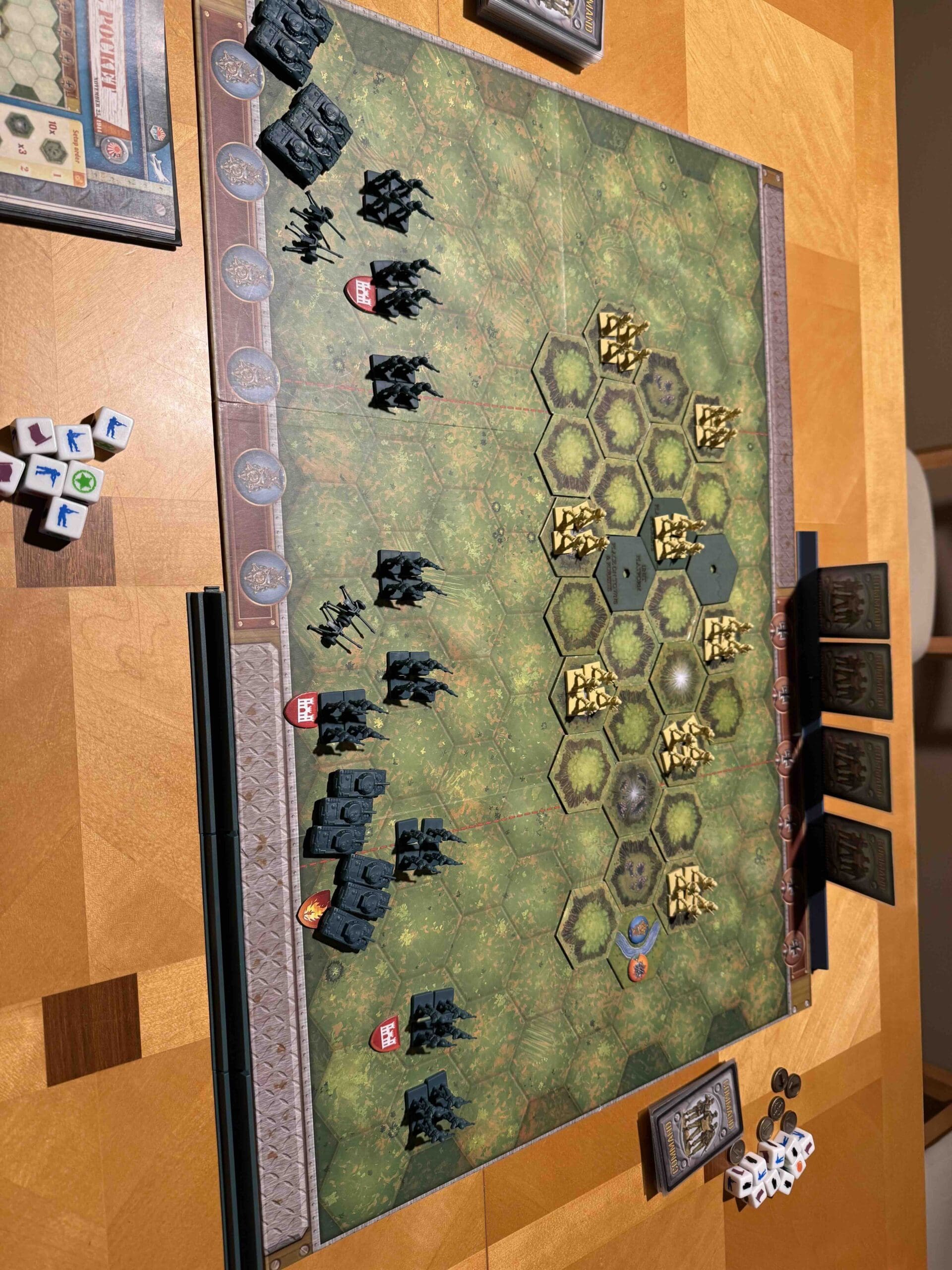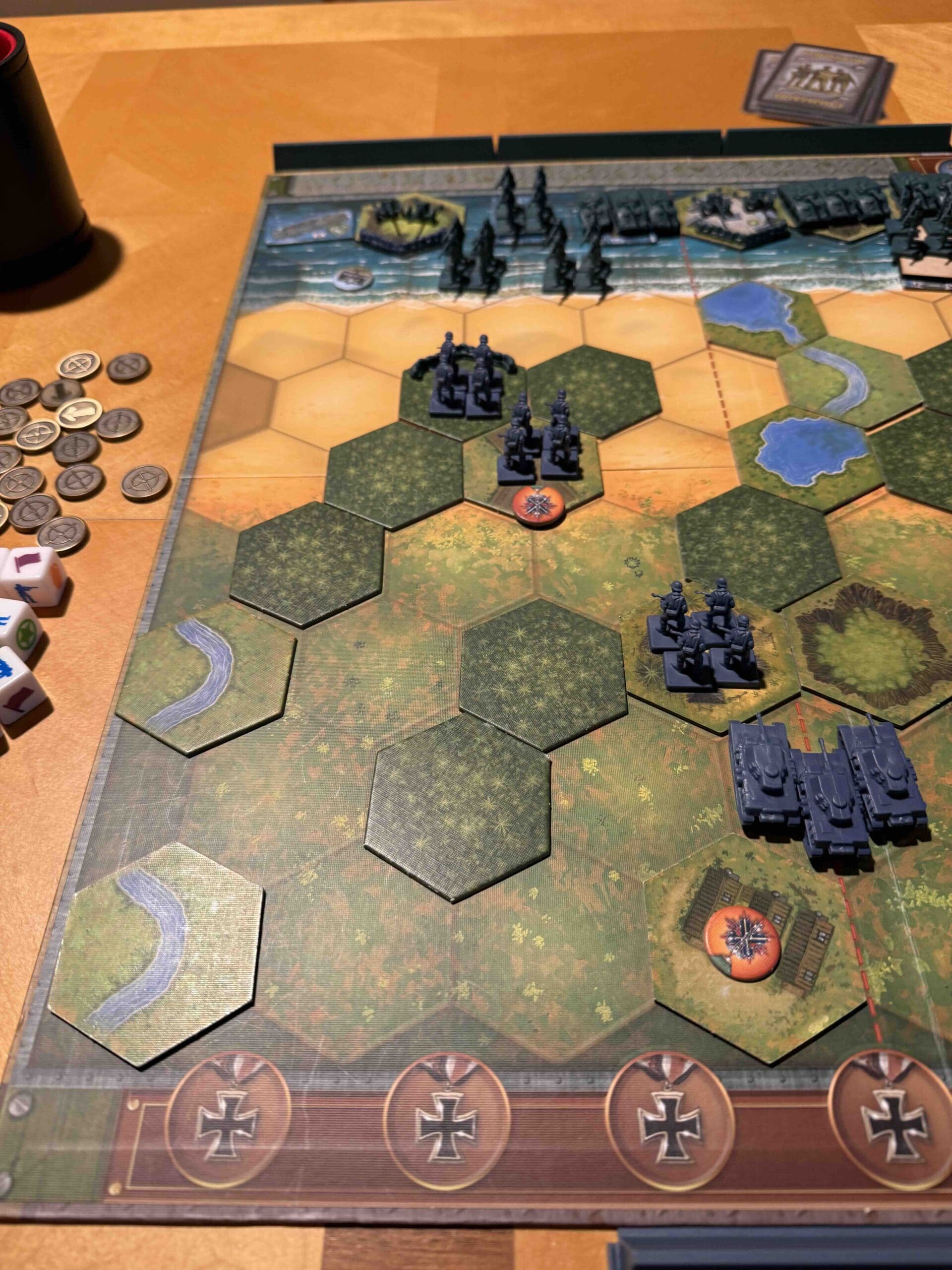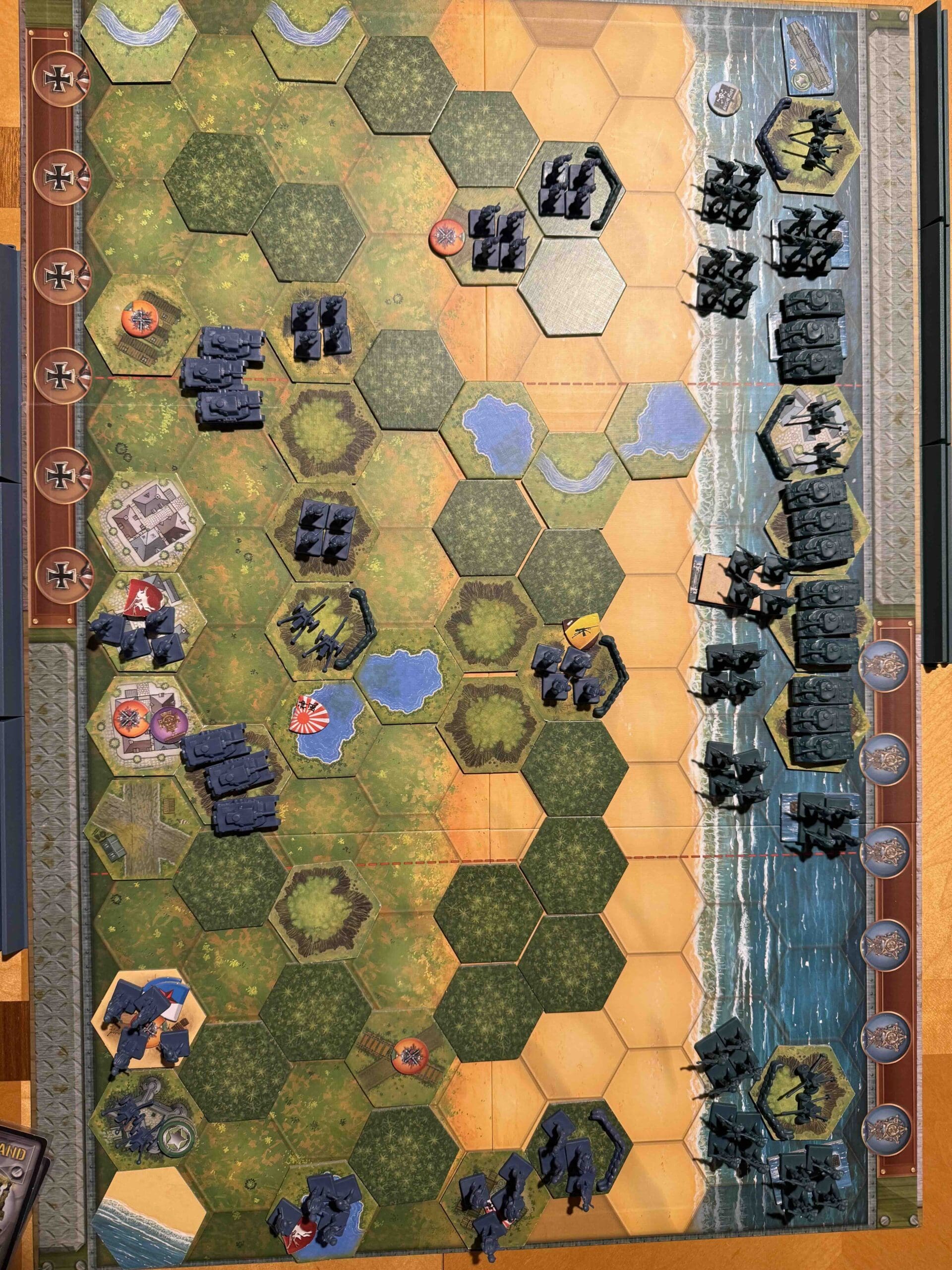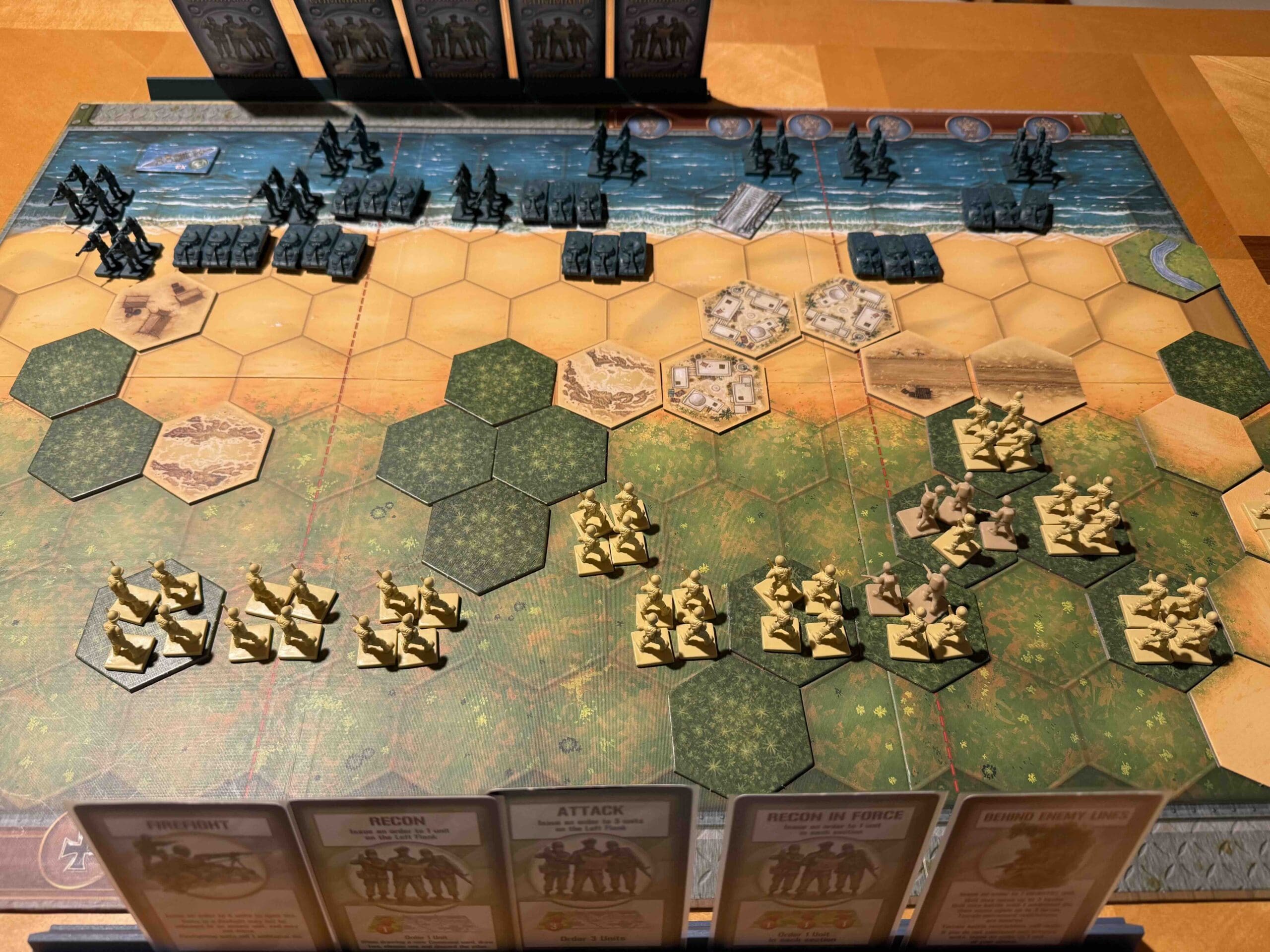
Peleliu Landings [Overlord]

Peleliu Landings (Overlord)

memoir 44 scenario

Listen up. When our boys hit Peleliu, they weren’t stepping onto some quiet stretch of sand — they were walking straight into a hornet’s nest carved out of coral and steel. The Japanese didn’t waste men on the beaches; they dug themselves into the ridges, the caves, and the guts of that island, building a fortress designed to bleed us dry.

The 1st Marine Division landed under murderous fire — artillery, machine guns, everything the enemy could throw. They took casualties by the score, but they kept pushing, clawing their way off those beaches yard by yard. By nightfall, they’d carved out a foothold. Not victory — just a place to start swinging.

Peleliu wasn’t taken in a day. It was a slugging match, the kind where grit and guts matter more than numbers. And the Marines proved that when the chips are down, America’s fighting men don’t back up — they break through.

~~ General Howitzer

13 VP’s

card

Card Balance:

Allies – 11

Axis – 8

Complexity:

5/5

Conditions:

Beach
beach

Context:

Historical

Location:

Palau Islands

Year:

1944

Theater:

Pacific

Campaign:

Guadalcanal Campaign

Summary:

This is an Overlord game, so make use of the Jungle Command cards, two per side.

Objectives:

12 Medals including Territorial Control, and Exit Row medals and a sudden death hex all for the Japanese.

Terrain:

Beach and jungle terrain, and mountains, and an airfield.

Troops:

Allies –  Infantry, Armor, Destroyers

Axis – Infantry, Armor, Artillery

Special Rules:

1. Majority  Temporary Territorial Control  – whomever controls 3 of the 4 buildings of the airfield

2.  Exit Row Medals – to any Marine forces that exit

3.  Imperial Japanese Army Command rules – Seishin Kyoiku Doctrine (SKD), Yamato Dashi Concept (No Surrender), Banzai War Cry

4.  US Marine Corps rules – Gung Ho! rule – activate one extra unit more than the card played indicates

5.  Airfield rules – no movement restrictions, no combat restrictions, no line of site restrictions

6.  Jungles – Movement, must stop; Battle, only if starting in, or adjacent to hex; blocks Line of Sight;

7.  Minefields,

8.  Marshes,

9.  Mountain terrain – only Infantry may move onto Mountains; Battle, up the mountain reduces dice by two; blocks Line of Site

10.  Destroyers – attacks at 3,3,2,2,1,1,1,1


medal allies 

Allied Strategy:

1.  The Marines should avoid the Japanese up in the mountains on their left flank.  There is little to be gained in that sector.  Instead direct your forces at an angle towards the center, to bring pressure to bear towards the airfield.

2.  The two Exit hexes for the Marines are an excellent and achievable goal.  Work your way through the jungle and send some of our boys home to safety!

3. You have a warship at your disposal on your left flank.  Use it at every opportunity to degrade the enemy forces.  It is close enough to the center, that you can provide some good support for the forces fighting on the center beach. 

4.  The Marines are able to use their Gung Ho! ability to command one additional unit – but only in one section at a time.  So the Command-In-Chief (CIC) should decide which sector requires the additional unit to be ordered, to either shore up a section that needs additional defense, or to enhance an attack with one additional unit to command.

5.  You start the battle with three Engineer units.  Get them off the beach and into the jungle as soon as possible. They will be able to overcome the jungle terrain protections, ignoring them at Close Assault, and being able to roll three dice for each attack. This will help to quickly blunt the Japanese SKD abilities. 

BIG PICTURE STRATEGY FOR BOTH SIDES:

1.  Because this is an Overlord game, hand management becomes critical.  At the start of the game, both sides have plenty of cards to fight with. The Allies get 11 cards, and the Axis get 8.  But because they can spend up to three cards per turn, and only get replenished at the rate of 2 cards per turn, each side will begin to run out of playable cards, about half-way through the game, and will have to resort to Initiative Rolls for one of their Field Commanders.

2.  The center two sections are where most of the action is going to take place.  As the Marines push up toward the Airfield, and the Japanese bring their Armor out from behind the mountains, they will all converge for an awesome bloodbath on the central beach.

3.  This is a long scenario with 13 Victory Points.  This means strategic hits, and good defensive moves, so that you are attacking the enemy from places of protection, will slowly build up to a successful attack, unit by unit. This scenario is not won in a single decisive attack.  You will need to use your forces everywhere for a total war attack methodology.

4.  This is an Overlord game, so be sure to understand the rules for how the Commander-In-Chief (CIC) distributes cards, and who is authorized to attack in which sections.  Clarify before the game starts, any special rules for how to apply multi-sectional cards, and Tactic cards.  The official Days of Wonder Overlord rules can be found here on the General Howitzer site.


medal axis

Axis Strategy

1.  You have a number of powerful Armor which are capable of doing great damage to the enemy on the beach. But they are blocked in by your Infantry.  So get the Infantry moved out of the way, and take a couple of turns to attack the unprotected and helpless forces on the beach.

2.  Keep a few forces close to the Airfield, which is a Permanent Majority Medal Objective.  If the enemy controls three of the four building hexes at the end of their turn, this will earn a Permanent Medal Objective.

3.  Also keep a few forces close to the Exit hexes to prevent the enemy from escaping, and earning medals.

4.  Because of the Seishin Kyoiku Doctrine (SKD), your full force Infantry units get to roll one extra dice in Close Assault attacks.  If you move your forces quickly forward onto the beach, you can capture the Marines at their weakest, and with your extra dice rolls, either kill them, or push them back into the sea for retreat kills.  (Although it should be noted that historically, the Japanese attacked the beach from a distance and waited for the Marines to come to them, all the while inflicting heavy losses upon them for each territorial gain.)

5.  You have two Artillery units which can reach all the way to the beach.  Use them at every opportunity to attack the enemy from a distance. Do not move out your forces too early to the beach.  Make them come to you, and keep hitting them with the Artillery as they approach. 

2
BR - Peleliu

Author:

Days of Wonder

Link:
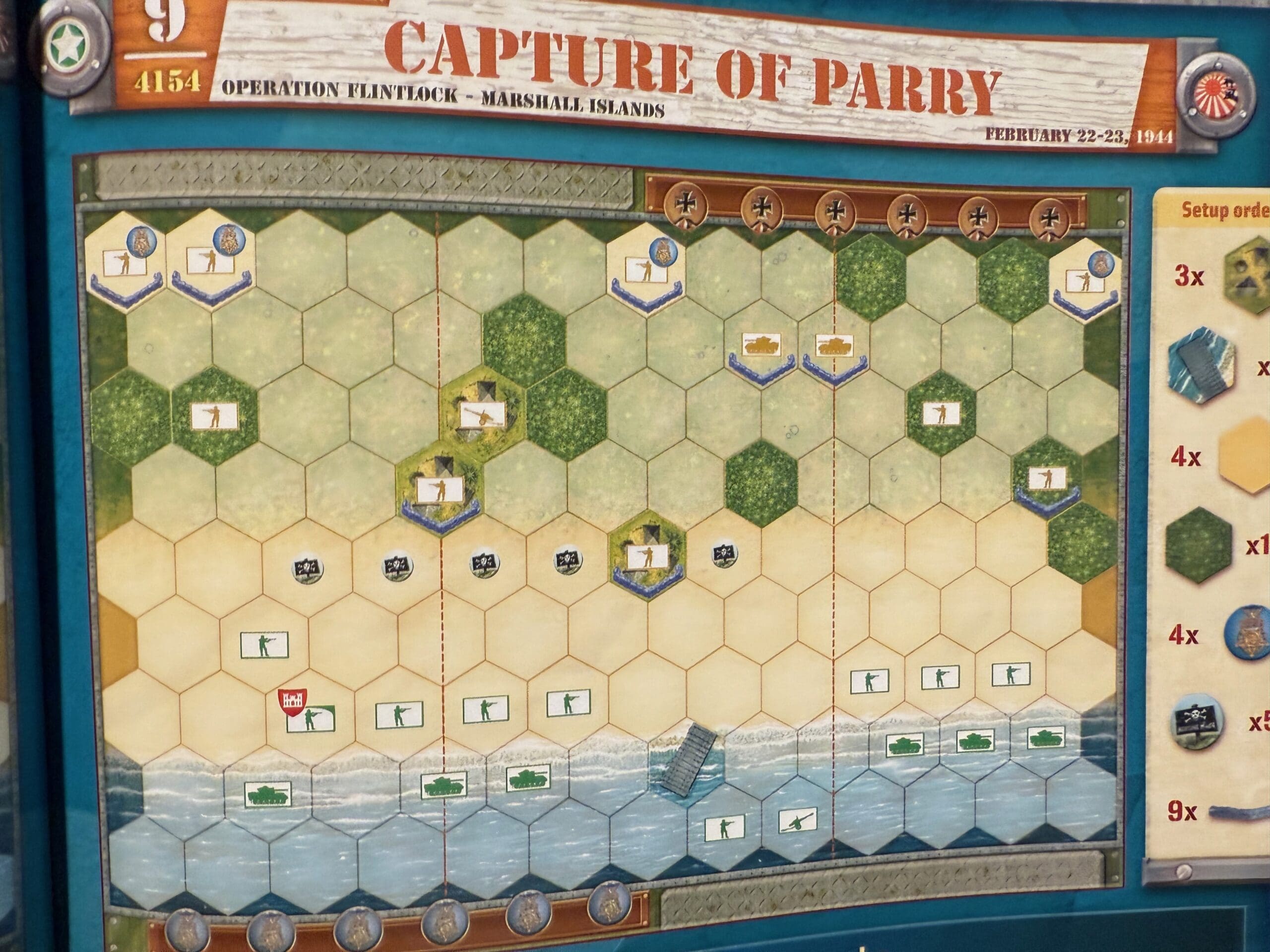
Capture of Parry

Capture of Parry

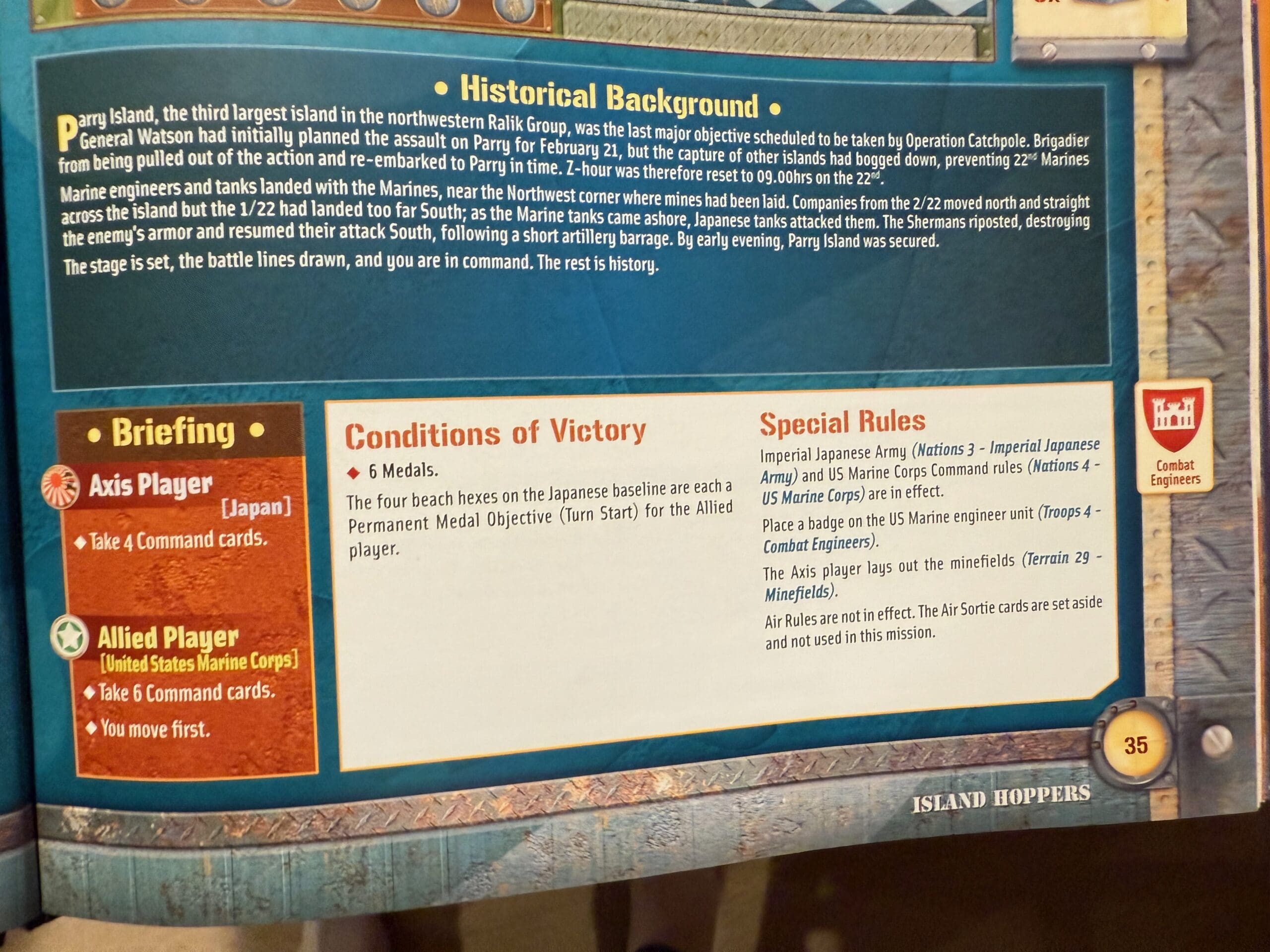
Parry Island was a textbook assault—our 4th Marines hit the beach with tanks rolling, guns blazing, and the Navy pounding from offshore. The enemy was dug in and ready to die, and they did—every last one of them. In just over a day, we turned their fortress into a smoking ruin. That win locked down Kwajalein and put us one step closer to Japan’s front porch. Fast, brutal, and effective—just the way war ought to be fought.

~~ General Howitzer

6 VP’s

card

Card Balance:

Allies – 6

Axis – 4

Complexity:

3

Conditions:

Beach &  Jungle

Context:

Location:

Marshall Islands

Year:

1944

Theater:

Western

Campaign:

Marshall Islands

Codename:

Operation Flintlock

Summary:

Objectives:

6 VP’s

Battlefield:

Beach.

Troops:

Allies – 9 Infantry, 6 Armor, 1 Artillery

Axis – 9 Infantry, 2 Armor, 1 Artillery


medal allies

Allied Strategy:

1.  

medal axis

Axis Strategy

1.

Battle Reports

0
BR - Capture of Parry

Author:

Days of Wonder

Resource:

Campaign Book, Volume 2

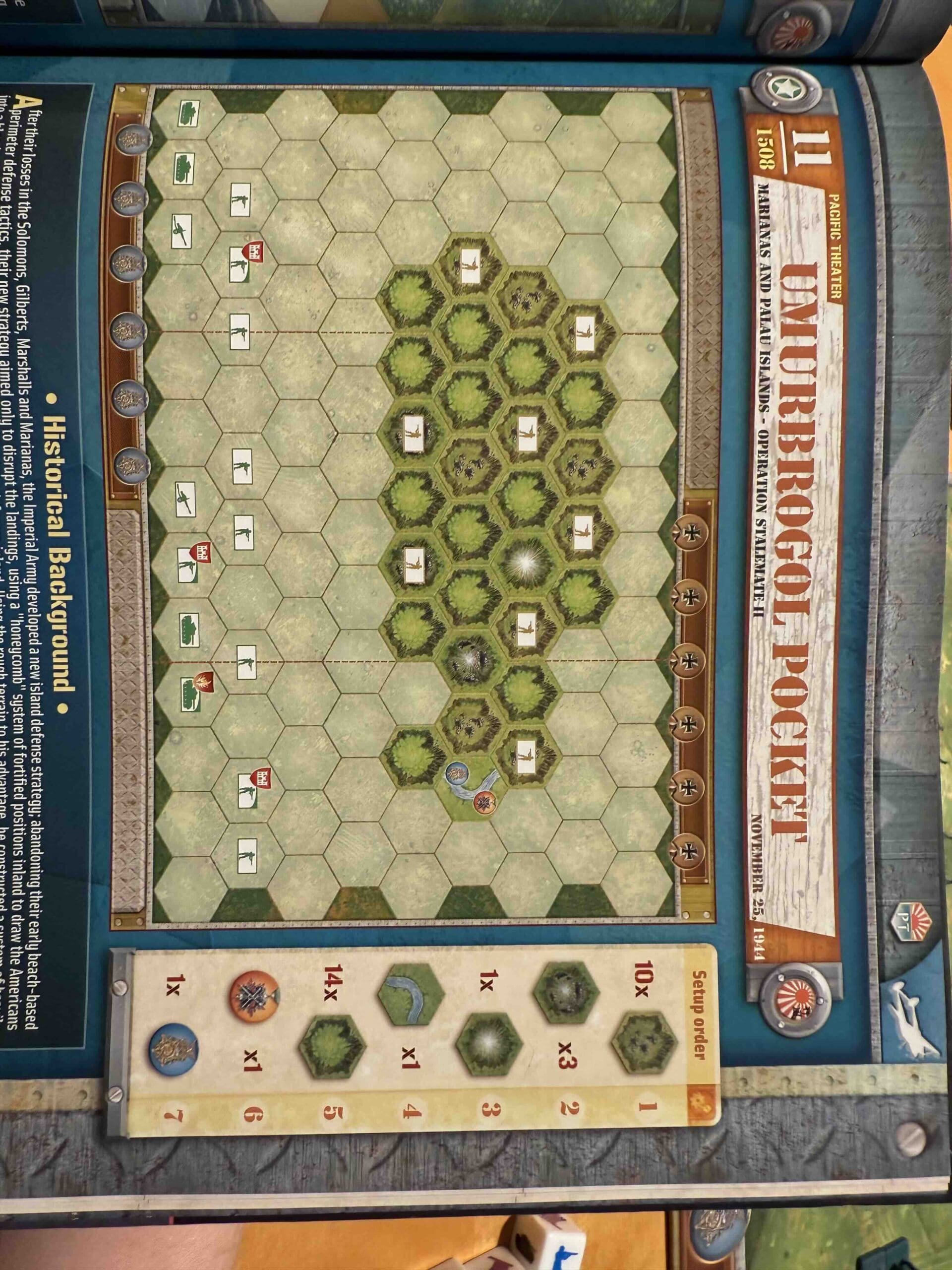
Umurbrogol Pocket

Umurbrogol Pocket

The Battle of the Umurbrogol Pocket in November 1944 was one of the fiercest and most grueling phases of the Battle of Peleliu during World War II. U.S. Marines faced deeply entrenched Japanese defenders in a mountainous, cave-ridden area known as “Bloody Nose Ridge.”

General Howitzer’s summary:

The Umurbrogol Pocket was a nightmare carved into rock—our Marines went up against die-hard defenders holed up in caves. The Japanese were dug in deep, fighting to the last man, and made us pay for every inch in blood. Flamethrowers, grenades, and guts—that’s what it took to root them out. It was slow, savage, and costly, but in the end, we crushed them. That ridge showed just how far the enemy would go—and how much farther we were willing to go to win.

5 VP’s

card

Card Balance:

Allies (US Marines) – 5

Axis – 4

Complexity:

3

Conditions:

Jungle Beach

Context:

Historical

Location:

Marianas & Palau Islands

Year:

1944

Theater:

Pacific

Campaign:

The Battle of Peleliu

Codename:

Operation Stalemate II

Summary:

Objectives:

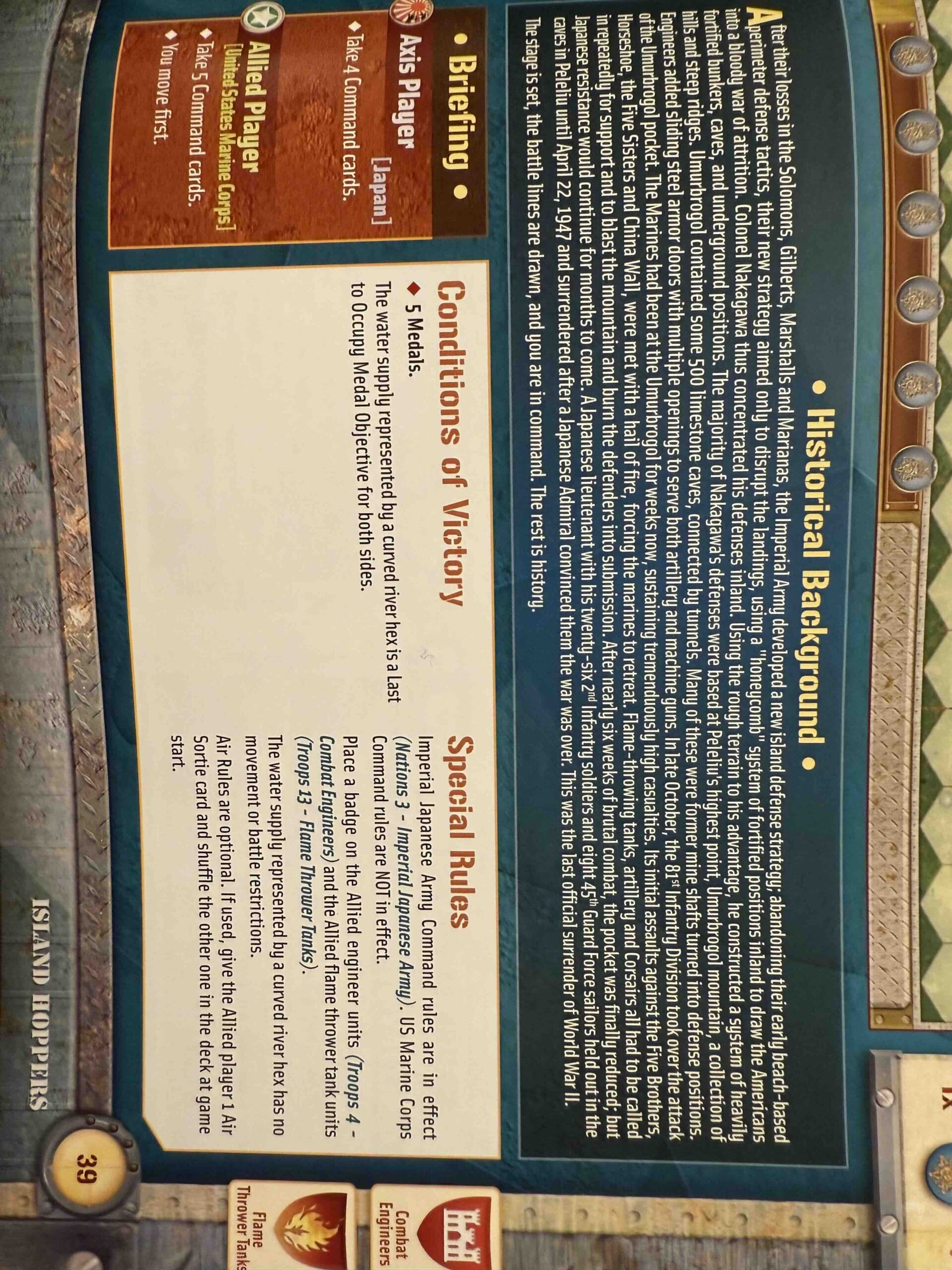
5 VP’s plus a Last to Occupy Medal Objective

Battlefield:

Combination of hills and hills with caves .

Troops:

Allies – 9 Infantry, 4 Armor, and 2 Artillery

Axis – 8 Infantry


medal allies

Allied Strategy:

1.  Use your Artillery and Armor as much as you can to attack the Japanese defenders at a distance.  When they are sufficiently weakened, you can move in your infantry, beginning with your Engineers to finish up the forward units.

2.  The fresh water river is a victory medal which goes to the  Last to Occupy.  Keep some forces on hand to grab it as a final victory point.

medal axis

Axis Strategy

1.  You have a very strong defensive position which allows you to quickly move between caves and hide your weak units when necessary.

2.  Take advantage of your Seishin Kyoiku powers and attack any enemy troops using the Banzai War Cry which come within two hexes of your Infantry.

3.  Guard the fresh water source, and keep the enemy away from it, as they will attempt to grab it on their final move. 

Battle Reports

0
BR - Umurbrogol Pocket

Author:

Days of Wonder

Resource:

Campaign Book, Volume 2

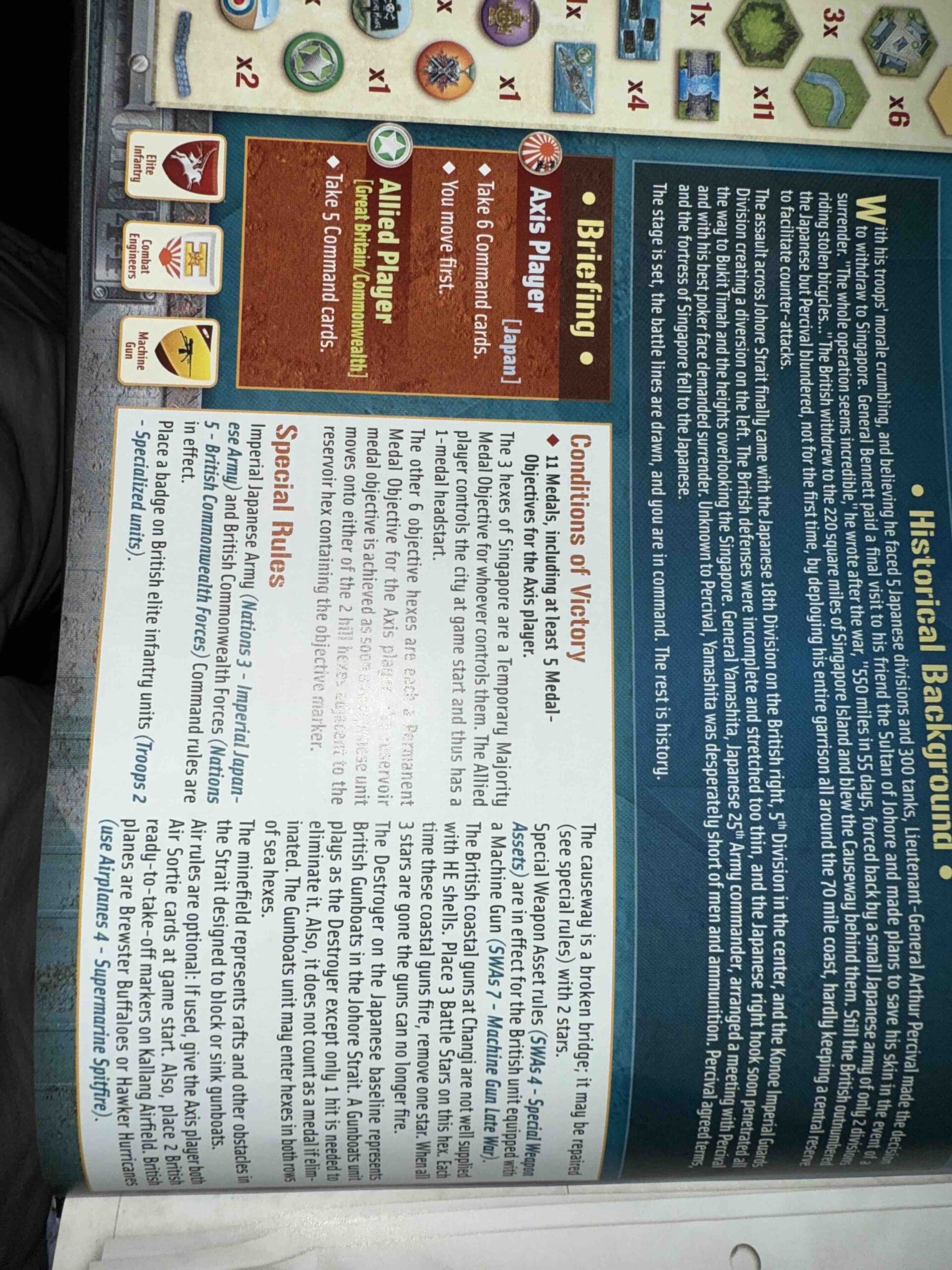
Singapore

Singapore

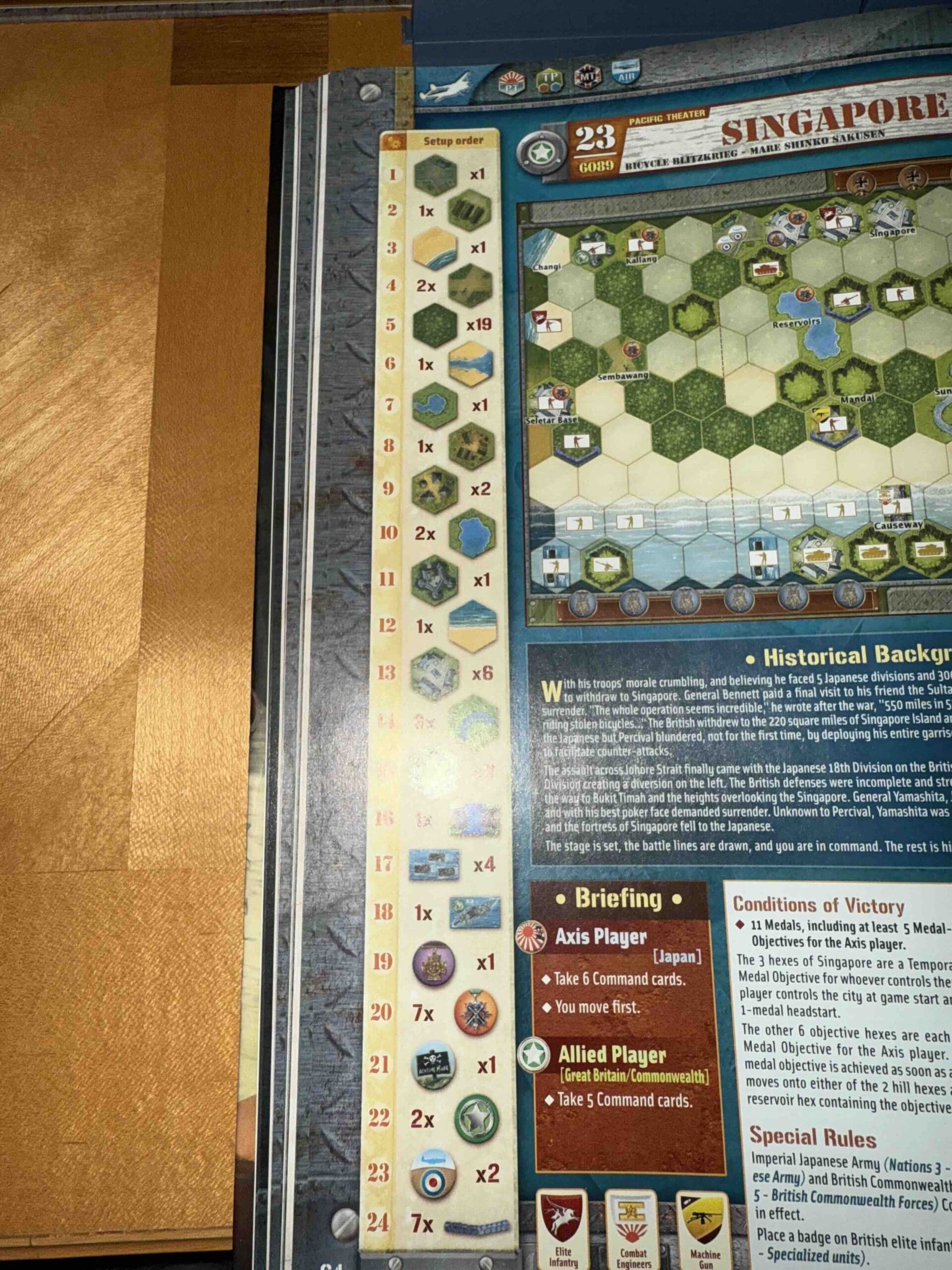
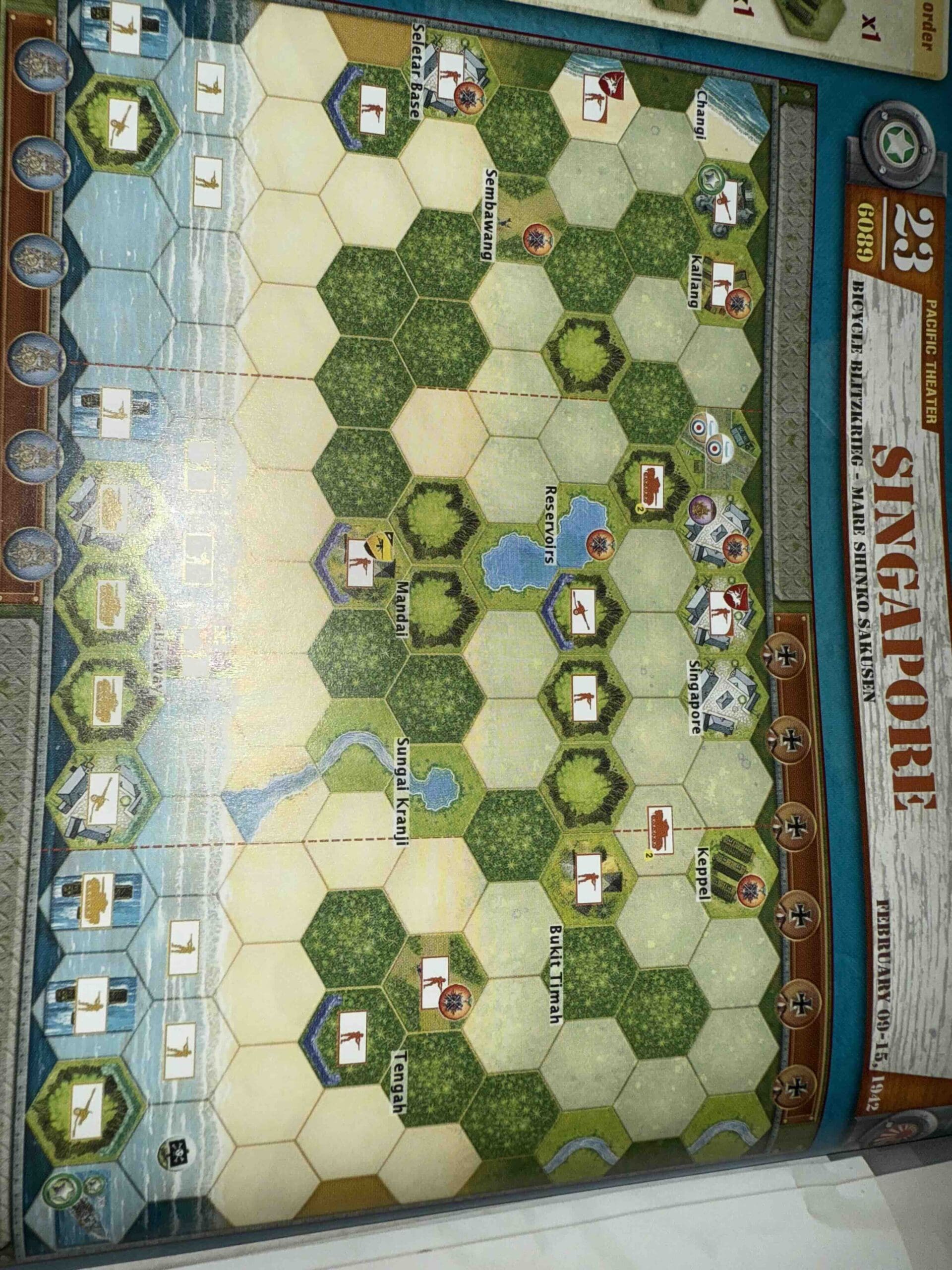
The Battle of Singapore in February 1942 was the climactic phase of Japan’s “Bicycle Blitzkrieg” during the Mare Shinko Sakusen (Greater East Asia Co-Prosperity Sphere offensive). Japanese forces, using speed, surprise, and bicycles to maneuver swiftly through Malaya, overwhelmed British Commonwealth defenses and pushed them back to Singapore.

Despite its strong coastal defenses, Singapore fell after a week of land-based attacks and psychological warfare. General Percival surrendered on February 15, 1942, in one of Britain’s worst military defeats, with over 80,000 Allied troops taken prisoner. The fall of Singapore stunned the Allies and gave Japan control over a key strategic stronghold in Southeast Asia.

General Howitzer sums it up in one sentence:
The Japanese rolled through Malaya on – can you believe it! – bicycles, outmaneuvered the Brits, and took Singapore without breaking stride—proof that arrogance and poor leadership lose wars faster than bullets.

11 VP’s, including at least 5 Medal Objectives for the Axis player.

card

Card Balance:

Allies – 5

Axis – 6

Complexity:

4

Conditions:

Jungle Beach

Context:

Historical

Location:

Singapore

Year:

1942

Theater:

Pacific

Campaign:

Bicycle Blitzkreig

Codename:

Summary:

Objectives:

11 VP’s including Permanent Medal and Temporary Majority Medal Objectives

Battlefield:

Combination of beach assault and jungle terrain and the city of Singapore.

Troops:

Allies – 10 Infantry including Machine Gun, 2 Artillery, a gun boat, and optional British Hawker Hurricanes

Axis – 10 Infantry, 4 Armor, 3 Artillery


medal allies

Allied Strategy:

1.  You have a gun boat in the corner right next to the enemy. Use it as many times as you can before they take it out.

2.  You have a couple of Artillery. Use them well, but note that the unit at Changi only has enough ammo for three hits. 

3. You have many Permanent Medal Objectives to guard, so in most cases you will need to keep your forces in a defensive position.

4.  Air rules are optional. It is important for British defenses to make use of them as you have two Hawker Hurricanes at your disposal.

medal axis

Axis Strategy

1.  You have many forces which can be brought to bear but you will need to use your landing craft to get them ashore. 

2.  You need to take out the enemy gun boat in the corner of your right flank ASAP. That will only take one Grenade. 

3.  Once you have dealt with immediate threats near the beach, you can take some time to repair the causeway, which will take two Stars.  Then you can advance your three Armor units into battle.

4.  Your right flank is your strongest. Once you get your forces ashore with the landing craft, you can advance against Tengah and capture your first Medal Objective. Then you can continue deep into enemy territory.

Battle Reports

0
BR - Singapore

Author:

Days of Wonder

Resource:

Campaign Book, Volume 2

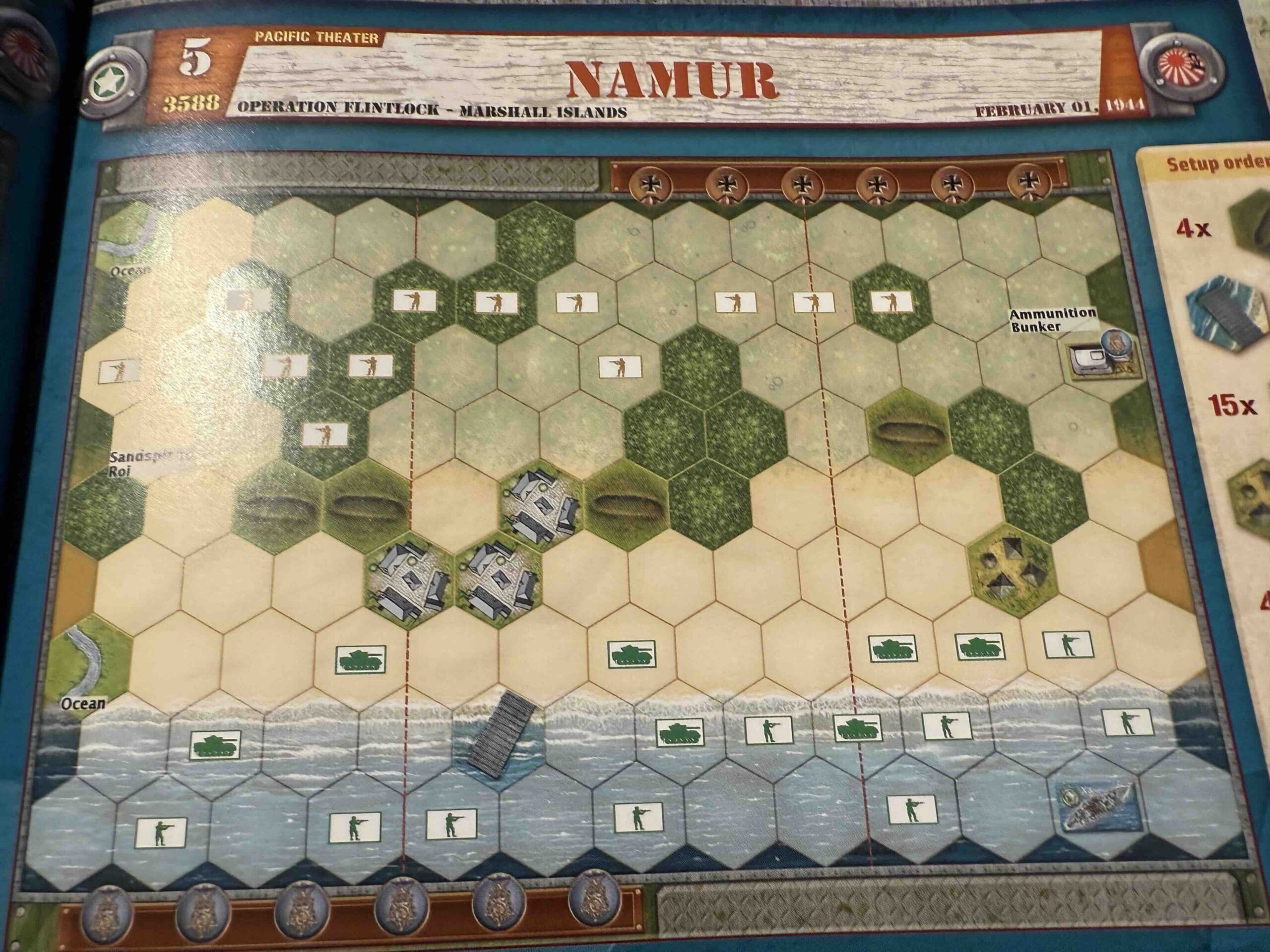
Namur

Namur

The Battle of Namur took place on February 1–2, 1944, as part of the U.S. assault on the Marshall Islands during World War II. U.S. 2nd Marine Division forces landed on Namur Island, part of the Kwajalein Atoll, facing fierce resistance from well-entrenched Japanese defenders. The battle saw intense close-quarters combat, complicated by Japanese bunkers, sniper fire, and booby traps. A massive explosion at a Japanese ammunition dump—triggered by American fire—caused heavy U.S. casualties but also disrupted enemy defenses. After two days of brutal fighting, the Marines secured the island. Namur’s capture was a key step in the U.S. island-hopping campaign, giving the Allies a critical foothold in the central Pacific and weakening Japan’s outer defensive ring.

General Howitzer’s summary:

Namur was a two-day slugfest—our 2nd Marines hit the beach and ran headfirst into bunkers, snipers, and traps laid by fanatical Japanese soldiers dug in like ticks. One hell of a blast tore through their ammo dump—and some of our boys with it—but it cracked their line wide open. When the smoke cleared, Namur was ours, and we had a solid damn grip in the Marshalls. Another island down, and one step closer to Tokyo.

5 VP’s

card

Card Balance:

Allies – 5

Axis – 5

Complexity:

3

Conditions:

Jungle Beach

Context:

Historical

Location:

Marshall Islands

Year:

1944

Theater:

Pacific

Campaign:

Codename:

Operation Flintlock

Summary:

Objectives:

5 VP’s plus the Ammunition Bunker Permanent Medal Objective

Battlefield:

Combination of beach assault and jungle terrain with some small villages.

Troops:

Allies – 9 Infantry, 7 Armor, and a Destroyer ship

Axis – 12 Infantry


medal allies

Allied Strategy:

1.  Like all beach scenarios, the first objective is to get off of the beach as quickly as possible and assemble all of your forces into a cohesive fighting unit. 

2.  You have a Destroyer which has an attack range and power of 3,3,2,2,1,1,1,1; so 8 hexes deep!  Plus with a successful hit you gain a targetting reticule upon the hex, which increases the dice by one until the hex is destroyed or vacated.   Use it!

3.  Use your Armor to soften up the enemy at a distance, should any of them venture near the shore.  Remember that because of the Seishin Kyoiku principle, and full-force Japanese units attack with four dice at Close Range.  So hit each one at least once before venturing near them.

4.  The Ammunition Bunker is a Permanent Medal Objective(!) – if you can blow it up.  So occupy it and roll two dice, and hope for a star; but a grenade will kill one of your Marine figures, so be careful!

medal axis

Axis Strategy

1.  You have superior numbers on your right flank and central section.  So move your forces into the jungles and town hexes to hold off the enemy forces.

2.  Get close and then by combining the Banzai two-hex Close Assault attack with any full-force units, you can hit them with the Seishin Kyoiku princple and roll four-dice with each attack.

3.  Guard the ammunition bunker so that the enemy does not get an easy Permanent Medal Objective.

4.  With all of the enemy tanks in the area, do not get any of your forces caught in the open.

Battle Reports

1
BR - Namur

Author:

Days of Wonder

Resource:

Campaign Book, Volume 2

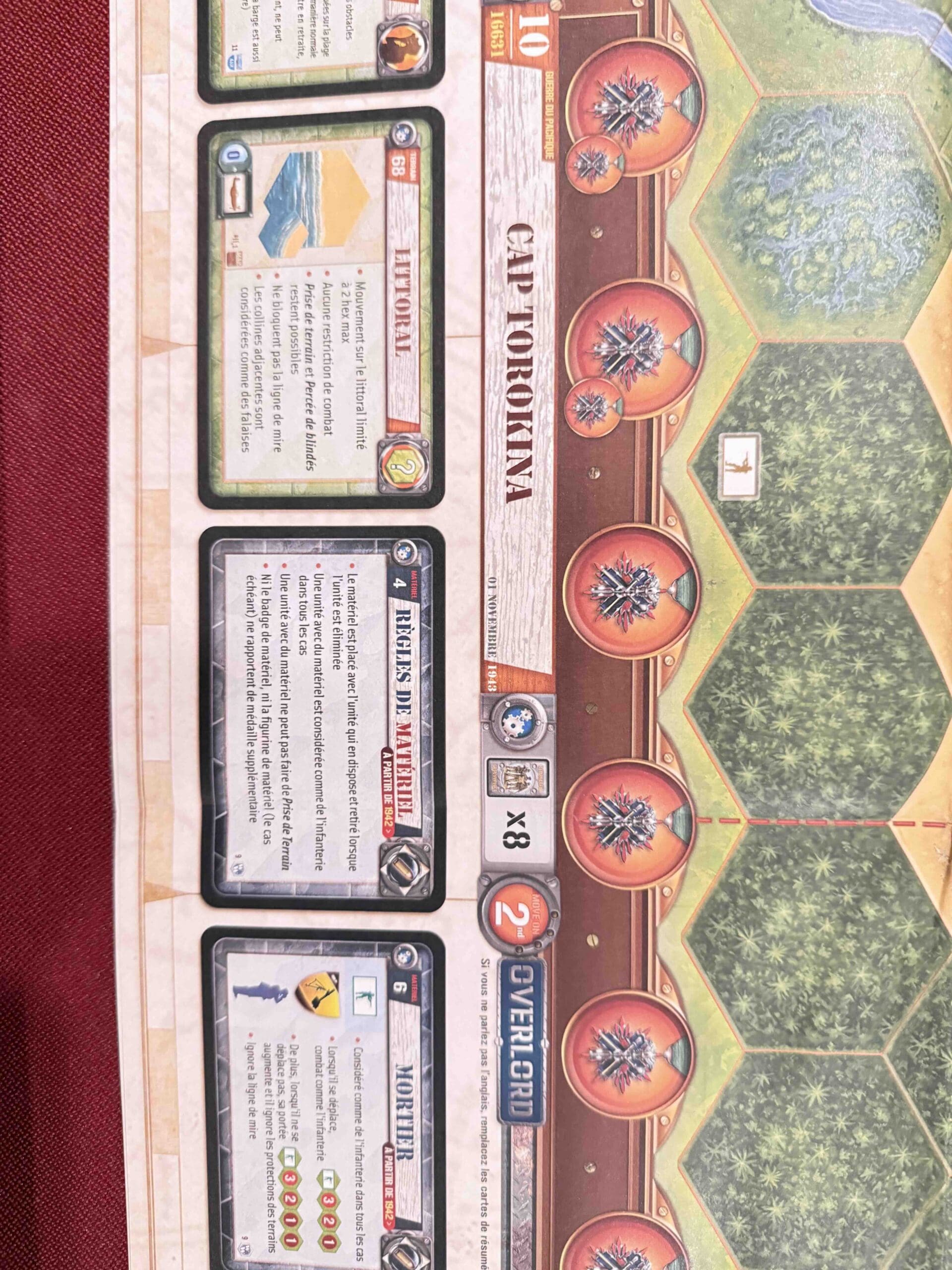
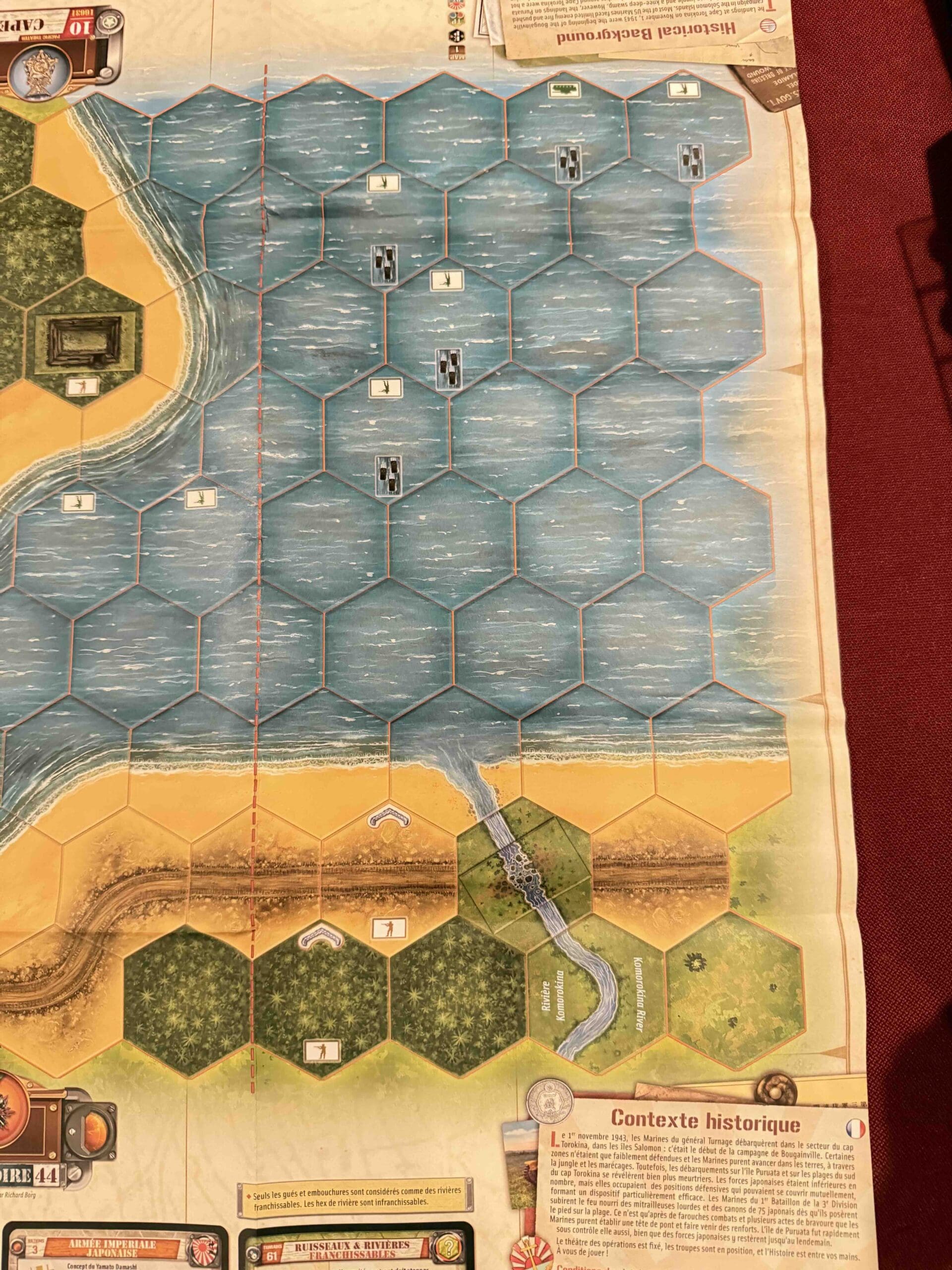
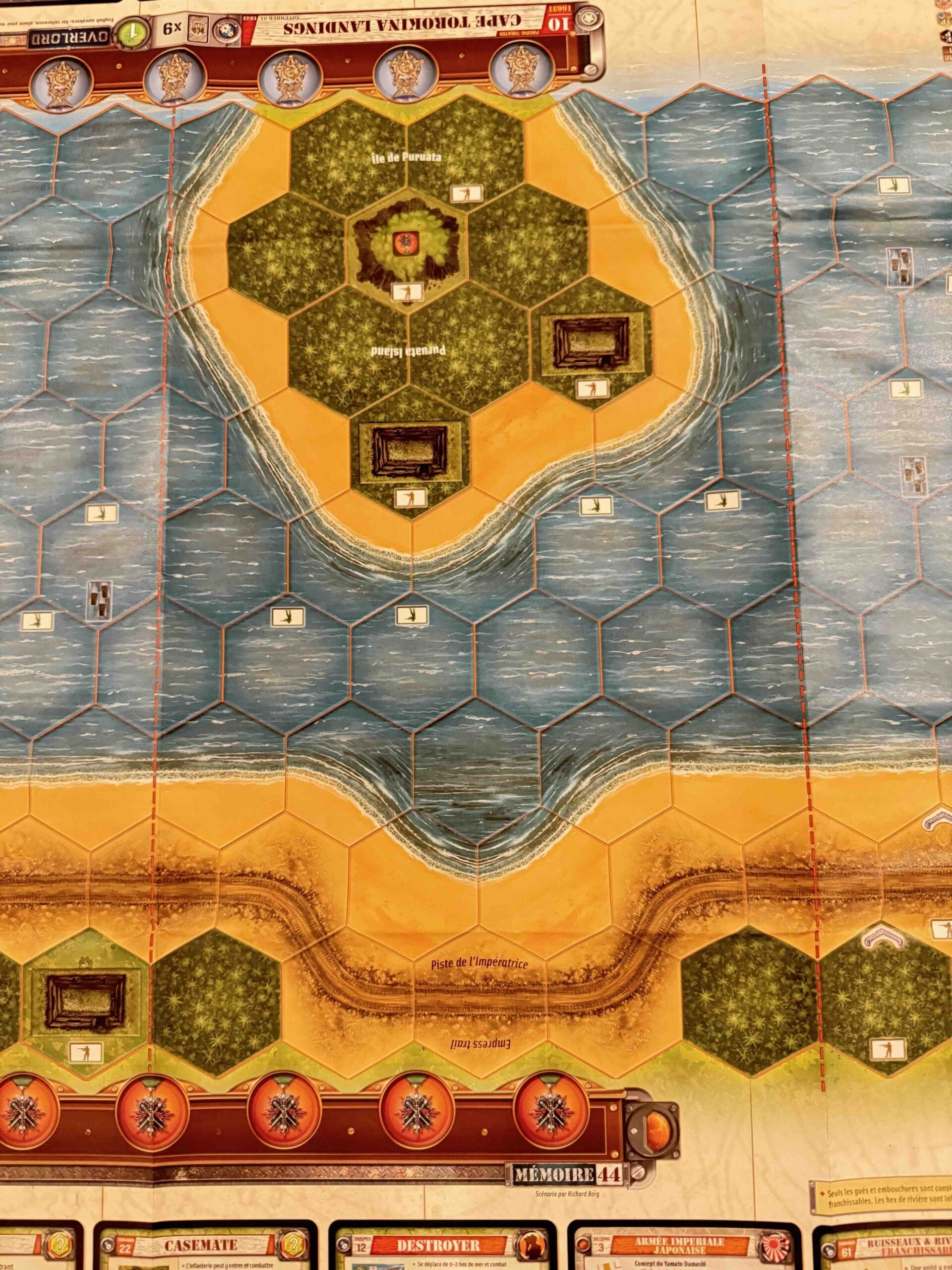
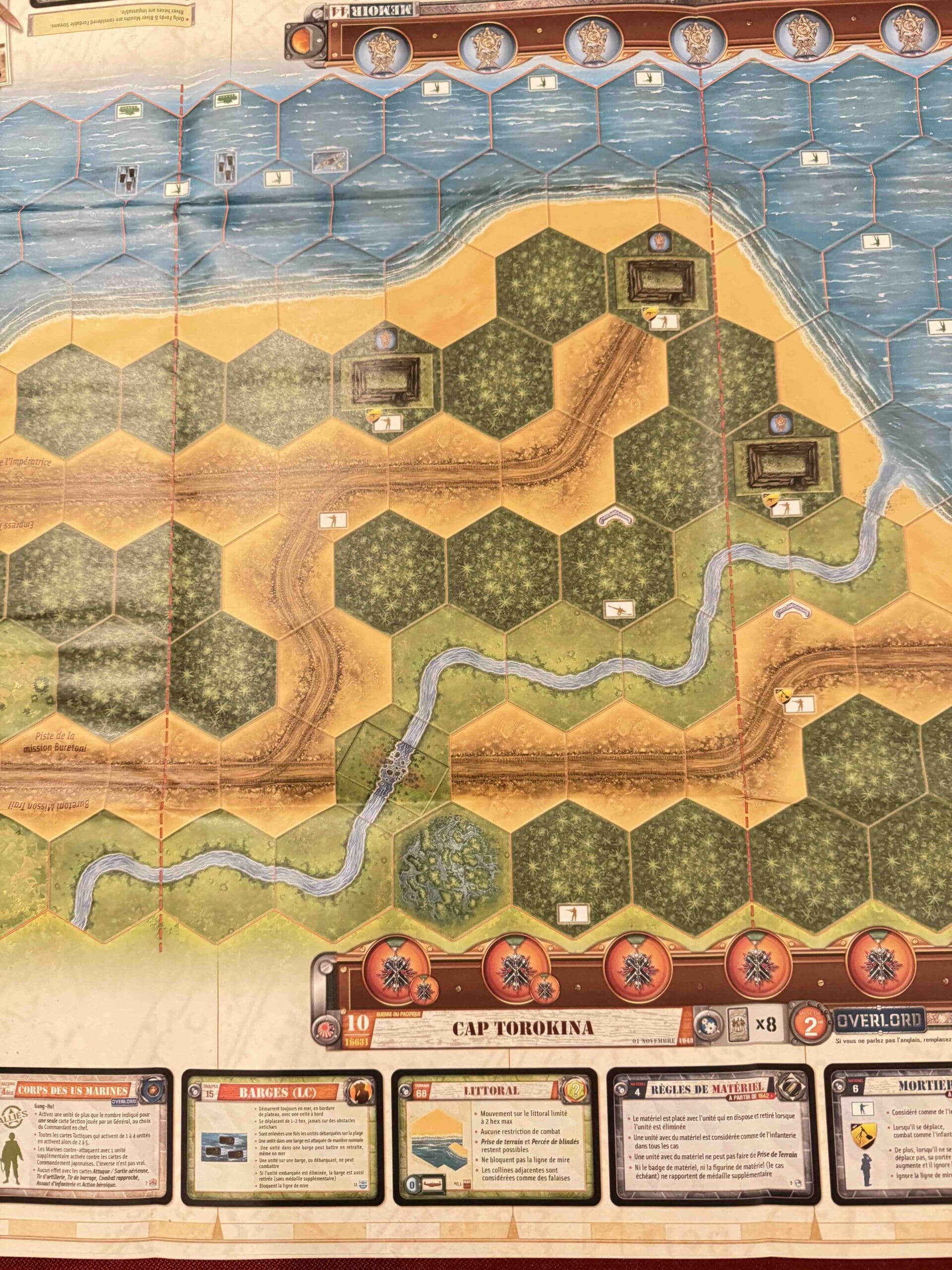
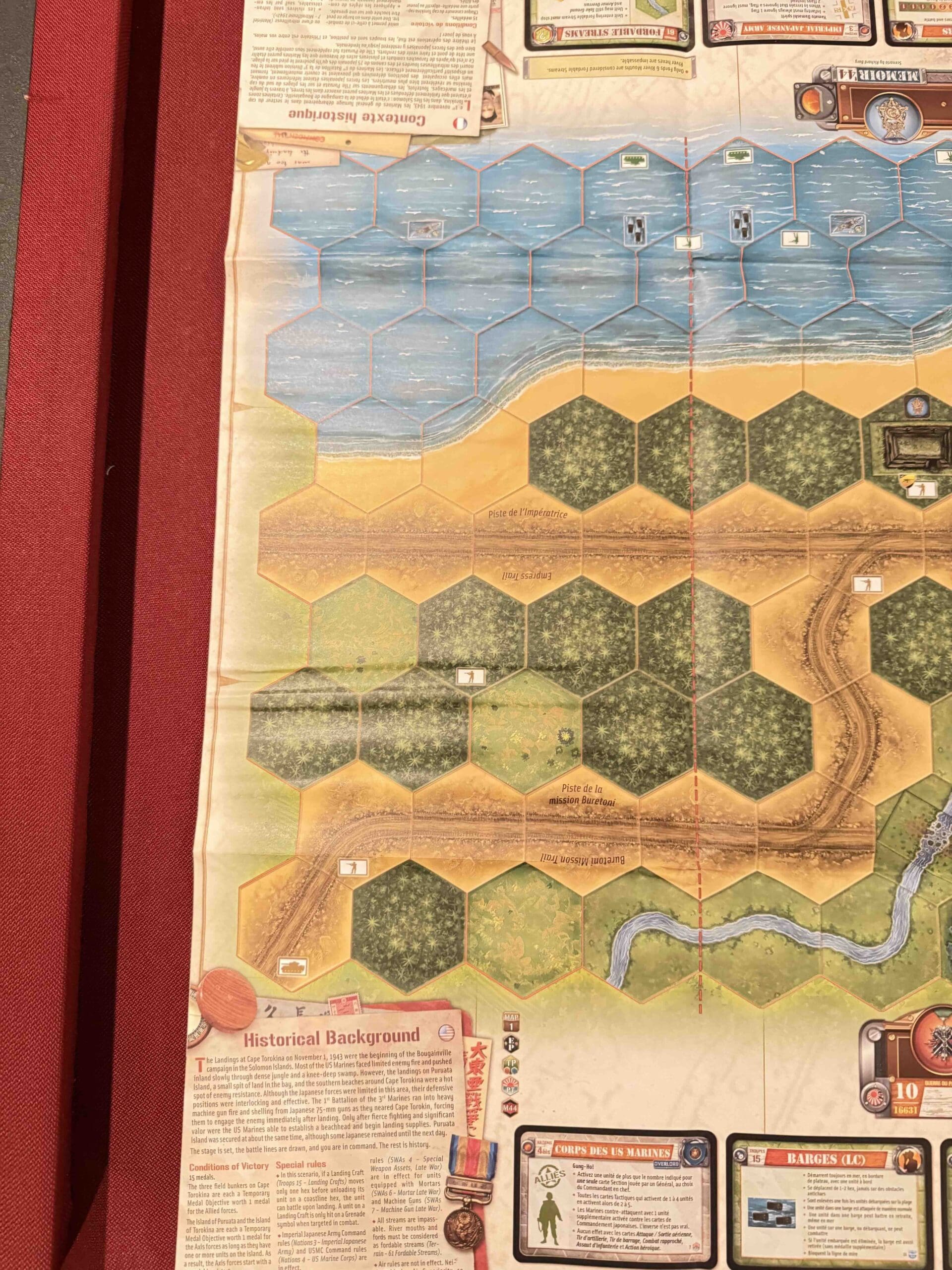
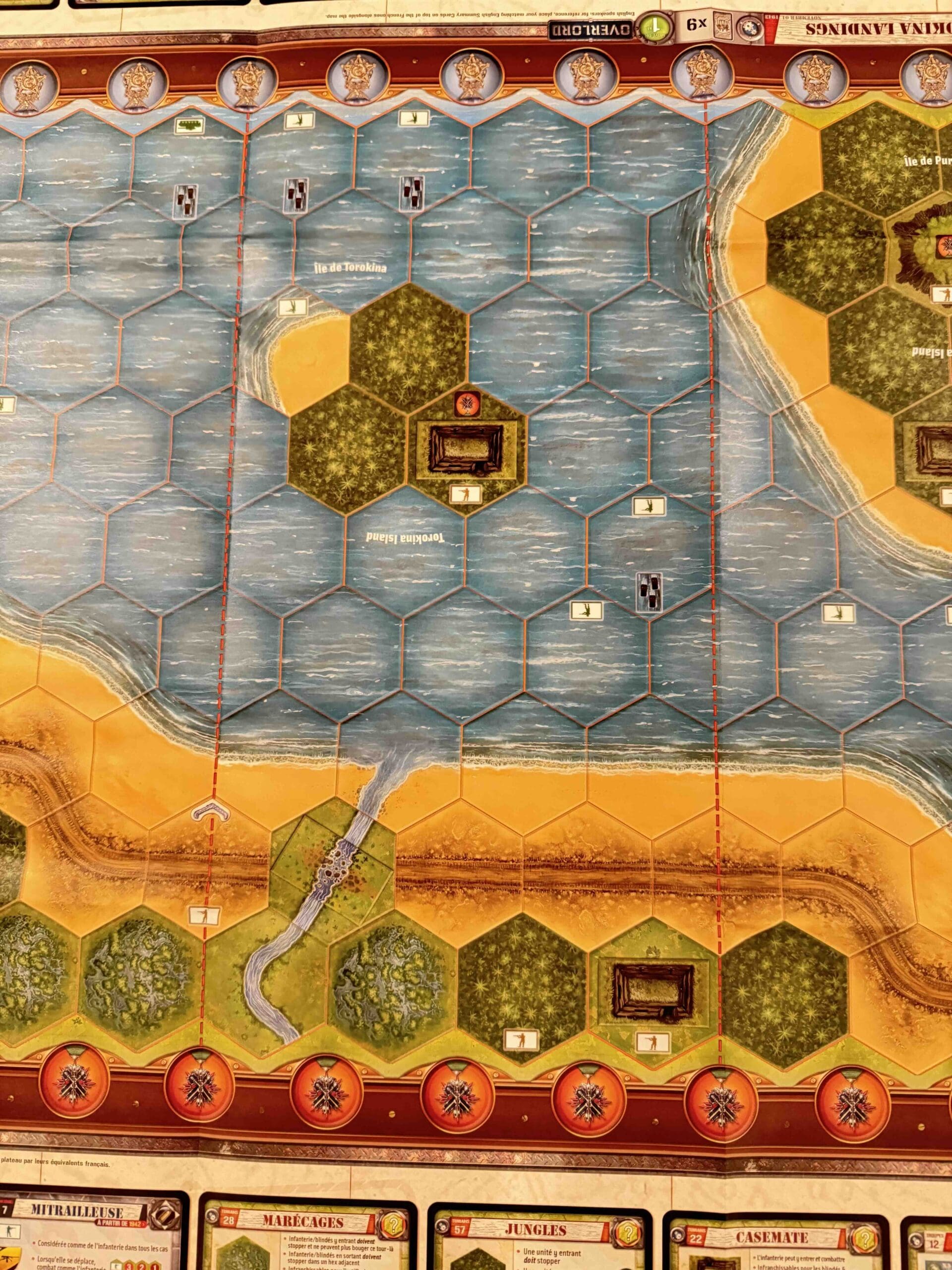
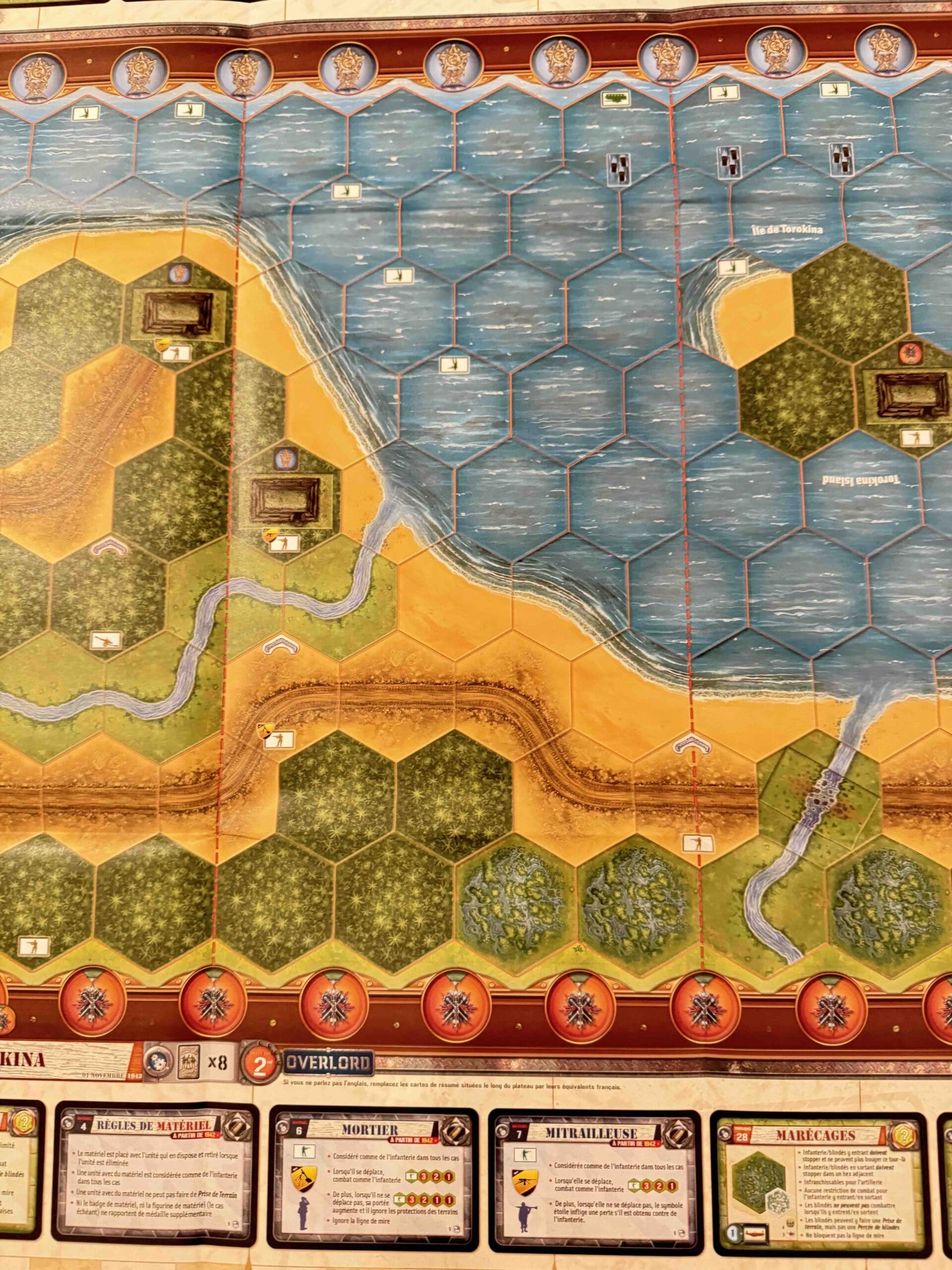
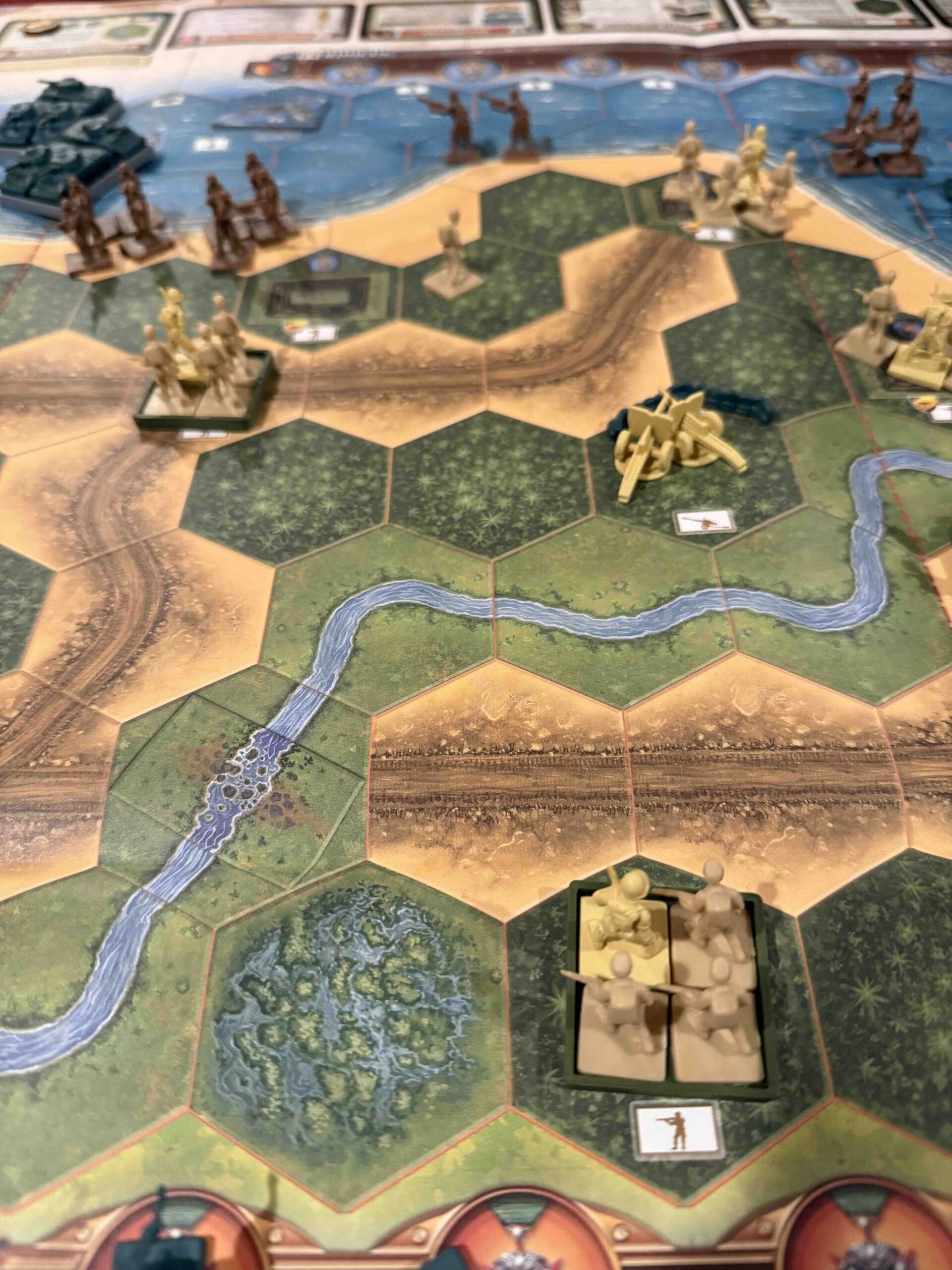
Cape Torokina Landings

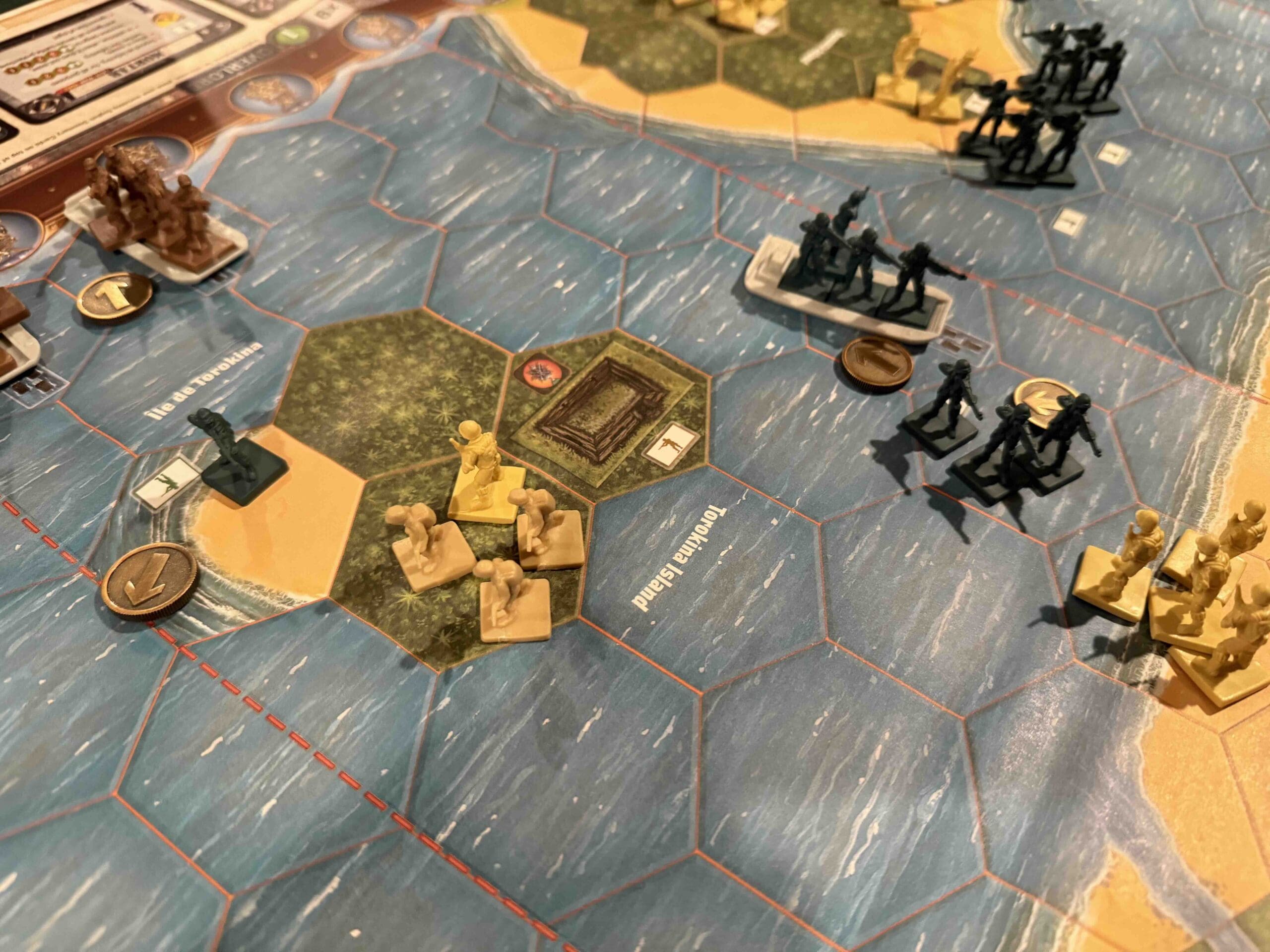
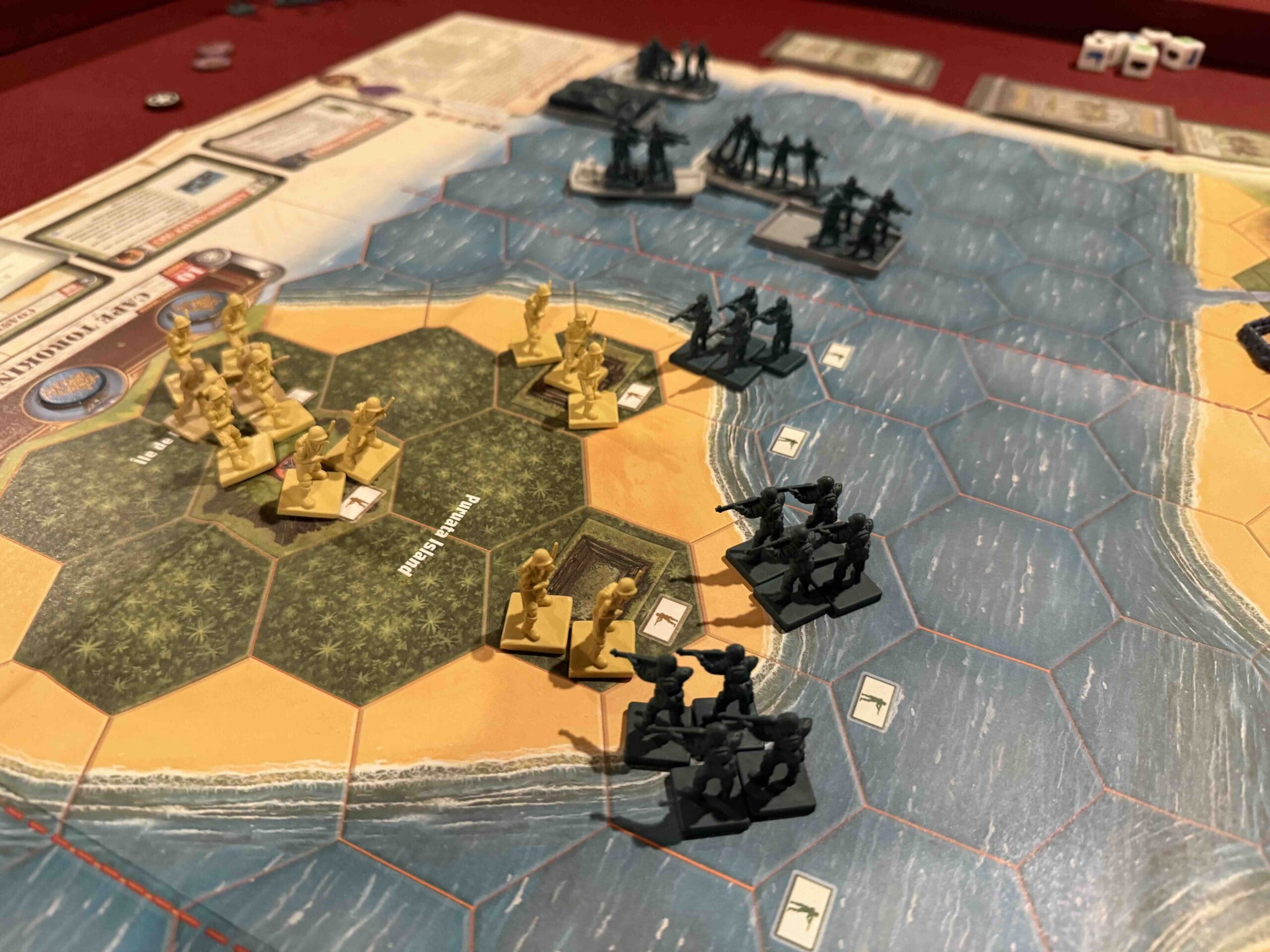
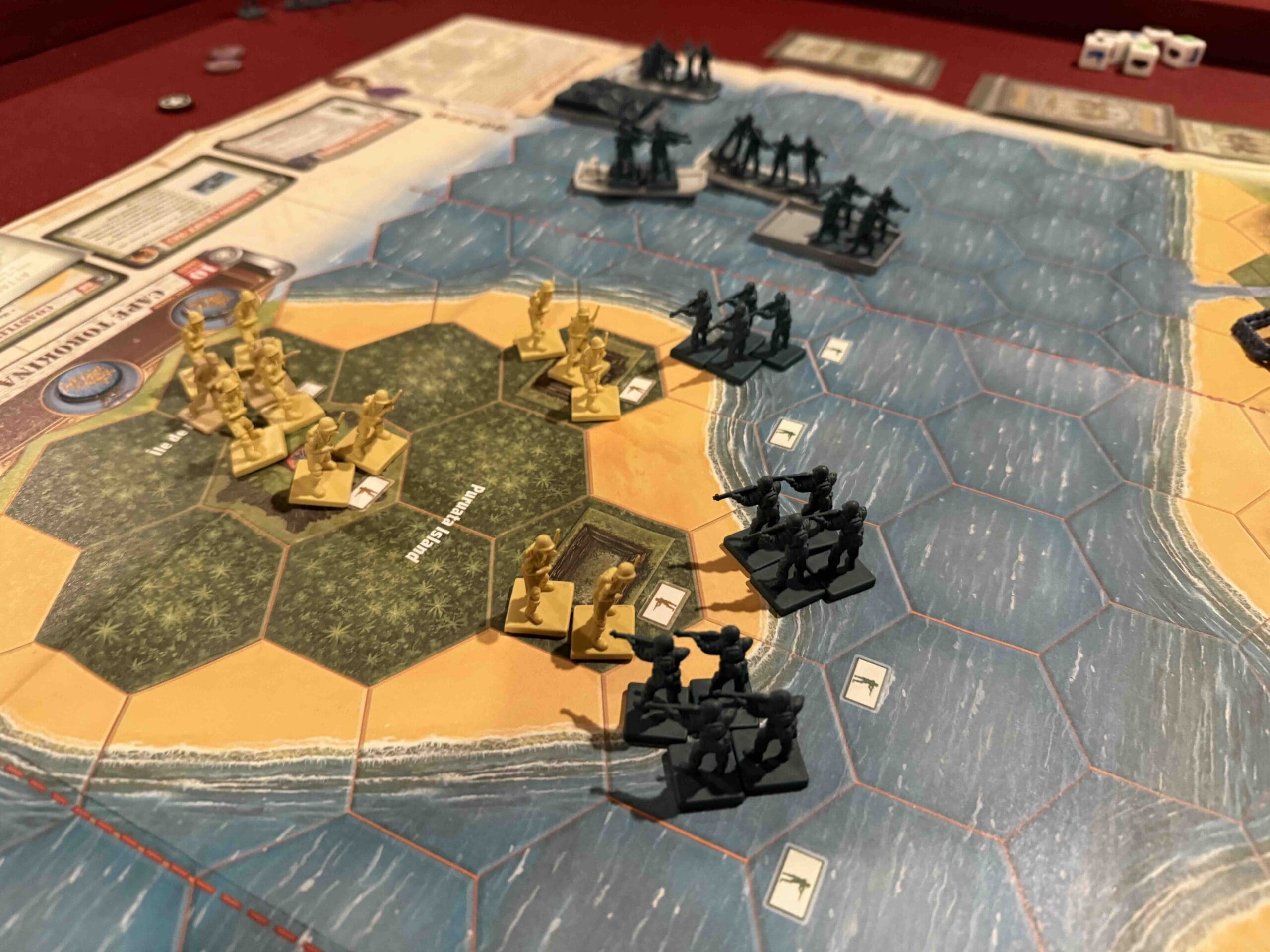
Cape Torokina Landings (Overlord Map)

“Listen up, men! On November 1st, 1943, our boys hit those beaches at Cape Torokina like a thunderbolt. Those Marines of the 1st and 3rd Divisions didn’t blink at the sight of jungle, mud, and dug-in enemy troops. They took that beachhead by the throat and held on like bulldogs!

This wasn’t just another island—it was the gateway to busting open Rabaul and cutting off those Japanese forces. The jungle was a green hell, but we cut through it, took the ground, and started building the airstrips and supply bases to keep the hammer coming down.

That’s how you do it, boys—land hard, fight harder, and don’t stop until you’ve got a fortress behind you and the enemy on the run. That’s what those Marines did at Cape Torokina—they paved the road to victory in the Pacific!

~~ General Howitzer

Timeline of the Cape Torokina Landings (Bougainville)

  • November 1, 1943D-Day for Cape Torokina:
    U.S. 1st and 3rd Marine Divisions land at Cape Torokina. Initial beachhead secured despite Japanese resistance and tough jungle terrain.

  • November 2–3, 1943
    Marines expand the perimeter, clearing Japanese defenses in nearby jungle areas.

  • Mid-November 1943
    Seabees and engineers begin constructing airfields and supply bases within the beachhead.

  • December 1943–January 1944
    Marines fortify positions, repel repeated Japanese counterattacks.
    Japanese strongpoints isolated and bypassed.

  • March–April 1944
    U.S. Army relieves Marines; continuing operations to expand and secure the beachhead.

15 VP’s

Card Balance:

Allies (Marines) – 9

Axis (Japan) – 8

Complexity:

4

Conditions:

Beach

Context:

Historical

Location:

Solomon Islands

Year:

1943

Theater:

Pacific

Campaign:

Bougainville

Codename:

Summary:

Objectives:

15 VP’s with various Medal Objectives for various territorial control.

Battlefield:

Islands with many rivers, roads, jungles, and hills

Troops:

Allies  – 21 Infantry, 4 Armor, 2 Destroyers, with Landing Crafts to bring them ashore

Axis  – 18 Infantry some with Special Weapons, 1 Armor, 1 Artillery


medal allies

Allied Strategy:

1.  There are a number of special rules which you need to be aware as commander of the Allied forces.  First, there are two islands (Torokina & Puruata), which must be taken. Because the enemy begins the battle with forces on the islands, they start the battle with two victory medals.  As soon as you eliminate the enemy from an island, you will cause them to lose a victory medal, but you will NOT gain one.    Also note that because the Landing Crafts (LC’s) leave after dropping off your troops, they will be stranded on that island. So make sure you commit enough troops to win, but not too many.

2.  There are also three Field Bunkers which provide Temporary Territorial Medals to whichever side occupies them.  But you must remain in the bunker to keep the medals. 

3.  What this means then, is that although you begin the battle with overwhelming force, in order to clear the islands, and then occupy the Field Bunkers, you will need to be leaving troops at each of those locations.  So your attack force will be diminished for each parcel of land which you capture.  This must be factored into your planning commander!

medal axis

Axis Strategy

1.  Your primary role in this battle is a defensive one, but that does not mean passive.  You have troops which need to be prepared to fight and brought into the battle arena.

2.  You have an Armor unit stuck in the corner in the right flank. Get it into the action as soon as you can.  

3.  You also have an Artillery which you should use at every opportunity to attack the enemy as they come ashore. 

4.  Make use of the Seishin Kyoiku doctrine to attack with your full force units at every opportunity in order to maximize your extra firepower while they are still strong. 

5. You have a lot of forces on the two islands.  Make the enemy pay for every inch of ground they take on the islands in order to reduce their main attack force.

Battle Reports

1
BR - Torokina

Author:

Days of Wonder

Link: