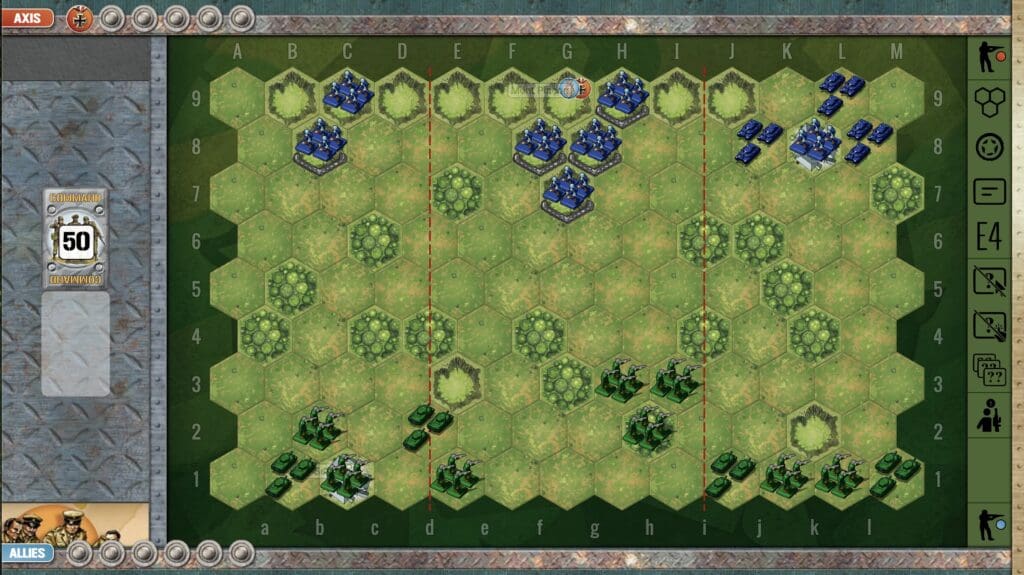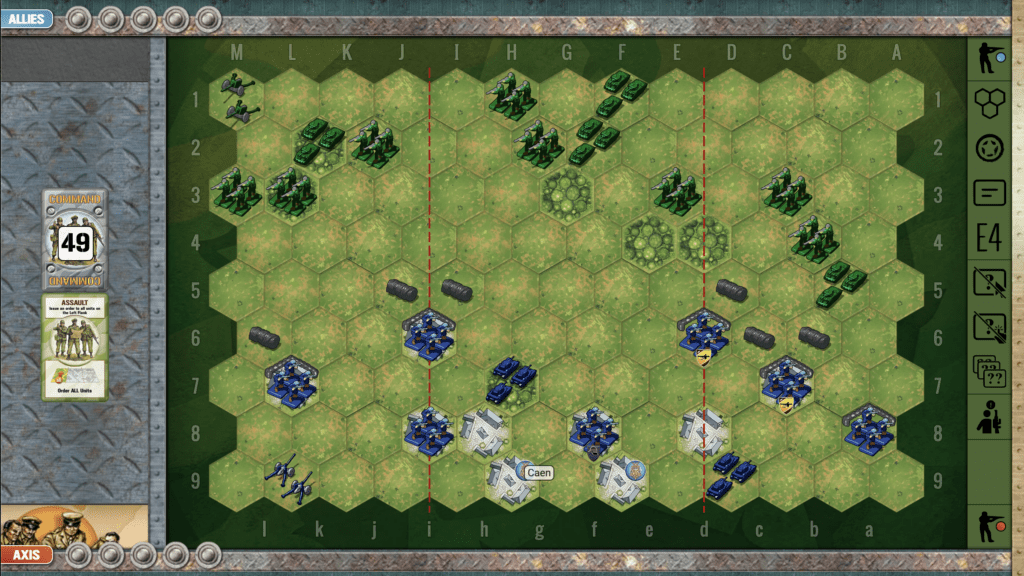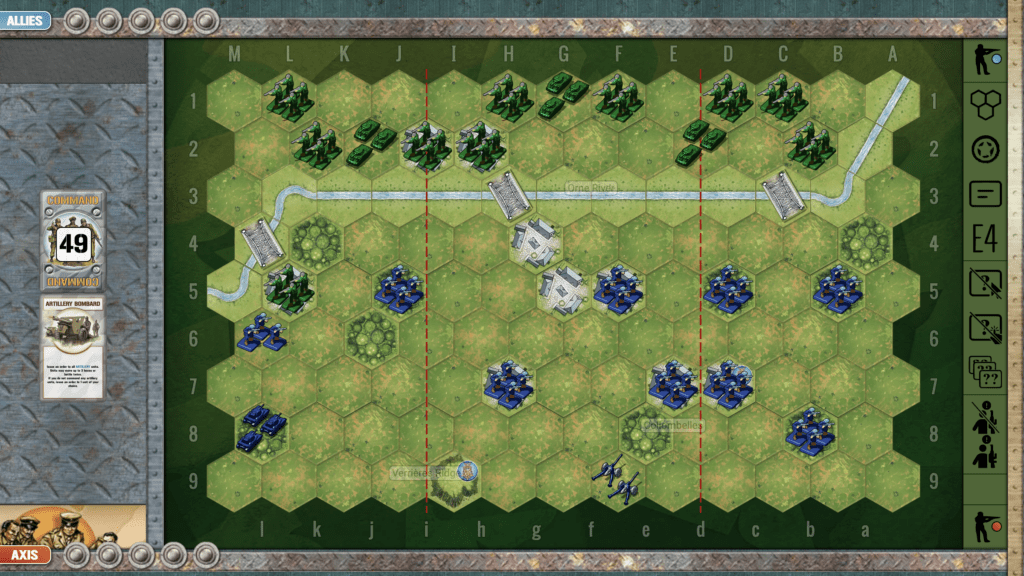
Night Withdrawal

Night Withdrawal

scenario_NightWithdrawal_start

“Listen up, boys! In the summer of ‘44, near Caen, the Germans knew the writing was on the wall. The British and Canadians were hammering them day and night with everything they had—artillery, tanks, and raw guts—as part of Operations Atlantic and Goodwood.

So what did those Germans do? They pulled a night withdrawal, slipping out under the cover of darkness to dodge the hammer blows and set up shop further south. It was a smart move to avoid being boxed in and crushed outright, but let’s be clear: they gave up precious ground and lost their grip on Caen.

That’s the way of war, boys—sometimes you gotta know when to pull back before the jaws of encirclement snap shut. But every step back they took was another step forward for us—paving the road for our breakout from Normandy and the final drive to finish the job.

Remember this—you can run, but you can’t hide forever!

~~ General Howitzer

5 VP’s

card

Card Balance:

Allies – 4

Axis – 5

Complexity:

2

Conditions:

Countryside

countryside

Context:

Historical

Location:

France

Year:

1944

Theater:

Western Front

Campaign:

Normandy Campaign

Summary:

Objectives:

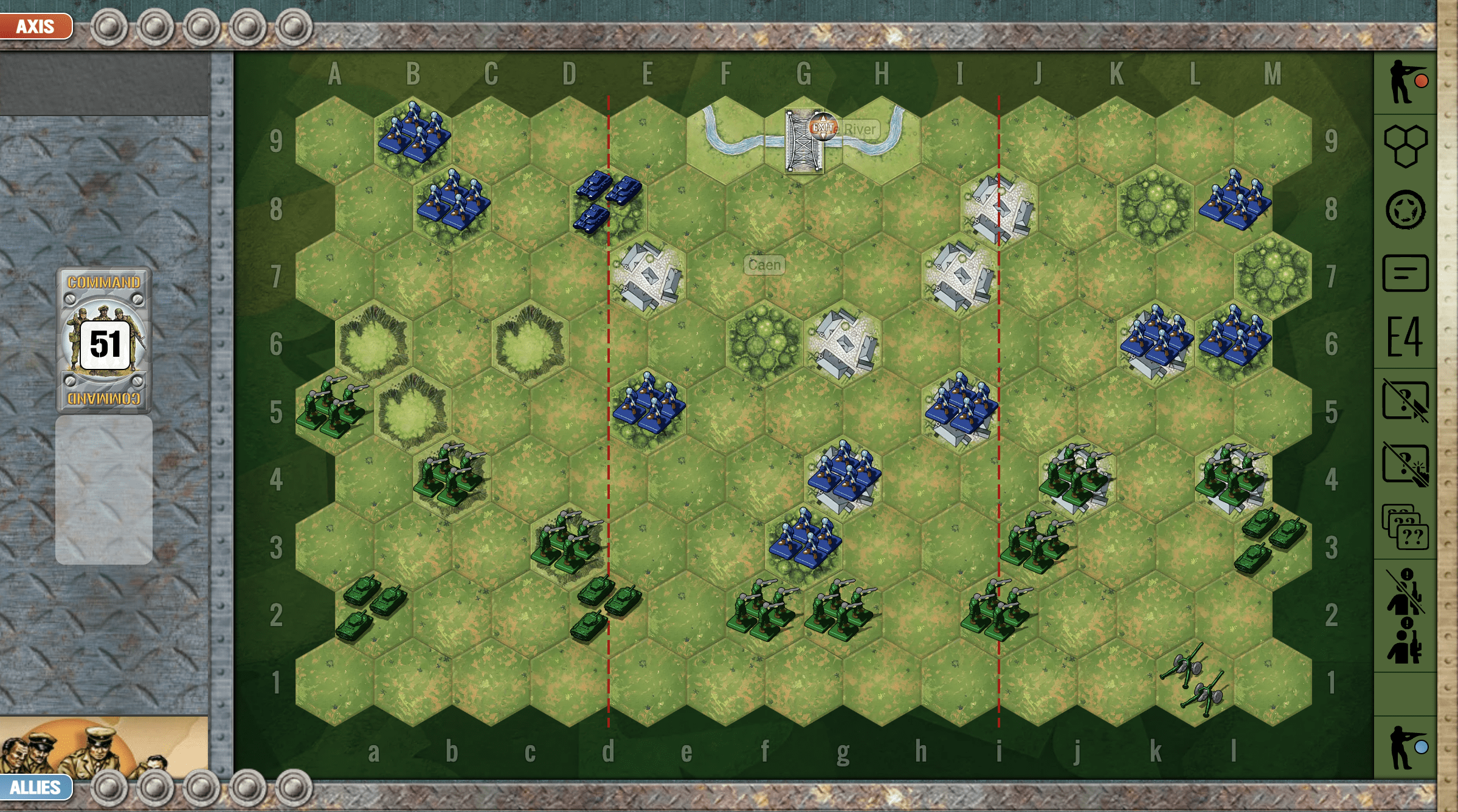
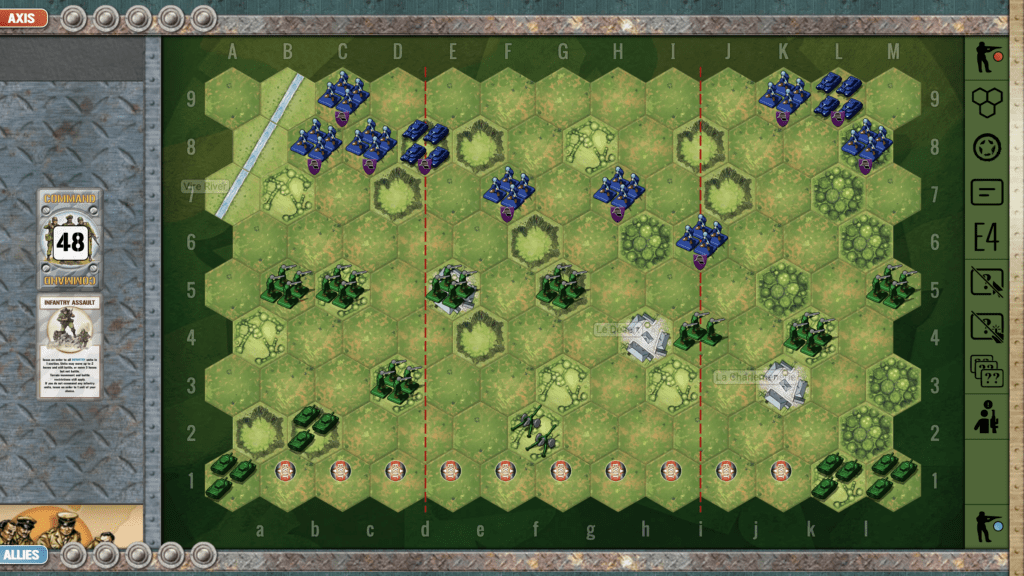
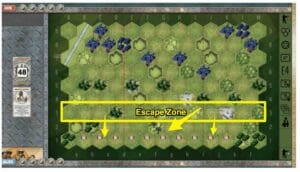
5 VP’s, plus the a exit row medals for the Axis(!) forces.

Terrain:

The battlefield is scattered with hills, towns, hedgerows, and forests.

Troops:

Allies – 9 Infantry, 3 Armor, 1 Artillery

Axis – 9 Infantry, 1 Armor


medal allies

Allied Strategy:

1.  The goal for the Allies is to pick off the Axis forces as they seek to escape across the Orne River.  If you can get one of your armor units in front of the bridge, you are almost guaranteed a victory. 

medal axis

Axis Strategy:

1. The goal for the Axis is to make a successful ‘Night Withdrawal’.  But the scenarios starts in daylight, while the Allies are able to blast you with Barrage, Air Power, and Artillery Bombardment.  So escape out the backdoor as soon as you are able to do so.

2.  Be wary of just running, as your forces will be picked off by the overwhelming Allied force before you can get away. So you need to do a strategic retreat in which some of your forces which are better positioned to either win, or quickly escape, can do so.

30
BR - Night Withdrawal

Author:

Days of Wonder

Link:
Martinville Ridge

Martinville Ridge

scenarios_MartinvilleRidge_start

“Listen here, men! The Battle of Martinville Ridge was a mean slugfest in July ‘44, right in the thick of the Normandy bocage. That damn hedgerow country turned every field into a fortress, and every ridge was a death trap. Our boys from the 35th Infantry Division went up that ridge with grit and guts, trying to crack those Nazi defenses wide open.

The Germans had the high ground and those thick hedgerows, making every inch of dirt a hellhole to fight for. We took the ridge at first—bayonets and grenades leading the way—but those Germans counterattacked like devils, forcing us to pull back and regroup. But I’ll tell you what: every drop of sweat and blood we left on that ridge kept the enemy tied up and bleeding too.

We didn’t take Martinville Ridge outright, but we sure as hell rattled the Germans’ cages and cleared the way for our breakout later in Cobra. That’s the price of victory, boys—no easy ground, no easy days. Keep pushing, keep killing, and never give ‘em an inch!

~~ General Howitzer

5 VP’s

card

Card Balance:

Allies – 5

Axis – 5

Complexity:

3

Conditions:

Countryside

countryside

Context:

Historical

Location:

France

Year:

1944

Theater:

Western Front

Campaign:

Normandy Campaign

Summary:

Objectives:

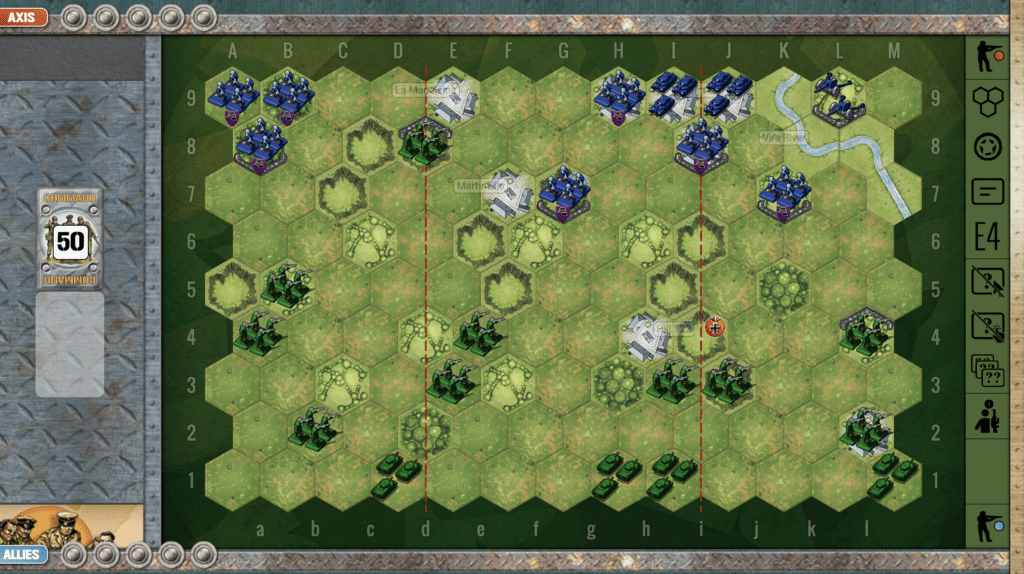
5 VP’s, plus territorial objectives for each side.

Allies can target St. Lo and the ridge by Martinville. Axis targets Hill 122. 

Terrain:

The battlefield is scattered with hills, towns, hedgerows, and forests.

Troops:

Allies – 10 Infantry, 4 Armor

Axis – 7 Infantry, 2 Armor, 1 Artillery


medal allies

Allied Strategy:

1.  Your forces are scattered and in disarray. You need to coordinate them into a cohesive attack force.

2.  Be aware that the enemy will quickly mass their forces for an attack against your forward infantry unit at d8.  If you can move your left flank Armor up to support it, you may be able to hold the position for a while and inflict some damage on the Axis.

3.  Beware the enemy Artillery in the corner of your right flank. Although he is locked in there, he can still roll powerful attacks on that flank.  Stay away and nullify any firepower from there.

4.  Your strategy should include plans for a continual push up the center in order to bring pressure to bear upon the two Medal Objectives on the hill and in the city of St. Lo.

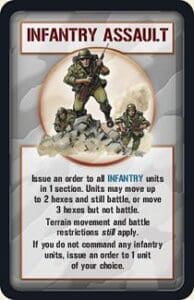
5.  Possible Attack Vector: One attack plan you can pursue is on the left flank. You only need five medals to win, and there are three enemy units up in the corner.  If you get a good set of attack cards, such as Infantry Assault you can quickly surround them and take them out.

medal axis

Axis Strategy:

1.  Your forces are outnumbered, so you will need to get your armor out of the town into attack positions.  You also need to move your infantry from the corner on your right flank and into a more centralized position.  An early win for you can be the forward Allied Infantry unit at d8.

2.  You have two Territorial Medals to protect.  Be aware of the mobility range of their Armor should they push up the center. If you move your units off of those hexes, be certain the enemy cannot sneak in at the end and grab a final medal.

43
BR - Martinville Ridge

Author:

Days of Wonder

Link:

Panzer Lehr Counter Attacks

Panzer Lehr Counter-Attacks

scenario_PanzerLehr_1

The Panzer Lehr Counterattacks occurred in July 1944 during the Normandy Campaign in World War II. The Panzer Lehr Division, an elite German armored unit, launched a series of counterattacks against advancing Allied forces, particularly around the town of Saint-Lô, in an effort to halt the Allies’ breakout from the beachheads.

Listen up, men—Panzer Lehr was no ragtag outfit. It was Germany’s pride: tanks gleaming, engines roaring, veterans in every seat. But when the hammer fell, all that iron and swagger met the full fury of Allied steel and sky. Our fighter-bombers tore them apart from above, our artillery shook the ground beneath them, and when the dust cleared, Lehr was bleeding oil and fire across the Norman fields.

Their counterattacks? Brave but doomed—crushed under the weight of Operation Cobra, the breakout that ripped open Hitler’s precious front and sent his armies reeling toward the Falaise trap. Panzer Lehr learned the hard way what happens when you stand in the path of an army that’s rolling for victory.

~~ General Howitzer

5 VP’s

card

Card Balance:

Allies – 6

Axis – 5

Complexity:

2

Conditions:

Countryside

Context:

Historical

Location:

France

Year:

1944

Theater:

Western Front

Campaign:

Normandy Campaign

Summary:

Objectives:

5 VP’s, plus the a exit row medals for the Axis

Terrain:

The battlefield is scattered with hills, towns, hedgerows, and forests.

Troops:

Allies – 8 Infantry, 4 Armor, 1 Artillery

Axis – 8 Infantry, 2 Armor


medal allies

Allied Strategy:

1.  You have an Armor superiority, but only if you get your armor that are stuck in the right corner, out into the action. It will take two turns to get them out and mobile.

2.  You have an Artillery in the center, protect it, and use it.

medal axis

Axis Strategy:

1.  Big Picture strategy is that your forces begin in disarray.  You need to consolidate your forces, and coordinate your efforts.  The Allies begin with control of two-thirds of the battlefield. They are protected by hedgerows, towns, and hills.  You will need to develop a strategy to attack those units one by one with concentrated firepower until each one is eliminated.

2.  Because there are a row of exit hexes which can provide additional medals for you,  you should continue a relentless push deep into the enemy territory.  If you can bring in your flank forces toward the center, it will make your forces unstoppable.

16
BR - Panzer Lehr

Author:

Days of Wonder

Link:

Payback! – Operation Bagration, Phase 1

Payback! - Operation Bagration, Phase 1

Scenario_Toulon_start_Allies

Exactly 4 years after the Nazi invasion of the Soviet Union, the Russians were now ready to pay back the Germans in kind! The Allies had finally landed in France and the German forces were stretched thin. Moreover, an elaborate campaign of deception had the Germans convinced the Russian Summer Offensive would be launched further to the South in Ukraine. Therefore, Army Group Center had been stripped of much of its armour and artillery. The main objective of the offensive was to liberate Belorussia and its capital Minsk. The success was to prove so enormous, however, that by the end of Operation Bagration the Soviets found themselves at the gates of Warsaw and the shores of the Baltic. German Army Group Center, which three years earlier, had come so close to capturing Moscow, had ceased to exist. Will you be able to duplicate this success as the Russian player or will you be able to slow them down and thereby save a substantial number of German troops, playing the Germans? The battle lines are drawn, you are in command and the rest is history!

36 VP’s (!)

card

Card Balance:

Allies –

  • Allied player [ Soviet Union ]
  • 6 Command cards for each Breakthrough board
  • You move first.

Axis –

  • Axis player [ Germany ]
  • Start with 3 Command cards for each Breakthrough board
  • Draw 2 cards each turn until you have 5 for each Breakthrough board

Complexity:

5

Conditions:

Countryside

countryside

Context:

Historical

Location:

Year:

1944

Theater:

Eastern Front

Campaign:

Codename:

Operation Bagration

Summary:

Objectives:

36 VP’s, plus many other conditions. Read the PDF special rules.

Terrain:

Countryside with rivers and roads 

Troops:  (check the PDF for specific the specific troop deployments) 

medal allies

Allied Strategy:

1.  

medal axis

Axis Strategy

1. 

0
BR - Payback

Author:

Willem Boersma

Complete Scenario Link:

https://generalhowitzer.com/62ne

Operation Spring

Operation Spring

scenario_OperationSpring_start


Operation Spring was  launched on July 25-27, 1944, during the Battle of Normandy. The operation aimed to capture key positions south of Caen, France, and support the larger Allied offensive, including Operation Cobra by the Americans.

  • The 2nd Canadian Infantry Division, supported by tanks from the 2nd Canadian Armoured Brigade, led the assault.
  • Their objectives included capturing key villages like Verrières Ridge, May-sur-Orne, and Tilly-la-Campagne, vital for controlling the high ground.
  • The Canadians faced well-entrenched German forces, including elements of the 12th SS Panzer Division and the 1st SS Panzer Division (Leibstandarte Adolf Hitler).
  • Heavy resistance, powerful defensive fire, and poor visibility caused high casualties.
  • The operation failed to achieve its primary objectives, though it diverted German forces from other fronts.
  • Canadian forces suffered over 1,500 casualties, marking one of their most costly engagements in Normandy.

Here are General Howitzer’s comments on the battle:

“Listen up! Operation Spring kicked off on July 25th, 1944. It was the Canadians’ job to take the high ground south of Caen, hit those German defenses, and give the Americans in Operation Cobra a clear path to move out.

Even though they didn’t take everything they wanted, they tied down those German divisions and gave the Allies the breathing room to keep pushing. That’s how you fight, boys—you go where you’re needed, you hit the enemy hard, and you keep the pressure on, no matter the cost!

6 VP’s

Card Balance:

Allies – 5

Axis – 6

Complexity:

4

Conditions:

Countryside

Context:

Historical

Location:

France

Year:

1944

Theater:

Mediterranean

Campaign:

Battle of Normandy

Codename:

Operation Spring

Summary:

Objectives:

6 VP’s including territorial objectives for town captures

Terrain:

Countryside with a couple of hilly ridges angling across the central section.

Troops:

Allies – 10 Infantry, 4 Armor, 1 Artillery

Axis –  7 Infantry, 4 Armor, 2 Artillery


medal allies

Allied Strategy:

1.  Your artillery in the right flank can control all the area around St. Andre.  If you move it forward just one row towards the center, and position it between both sections, you will be in a better offensive position to control the right flank, but more importantly, can support the attack against the central hills with 2D rolls.

2. If you get the right set of cards, you can quickly gain the hilly advantage in the center section. From there you will be able to make things much for difficult for the Axis forces. But be aware that your plan must include an assault on the Allies central artillery, and medal objective. 

medal axis

Axis Strategy:

1.  Your trapped artilley behind the Orne River will only be basically useful for defensive purposes, should the enemy make a fool-hardy assault on that flank.

2.  Your artillery in the town of Verriers will be the key to controlling the central section and eliminating any enemy forces that try to control the central hills.

3.  One of the two armor on your right flank should be placed on the ridge in the central section as both a deterrant, and eventual attack function.  The other can either defend against any attack towards the town of Tully-la-campaigne, or eventual move into the center to support that attack vector.

17
BR - Operation Spring

Author:

Link:

Battle Of Tannenburg Line (BT,EF,TP)

Battle Of Tannenburg Line (BT,EF,TP)

map

By the summer of 1944, the Soviet Red Army was on the offensive, pushing westward toward the Baltic Sea in a bid to crush the German Army Group North. One of the most critical defensive positions for the Germans lay in northeastern Estonia, on the Tannenberg Line. This line was anchored by the Sinimäed Hills — a series of three steep elevations known as Lastekodumägi, (Children’s Home Hill), Põrguaugu (Hell’s Hole), and Tornimägi (Tower Hill). These hills provided a natural defensive barrier, and the Germans had heavily fortified them with bunkers, trenches, and artillery positions.


Facing them was the Soviet Leningrad Front, under the command of Marshal Leonid Govorov, tasked with breaking through the Tannenberg Line and opening the path to the Baltic Sea. Soviet forces included powerful infantry, armor, and artillery units, determined to seize the high ground. However, the rugged terrain and Axis fortifications posed a formidable challenge. Swamps, forests, and anti-tank obstacles complicated the Soviet advance, making coordinated assaults difficult. The German defenders, led by General Johannes Frießner, included regular Wehrmacht units and elite Estonian Waffen-SS forces, fighting tenaciously to hold their positions on the Sinimäed Hills. These defensive positions offered a clear advantage, giving the Axis the ability to rain down fire on Soviet units struggling to traverse the open ground and difficult terrain below.


The Soviet assault began on July 25, 1944, with fierce fighting erupting on the hills. Over the course of the battle, Soviet forces launched wave after wave of attacks, while the Axis defenders, outnumbered but well-entrenched, fiercely resisted.

The stage is set, the battle lines are drawn, and you are in command. The rest is history.

12 VP’s

Card Balance:

Allies – 5

Axis – 6

Complexity:

4

Conditions:

Countryside

Context:

Historical

Location:

Estonia

Year:

1944

Theater:

Eastern Front

Summary:

Objectives:

12 VP’s, including some territorial objectives:

Lastekodumägi, Põrguaugu mägi and Tornimägi are Permanent Medal Objectives for the Allied forces.

Terrain:

Includes a series of three steep elevations known as Lastekodumägi, (Children’s Home Hill), Põrguaugu (Hell’s Hole), and Tornimägi (Tower Hill). These hills provided a natural defensive barrier, and the Germans had heavily fortified them with bunkers, trenches, and artillery positions.

Troops:

Allies – 9 Infantry, 5 Armor, 2 Artillery

Axis – 10 Infantry, 3 Armor, 3 Artillery

Special Rules:

Russian command rules are in effect


Allied Strategy:

Axis Strategy

1
BR - Tannenburg Line

Author:

raikster