Valkenburg Airfield

Valkenburg Airfield

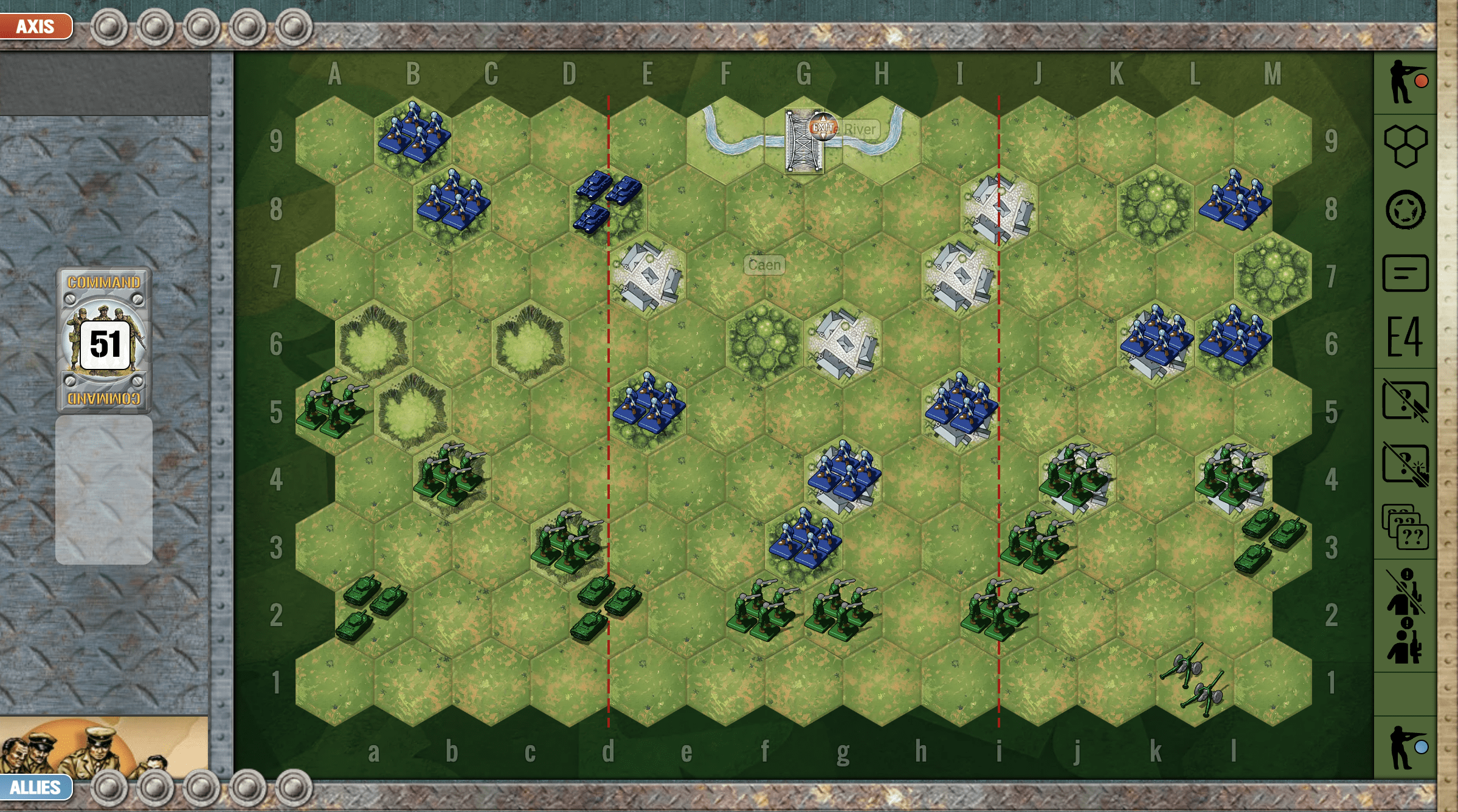
The Battle for Valkenburg Airfield (May 10–14, 1940) occurred during the German invasion of the Netherlands at the start of World War II. The airfield, located near Valkenburg in South Holland, was a key target for German forces as part of their broader plan to quickly secure control over the Netherlands.

German paratroopers and airborne troops launched a surprise attack, landing at and around the airfield. However, the airfield was incomplete and unsuitable for heavy aircraft, causing damage to many German planes upon landing. Despite this, the German troops initially managed to capture the airfield and establish a foothold.

Dutch forces launched determined counterattacks to retake the airfield, engaging in fierce fighting. The incomplete state of the airfield and the strong Dutch resistance, including effective use of artillery, hindered the Germans’ ability to reinforce their position. After several days of intense combat, Dutch forces were unable to fully regain control, but the German position at Valkenburg became irrelevant as the broader campaign concluded with the Dutch surrender on May 15, 1940.

The battle demonstrated both the challenges of airborne operations and the resilience of the Dutch defenders during the German blitzkrieg.

6 VP’s

card

Card Balance:

Allies – 5

Axis – 5

Complexity:

3

Conditions:

Countryside

Context:

Historical

Location:

Netherlands

Year:

1940

Theater:

Western Front

Campaign:

Summary:

Objectives:

6 VP’s

Terrain:

Troops:

Allies – 

Axis – 


medal allies

Allied Strategy:

medal axis

Axis Strategy:

0
BR - Valkenburg Airfield

Author:

jdrommel 

Link: View Here

Martinville Ridge

Martinville Ridge

scenarios_MartinvilleRidge_start

“Listen here, men! The Battle of Martinville Ridge was a mean slugfest in July ‘44, right in the thick of the Normandy bocage. That damn hedgerow country turned every field into a fortress, and every ridge was a death trap. Our boys from the 35th Infantry Division went up that ridge with grit and guts, trying to crack those Nazi defenses wide open.

The Germans had the high ground and those thick hedgerows, making every inch of dirt a hellhole to fight for. We took the ridge at first—bayonets and grenades leading the way—but those Germans counterattacked like devils, forcing us to pull back and regroup. But I’ll tell you what: every drop of sweat and blood we left on that ridge kept the enemy tied up and bleeding too.

We didn’t take Martinville Ridge outright, but we sure as hell rattled the Germans’ cages and cleared the way for our breakout later in Cobra. That’s the price of victory, boys—no easy ground, no easy days. Keep pushing, keep killing, and never give ‘em an inch!

~~ General Howitzer

5 VP’s

card

Card Balance:

Allies – 5

Axis – 5

Complexity:

3

Conditions:

Countryside

countryside

Context:

Historical

Location:

France

Year:

1944

Theater:

Western Front

Campaign:

Normandy Campaign

Summary:

Objectives:

5 VP’s, plus territorial objectives for each side.

Allies can target St. Lo and the ridge by Martinville. Axis targets Hill 122. 

Terrain:

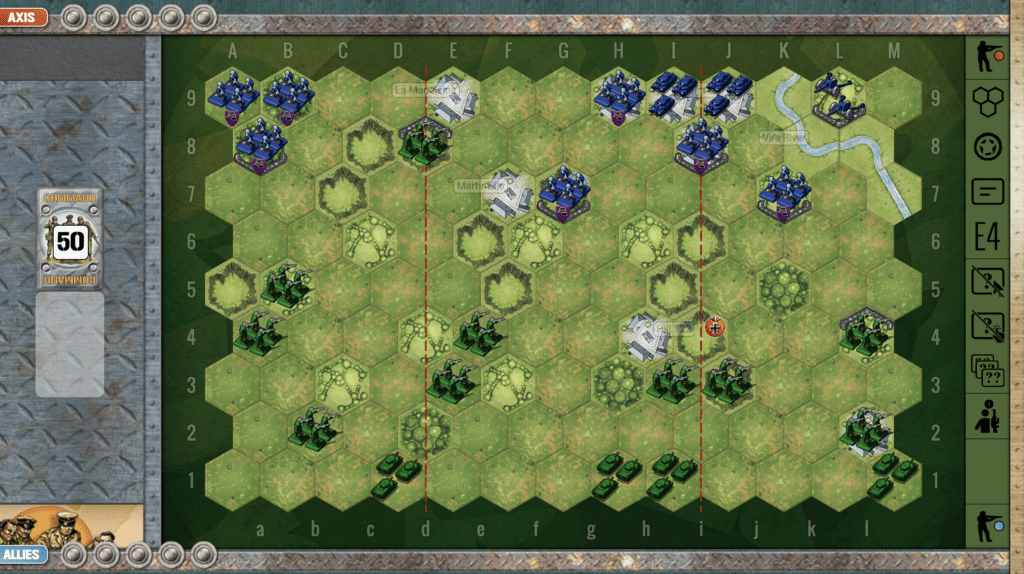
The battlefield is scattered with hills, towns, hedgerows, and forests.

Troops:

Allies – 10 Infantry, 4 Armor

Axis – 7 Infantry, 2 Armor, 1 Artillery


medal allies

Allied Strategy:

1.  Your forces are scattered and in disarray. You need to coordinate them into a cohesive attack force.

2.  Be aware that the enemy will quickly mass their forces for an attack against your forward infantry unit at d8.  If you can move your left flank Armor up to support it, you may be able to hold the position for a while and inflict some damage on the Axis.

3.  Beware the enemy Artillery in the corner of your right flank. Although he is locked in there, he can still roll powerful attacks on that flank.  Stay away and nullify any firepower from there.

4.  Your strategy should include plans for a continual push up the center in order to bring pressure to bear upon the two Medal Objectives on the hill and in the city of St. Lo.

5.  Possible Attack Vector: One attack plan you can pursue is on the left flank. You only need five medals to win, and there are three enemy units up in the corner.  If you get a good set of attack cards, such as Infantry Assault you can quickly surround them and take them out.

medal axis

Axis Strategy:

1.  Your forces are outnumbered, so you will need to get your armor out of the town into attack positions.  You also need to move your infantry from the corner on your right flank and into a more centralized position.  An early win for you can be the forward Allied Infantry unit at d8.

2.  You have two Territorial Medals to protect.  Be aware of the mobility range of their Armor should they push up the center. If you move your units off of those hexes, be certain the enemy cannot sneak in at the end and grab a final medal.

43
BR - Martinville Ridge

Author:

Days of Wonder

Link:

Panzer Lehr Counter Attacks

Panzer Lehr Counter-Attacks

scenario_PanzerLehr_1

The Panzer Lehr Counterattacks occurred in July 1944 during the Normandy Campaign in World War II. The Panzer Lehr Division, an elite German armored unit, launched a series of counterattacks against advancing Allied forces, particularly around the town of Saint-Lô, in an effort to halt the Allies’ breakout from the beachheads.

Listen up, men—Panzer Lehr was no ragtag outfit. It was Germany’s pride: tanks gleaming, engines roaring, veterans in every seat. But when the hammer fell, all that iron and swagger met the full fury of Allied steel and sky. Our fighter-bombers tore them apart from above, our artillery shook the ground beneath them, and when the dust cleared, Lehr was bleeding oil and fire across the Norman fields.

Their counterattacks? Brave but doomed—crushed under the weight of Operation Cobra, the breakout that ripped open Hitler’s precious front and sent his armies reeling toward the Falaise trap. Panzer Lehr learned the hard way what happens when you stand in the path of an army that’s rolling for victory.

~~ General Howitzer

5 VP’s

card

Card Balance:

Allies – 6

Axis – 5

Complexity:

2

Conditions:

Countryside

Context:

Historical

Location:

France

Year:

1944

Theater:

Western Front

Campaign:

Normandy Campaign

Summary:

Objectives:

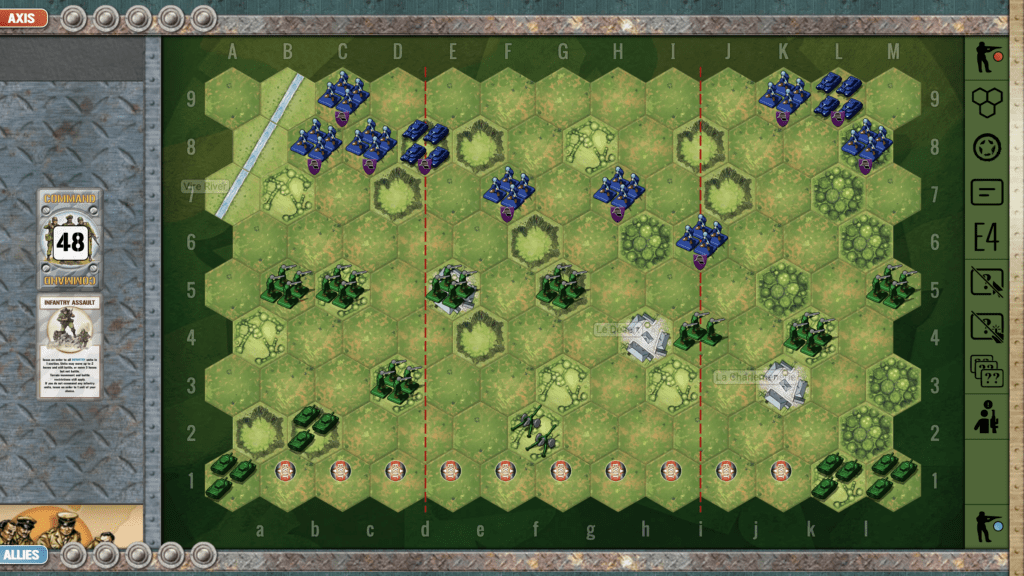
5 VP’s, plus the a exit row medals for the Axis

Terrain:

The battlefield is scattered with hills, towns, hedgerows, and forests.

Troops:

Allies – 8 Infantry, 4 Armor, 1 Artillery

Axis – 8 Infantry, 2 Armor


medal allies

Allied Strategy:

1.  You have an Armor superiority, but only if you get your armor that are stuck in the right corner, out into the action. It will take two turns to get them out and mobile.

2.  You have an Artillery in the center, protect it, and use it.

medal axis

Axis Strategy:

1.  Big Picture strategy is that your forces begin in disarray.  You need to consolidate your forces, and coordinate your efforts.  The Allies begin with control of two-thirds of the battlefield. They are protected by hedgerows, towns, and hills.  You will need to develop a strategy to attack those units one by one with concentrated firepower until each one is eliminated.

2.  Because there are a row of exit hexes which can provide additional medals for you,  you should continue a relentless push deep into the enemy territory.  If you can bring in your flank forces toward the center, it will make your forces unstoppable.

16
BR - Panzer Lehr

Author:

Days of Wonder

Link:
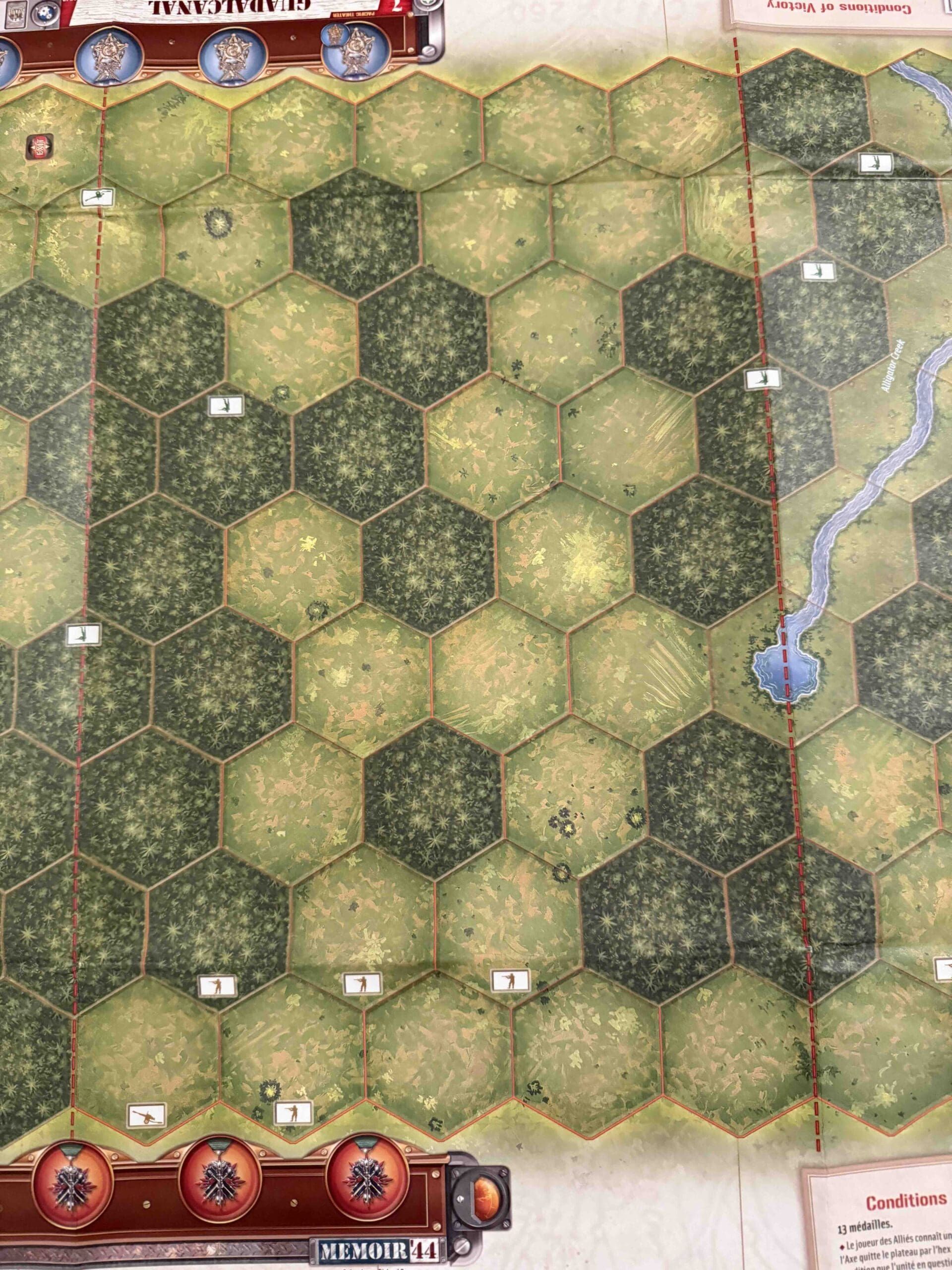
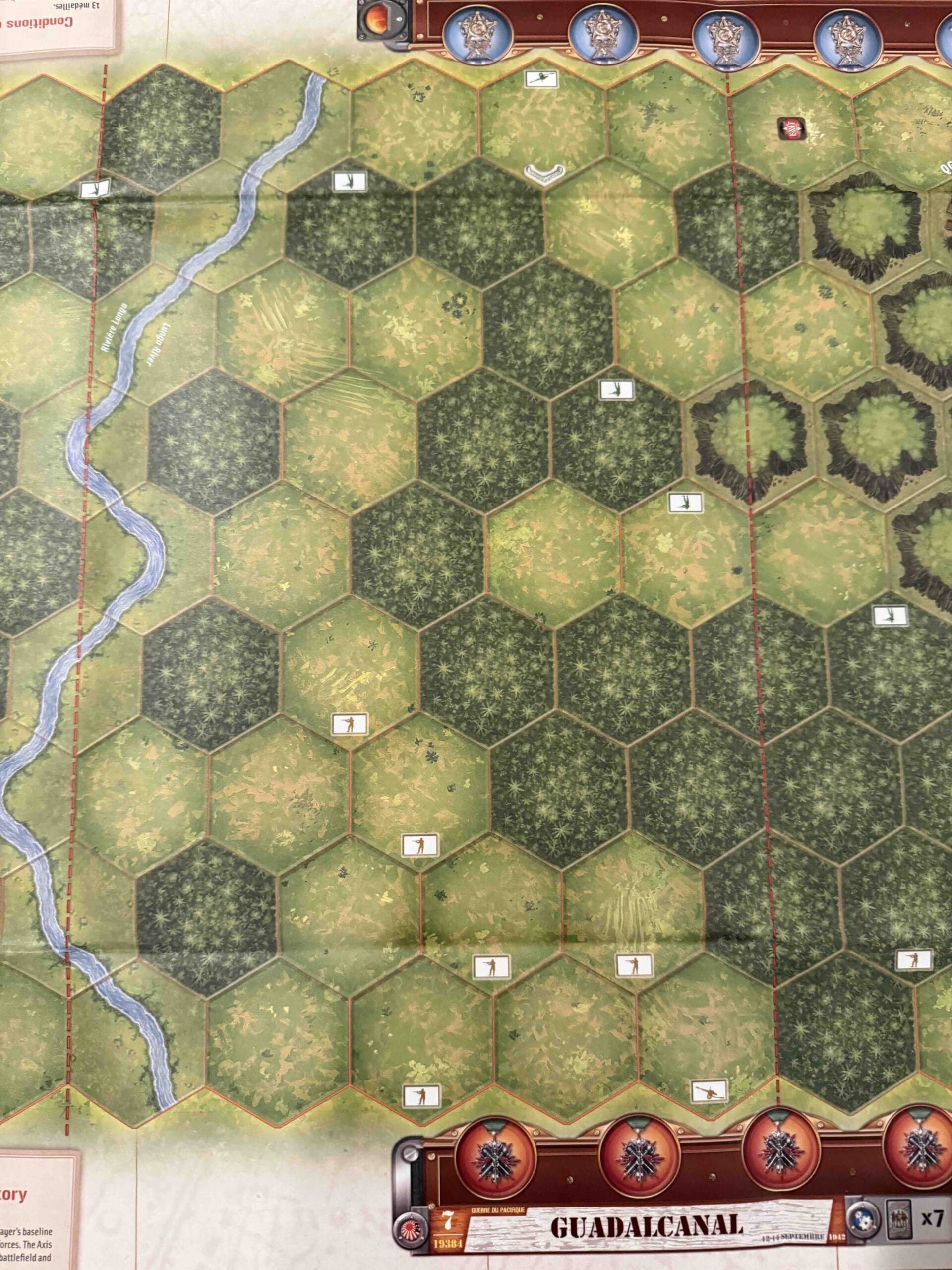
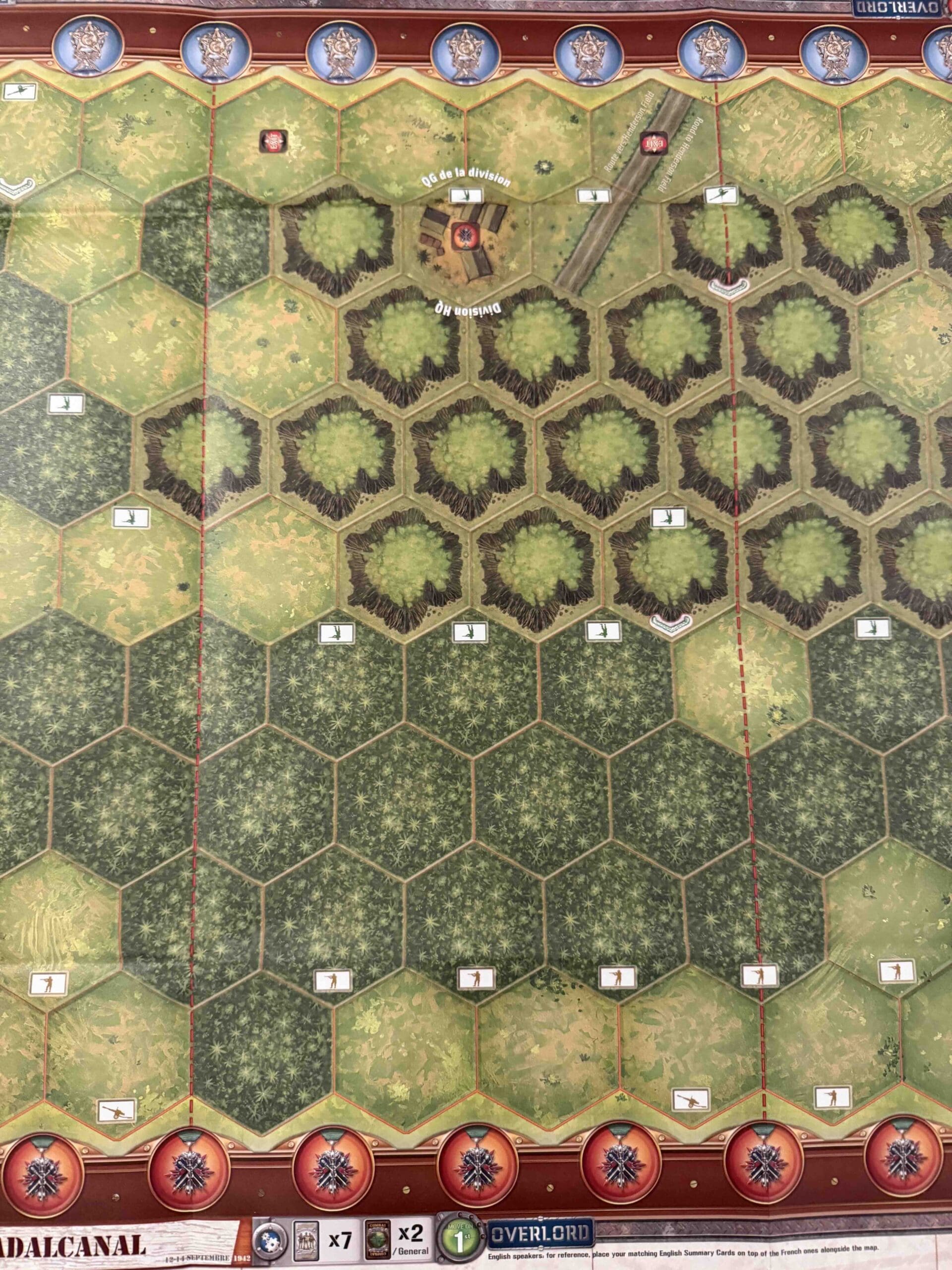
Guadalcanal [Overlord]

Guadalcanal

Guadalcanal. August ’42 to February ’43. The place where the tide started to turn in the Pacific—and where the United States Marine Corps showed the world exactly what American grit looks like.

The Japanese thought they were building themselves a nice little airfield to dominate the Solomon Islands and choke off our lifeline to Australia. Big mistake. We hit that island hard, landed the U.S. Marines, and made damn sure that airstrip—Henderson Field—was going to fly our planes, not theirs.

It wasn’t a cakewalk. It was jungle rot, mud, bugs, no sleep, and short supplies. The enemy threw everything they had at us—infantry assaults, air raids, naval bombardments. But we held. We bled. And we broke them.

By the time it was over, the Japanese were down thousands of men, ships, and planes. They’d lost their shot at controlling the Pacific, and we took the initiative. From then on, it was our war to win, and we were going to take it island by island, all the way to Tokyo.

Guadalcanal wasn’t just a battle—it was a message: The United States doesn’t back down. We plant our flag, we dig in, and we don’t leave until the job’s done.

~~ General Howitzer

13 VP’s

card

Card Balance:

Allies – 9

Axis – 7

Complexity:

5

Conditions:

Jungle

Context:

Historical

Location:

Solomon Islands

Year:

1943

Theater:

Pacific

Campaign:

Guadalcanal Campaign

Codename:

Operation Watchtower

Summary:

This is an Overlord game, so make use of the Jungle Command cards, two per side.

Objectives:

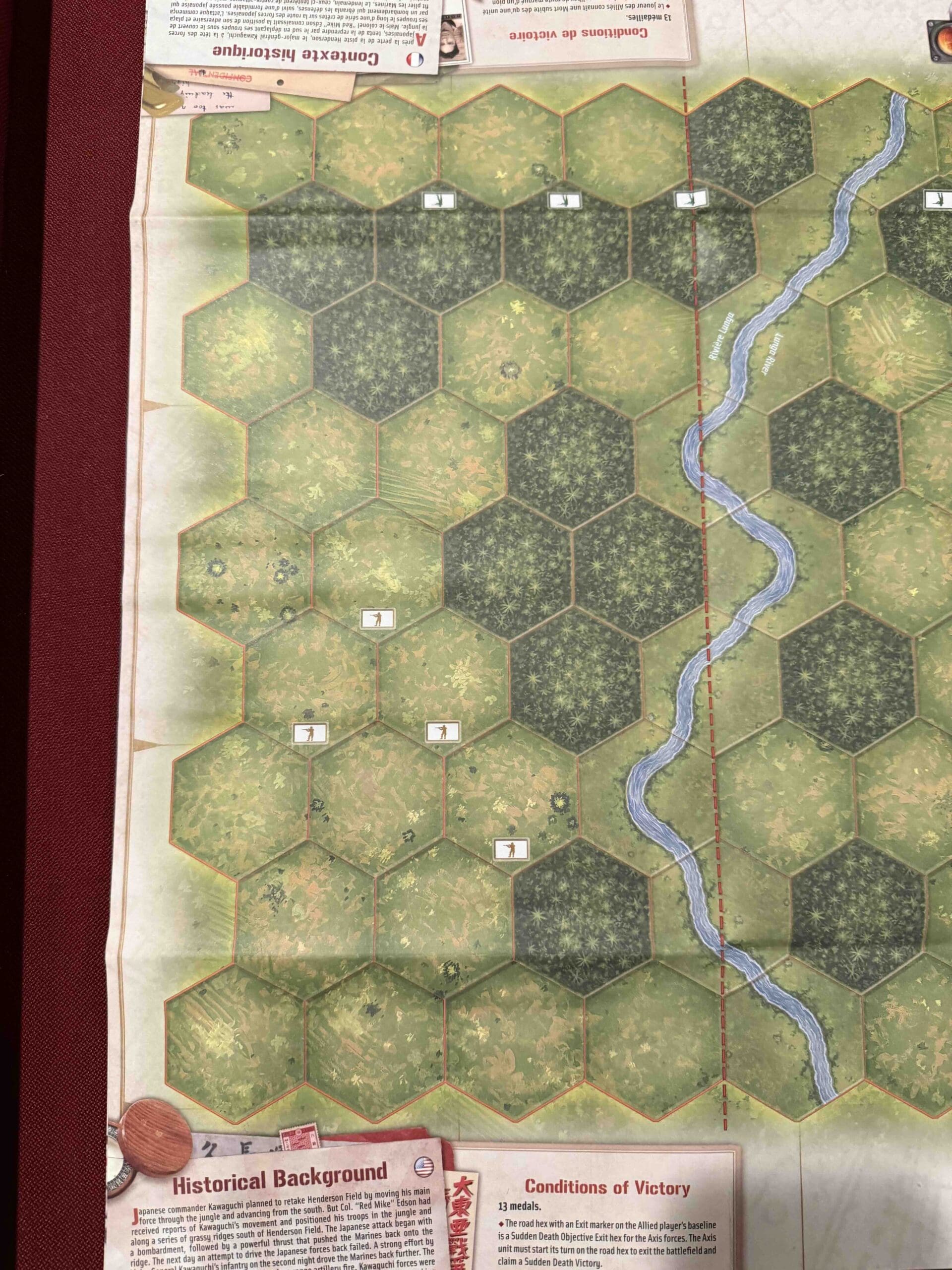
13 Medals including Territorial Control, and Exit Row medals and a sudden death hex all for the Japanese.

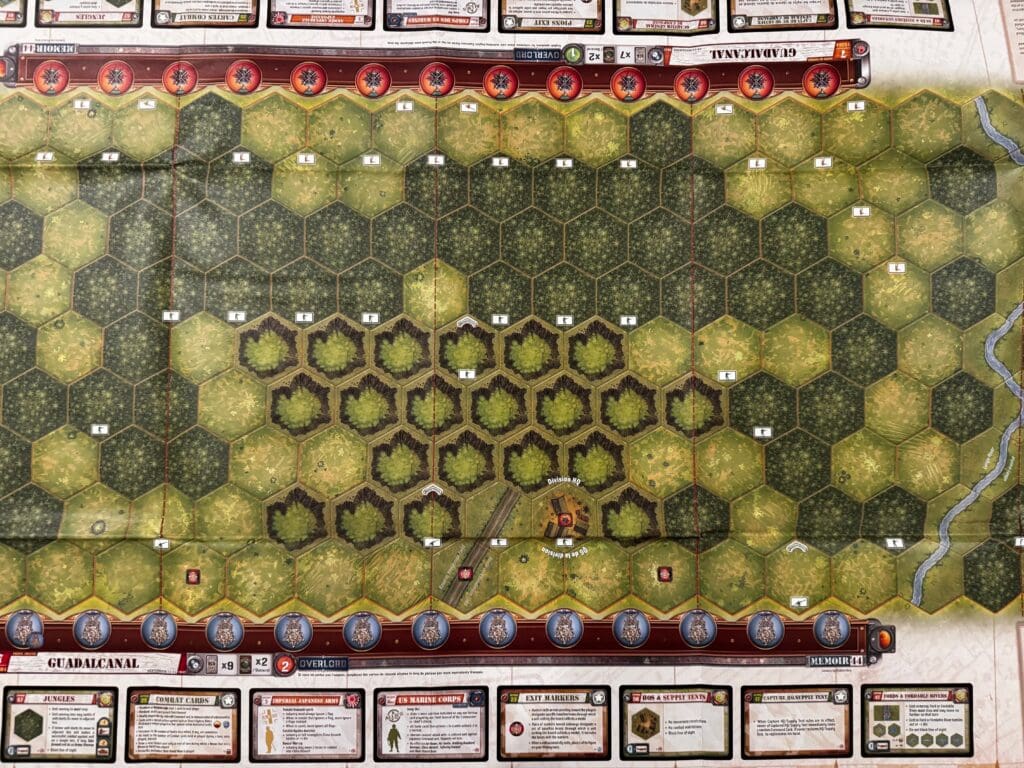
Terrain:

Jungle terrain with a 21-hex hill in the center which is a majority-control objective for one medal. 

Troops:

Allies – 21 Marine Infantry, 3 Artillery

Axis – 24 Japanese Infantry, 3 Artillery

Special Rules:

1. Majority  Temporary Territorial Control  – whomever controls most of the 21-hill hexes gains 1 Medal

2.  Exit Row Medals – to any Japanese forces that exit

3.  Sudden Death Hex – to any Japanese forces that maintain control of the hex at the start of their next turn, total win for the Japanese


medal allies 

Allied Strategy:

1. Big Picture Plan when defending against the Japanese onslaught, is to reduce every full-power unit by at least one hit in order to cancel our their Seishin Kyoiku Doctrine. 

2.  Because of the special Rules, it is imperative that the Marines defende the center section, and prevent the Japanese forces from overwhelming the hill, to gain that point; or exiting out the back, to get those points, or most importantly, never let them gain access to the sudden death hex. 

medal axis

Axis Strategy

1.  Big Picture Strategy for Axis; while the flanks provide an excellent attack possibility, if you have the cards, they should always be considered secondary to your primary objective of overwhelming the 21-hex hill and gaining all the extra win points associated with it, and the exit hexes, and the sudden death hex.

2.  When given the opportunity on your flanks, move your forces towards the central section to continue to put pressure on the enemy and eventually overrun his position.

3
BR - Guadalcanal

Author:

Days of Wonder

Link:
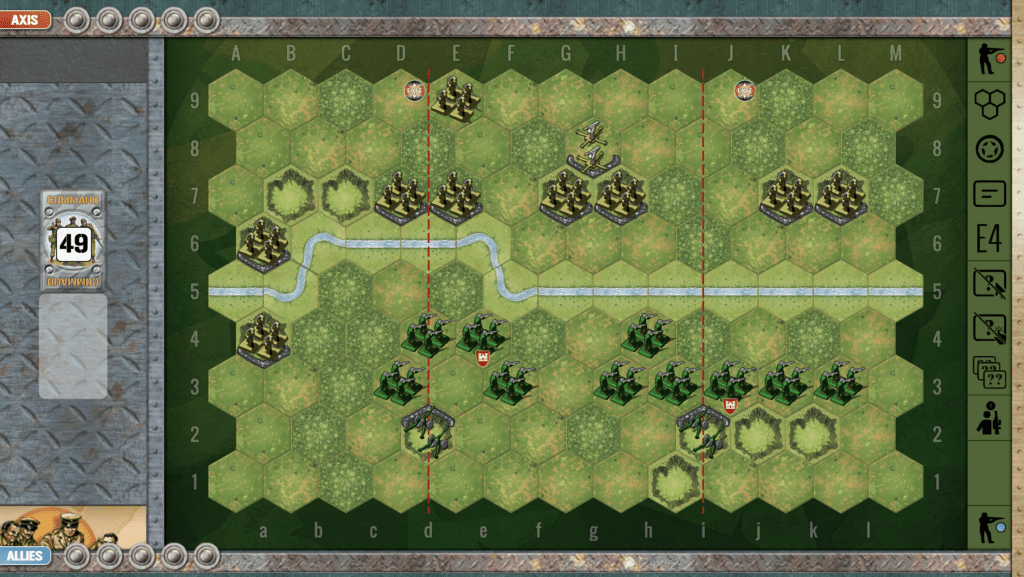
Clearing Matanikau River

Clearing Matanikau River

scenario_ClearingMatanikauRiver_start

The Battle of the Matanikau River was a series of engagements during the Guadalcanal Campaign in late 1942, part of the Pacific Theater in World War II. The battles focused on clearing Japanese forces from the Matanikau River area on Guadalcanal to secure the perimeter around the strategic Henderson Field airbase, held by U.S. Marines.

In several operations between September and November 1942, U.S. Marines, supported by naval and aerial bombardment, launched attacks against well-entrenched Japanese positions along the river. These actions disrupted Japanese attempts to launch counterattacks against the American-held airfield.

General Howitzer’s summary:
We swept the jungle clean—rooted out every last Japanese fighter and locked down the western flank of Henderson Field. Those clearing fights weren’t just mop-up—they were the nail in the enemy’s coffin on Guadalcanal. That island was the start of our long march west, and by God, it was the turning point that broke their back in the Pacific.

5 VP’s

card

Card Balance:

Allies – 6

Axis – 5

Complexity:

2

Conditions:

Jungle

Context:

Historical

Location:

Gaudalcanal

Year:

1943

Theater:

Pacific

Campaign:

Guadalcanal

Summary:

Objectives:

5 VP’s

Terrain:

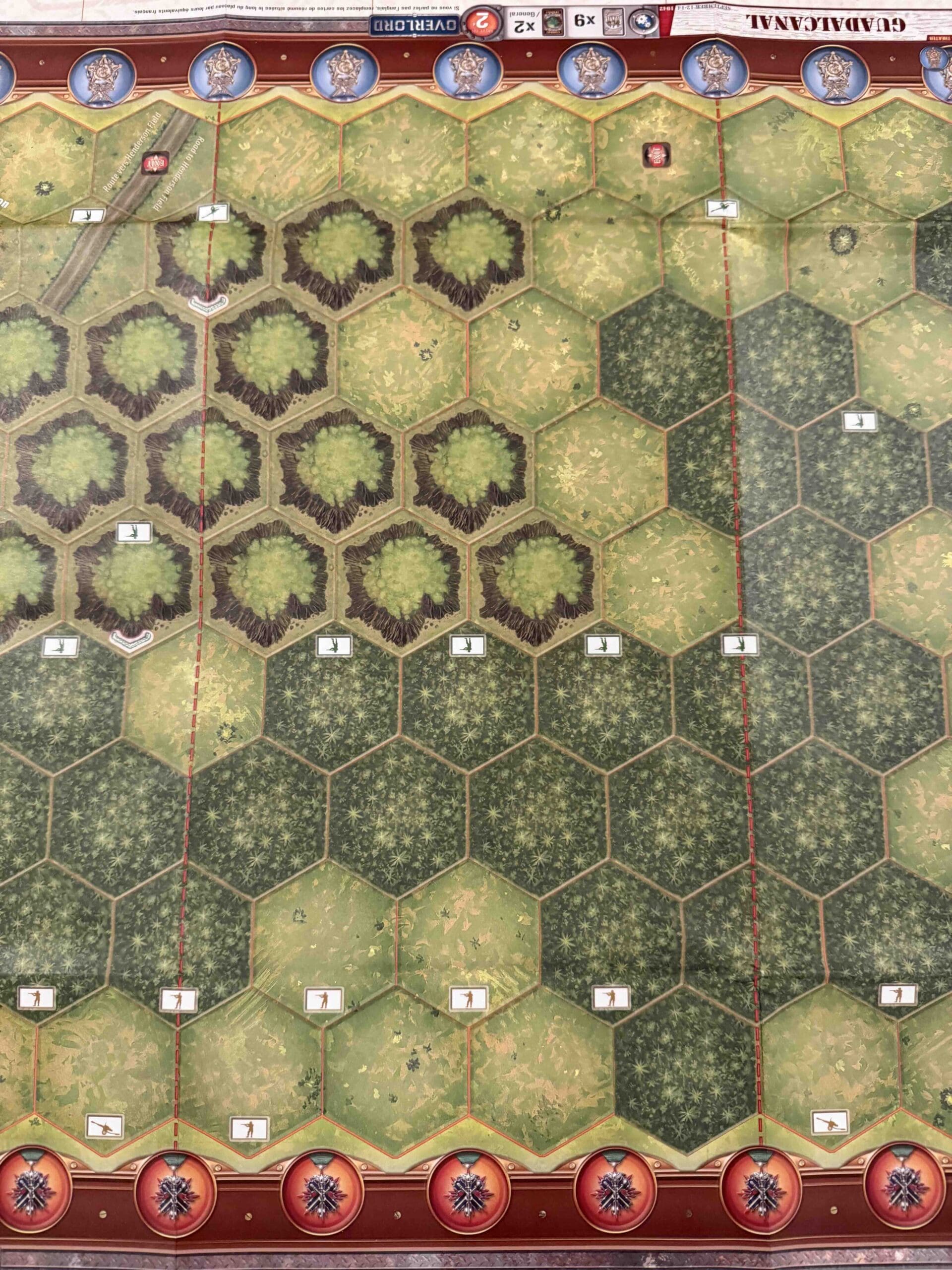
The Matanikau River cuts horizontally across the battlefield.

Troops:

Allies – 10 Infantry, 2 Artillery

Axis – 9 Infantry, 1 Artillery


bimedal allies

Allied Strategy:

1.  Big Picture Strategy: your job is to clear the Matanikau River of all enemy belligerents.  This will require advancing across the river, but do not do so until your two Artillery units have softened up the enemy forces.  This primarily means to hit each unit at least once, thus eliminating the Seshin Kyoiku Doctrine with their powerful plus 1D attack powers.

2.  Once they have been sufficiently softened up, and you have the right card combination in hand for an attack, then advance and win! 

3.  Be aware that the enemy infantry on your left flank at a4 is both a danger and an opportunity: a danger, because they are close enough to attack and gain a tactical medal win;  but an opportunity, because they are trapped across the river, separated from their forces without a quick escape. 

medal axis

Axis Strategy

1.  Big Picture Strategy: As you are outnumbered, this is primarily a defensive scenario for the Axis.  But if you can build up the cards to mount an attack in on one side, you should do it.  For example, your Infantry at a4 on your right flank is within striking distance of the enemy Artillery, if you had a Behind Enemy Lines card.

2. Be wary of the powerful Allied Artillery, which historically, was able to turn the tide in many engagements in the Pacific. Keep at least five hexes away from them until you are ready.

3. Make use of your Seishin Kyoiku Doctrine and the Banzai War Cry to overwhelm the enemy when they get too close. 

19
BR - Clearing Matanikau

Author:

Days of Wonder

Link:
Payback! – Operation Bagration, Phase 1

Payback! - Operation Bagration, Phase 1

Scenario_Toulon_start_Allies

Exactly 4 years after the Nazi invasion of the Soviet Union, the Russians were now ready to pay back the Germans in kind! The Allies had finally landed in France and the German forces were stretched thin. Moreover, an elaborate campaign of deception had the Germans convinced the Russian Summer Offensive would be launched further to the South in Ukraine. Therefore, Army Group Center had been stripped of much of its armour and artillery. The main objective of the offensive was to liberate Belorussia and its capital Minsk. The success was to prove so enormous, however, that by the end of Operation Bagration the Soviets found themselves at the gates of Warsaw and the shores of the Baltic. German Army Group Center, which three years earlier, had come so close to capturing Moscow, had ceased to exist. Will you be able to duplicate this success as the Russian player or will you be able to slow them down and thereby save a substantial number of German troops, playing the Germans? The battle lines are drawn, you are in command and the rest is history!

36 VP’s (!)

card

Card Balance:

Allies –

  • Allied player [ Soviet Union ]
  • 6 Command cards for each Breakthrough board
  • You move first.

Axis –

  • Axis player [ Germany ]
  • Start with 3 Command cards for each Breakthrough board
  • Draw 2 cards each turn until you have 5 for each Breakthrough board

Complexity:

5

Conditions:

Countryside

countryside

Context:

Historical

Location:

Year:

1944

Theater:

Eastern Front

Campaign:

Codename:

Operation Bagration

Summary:

Objectives:

36 VP’s, plus many other conditions. Read the PDF special rules.

Terrain:

Countryside with rivers and roads 

Troops:  (check the PDF for specific the specific troop deployments) 

medal allies

Allied Strategy:

1.  

medal axis

Axis Strategy

1. 

0
BR - Payback

Author:

Willem Boersma

Complete Scenario Link:

https://generalhowitzer.com/62ne