

General Howitzer · Field Guide
Memoir '44 Rules Database
Search the Memoir ’44 rules database by keyword. Use the category checkboxes to narrow your results.
Search results
1184 matching records · page 20 of 99
Barracks
- Rule Category
- Terrain
- Description
- No text description is stored for this record.
Picture
No picture is stored for this record.
Record 47402 · unclassified · Review: needs_review
Barrage
- Rule Category
- CardSet - Command
- Description
- No text description is stored for this record.
Picture
No picture is stored for this record.
Record 47136 · unclassified · Review: needs_review
Barrage
- Rule Category
- Command Cards
- Description
- No text description is stored for this record.
Picture
No picture is stored for this record.
Record 47199 · unclassified · Review: needs_review
Barrage
- Rule Category
- CardSet - Command CardSet - Tactical
- Description
- No text description is stored for this record.
Picture
No picture is stored for this record.
Record 47473 · unclassified · Review: needs_review
Barrage
- Rule Category
- CardSet - Overlord
- Description
- No text description is stored for this record.
Picture
No picture is stored for this record.
Record 47635 · unclassified · Review: needs_review
Barrage
- Rule Category
- COMMAND CARDS
- Description
- No text description is stored for this record.
Picture
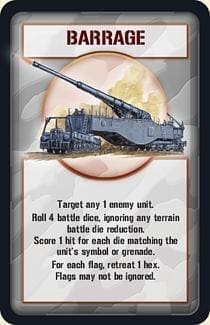
Record 48041 · unclassified · Review: needs_review
Barrage (Command Card)
- Rule Category
- Command Cards (Breakthrough)
- Description
- No text description is stored for this record.
Picture
No picture is stored for this record.
Record 47525 · unclassified · Review: needs_review
Base Deck to Breakthrough Deck Conversion List
- Rule Category
- CardSet - Breakthrough Misc. Q's
- Description
- Shows you the card differences between the two decks.
Picture
No picture is stored for this record.
Record 47648 · unclassified · Review: needs_review
Base Game (classic) — PDF p. 1 [base-1-0]
- Rule Category
- Rulebook excerpt
- Description
- Rules & Battle Scenarios Rules & Battle Scenarios For 2 players and team-play For 2 players and team-play Ages 8 and above 30-60 minutes Ages 8 and above 30-60 minutes
Picture
No picture is stored for this record.
Record 47660 · official · Review: approved
Base Game (classic) — PDF p. 10 [base-10-0]
- Rule Category
- Rulebook excerpt
- Description
- 1010 • Terrain Reductions Each type of terrain and obstacle is described in the Terrain and Obstacles section (Appendix 2, p 13). Please refer to that section or the corresponding summary cards, and deduct any potential terrain Battle dice reduction from the number of dice to be rolled in the attack. • Resolve Battle Hits are resolved first, followed by retreats. Hit In battle, the attacker scores 1 hit for each dice symbol rolled that matches the unit type targeted. Each Grenade rolled is also 1 hit. For each hit scored, 1 figure is removed from the target unit. When the last piece in the opponent's unit is removed, place it on top of one of the empty Medal Stands on your side of the battlefield. If an attacking player rolls more hits than the number of figures in the defending unit, these additional hits have no effect. Miss Retreat The player controlling the unit decides which hex his unit retreats onto using the following rules: ◆ A unit must always retreat toward its controlling player’s side of the board. ◆ Terrain has no effect on retreat moves, therefore a retreating unit may move through a forest or village without stopping. However, impassable terrain may not be moved through during a retreat move. ◆ A unit may not retreat onto, or through, a hex already containing another unit (regardless if friend or foe). ◆ If a unit cannot retreat; is forced to retreat off the limits of the battlefield; or would be pushed back onto a sea hex, one figure must be removed from the unit for each retreat move that cannot be completed. ◆ Some obstacles will allow certain units to ignore the first flag rolled against them. Score 1 hit on Infantry Score 1 hit on Armor Score 1 hit on any type: Infantry, Armor or Artillery HIT MISS If the attacker fails to roll any of the symbols needed to hit the enemy target or to force the enemy to retreat, this is a miss. The Star side of the Battle die is used in a limited number of Tactical Command Cards, otherwise it is a miss. Retreat After all hits have been resolved and casualties removed, retreats are resolved. For each Flag rolled on the target unit, the unit must move one hex back toward its own side of the battlefield. Two flags push the unit back two hexes, etc. Allied unit rolls a Flag, an Infantry and a Star. After taking 1 casualty, the Axis unit has 2 possible retreats: or
Picture
No picture is stored for this record.
Record 47671 · official · Review: approved
Base Game (classic) — PDF p. 11 [base-11-0]
- Rule Category
- Rulebook excerpt
- Description
- 1111 • Taking Ground When an ordered Infantry unit in Close Assault combat eliminates the enemy unit or forces it to retreat, it may Take Ground by advancing into the vacated hex. An Artillery unit may not take ground. Terrain movement and battle restrictions still apply when units take ground. When an ordered Armor unit in Close Assault combat eliminates the enemy unit or forces it to retreat, it may take the ground by advancing into the vacated hex and claim an Armor Overrun combat. • Armor Overrun Combat On a successful Close Assault Combat, an ordered Armor unit may move into the vacated hex and may then battle again. If the ground you take during the Overrun puts you adjacent to an enemy unit, this second battle must once again be a Close Assault Combat. Otherwise, you may fire at a distant unit. ◆ A unit may Take Ground again after a successful Overrun Combat. ◆ However, an Armor unit may only make one Overrun Combat during a turn. ◆ All Battles, Close Assault and Overrun Combats must be completed before the next unit may battle. 5 - Draw a Command card After resolving all hits and retreats, discard the Command card played and draw another card from the deck. Your turn is now over. If the draw deck runs out of cards, the discards are shuffled to form a new draw deck. Here, another Axis unit is in the way - there is only one retreat path left: Allied Infantry rolls a Flag and an Infantry symbol on a Close Assault The Allied player chooses to "Take Ground" immediately, to take advantage of the forest’s cover. After taking one casualty, the Axis unit retreats Allied Armor rolls a Flag and an Infantry symbol on a Close Assault The Allied player chooses to "Overrun" immediately After moving in, the Armor unit can now battle again! After taking one casualty, the Axis unit retreats An Axis unit and a river block both retreat options – the Axis unit cannot move and takes one additional casualty as a result : 1 2 3 4
Picture
No picture is stored for this record.
Record 47672 · official · Review: approved
Base Game (classic) — PDF p. 12 [base-12-0]
- Rule Category
- Rulebook excerpt
- Description
- 1212 Appendix 1 - SPECIAL UNITS Using the Special Units summary card On the back of the Standard Units summary card is a list of the various types of Special Forces and other Elite units that may be encountered in Memoir ’44. Rounded corners at the top of a unit’s symbol are used to denote a Special Forces or Elite unit on the map. A number in the lower right corner of a unit’s symbol is used to indicate the number of figures per unit, when it differs from the standard number. Special Forces and Elite units behave in the same way as the corresponding (Infantry or Armor) standard unit in all respects except as described below and on the summary card. Using the Special Forces Badges In scenarios combining Standard and Special Units relying on the same figures (Commandos mixed with Infantry on the edges of Sword Beach, for example), use the corresponding Special Forces badges, putting one into each hex occupied by the Special Unit, to distinguish it from regular troops. French Resistance benefited from a superior knowledge of the countryside and increasing support of the population as the war went on. As such, French Resistance forces: ◆ May always battle when they penetrate a new terrain type (Woods, Villages, Hedgerows) where standard Infantry would stop and not battle. ◆ May disappear in the countryside, retreating up to 3 hexes instead of the standard 1 on any retreat flag rolled. ◆ Their limited number means they always start with 3 figures per unit, in lieu of the standard 4. ◆ Unlike other Special Forces, French Resistance units that opt to move 2 hexes may not battle on the same turn. Special Forces (including US Rangers, British Commandos and other Elite units): Special Forces Special Forces and Elite units symbols and powers Axis "Kommandos" British special troops Rangers unit "LA RÉSISTANCE" is the generic term used to describe the various movements (armed or not) that fought the Axis forces in occupied France following the surrender of 1940. General De Gaulle's widely heard broadcast of June 18th, 1940 on BBC galvanized patriots of all political and geographic origins. Increasingly larger, well organized and better equipped groups sprang into action over the following years, providing an effective "Shadow" army in the days leading to D-Day. In close contact with the Allies, who often air-dropped them arms and money, the Resistants sabotaged supply lines, sheltered Special forces operating behind the enemy lines, and assassinated prominent figures of the German-backed regime. From 1944 on, the military groups within the Resistance became known as the FFI (“Forces Francaises de l’Intérieur” – French Forces of the Interior). The intelligence they offered during the preparatory stages of Operation Overlord paved the way for the successful Allied landings. The Rangers shoulder patch of the units who attacked the Pointe-du-Hoc The "Pegasus" shoulder patch of the British 6th Airborne Division who took "Pegasus Bridge" Axis attacked Resistants w
Picture
No picture is stored for this record.
Record 47673 · official · Review: approved